Loading...
Done
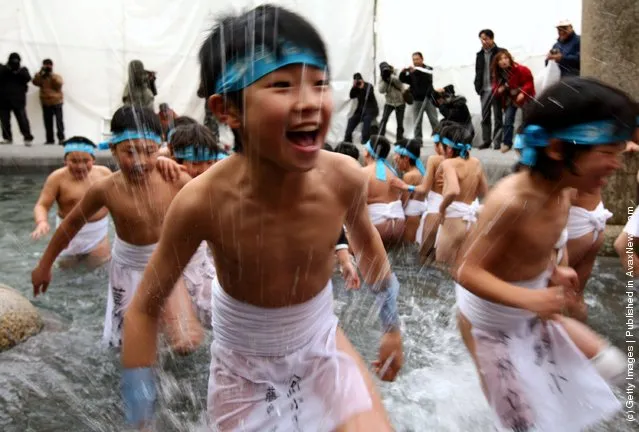
Japanese children wear loincloths as they splash about in freezing cold water during Saidaiji Naked Festival, at Saidaiji Temple

“A Hadaka Matsuri (“Naked Festival”) is a type of Japanese festival, or matsuri, in which participants wear a minimum amount of clothing; usually just a Japanese loincloth (called fundoshi), sometimes with a short happi coat, and rarely completely naked. Whatever the clothing, it is considered to be above vulgar, or everyday, undergarments, and on the level of holy Japanese shrine attire. Naked festivals are held in dozens of places throughout Japan every year, usually in the summer or winter. The most famous festival is held in Okayama, where the festival originated. Every year, over 9,000 men participate in this festival”. – Wikipedia

Photo: Japanese men wear loincloths as they splash about in freezing cold water during Saidaiji Naked Festival, at Saidaiji Temple on February 18, 2012 in Okayama, Japan. (Photo by Buddhika Weerasinghe/Getty Images)
Details
19 Feb 2012 12:18:00
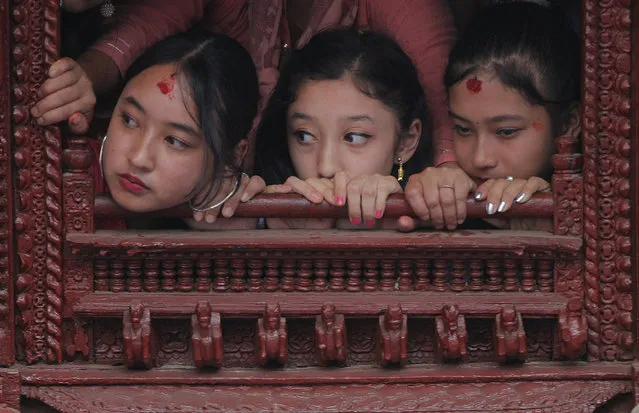
A former living goddess Kumari, middle, watches the Indra Jatra festival, an eight-day festival that honors Indra, the Hindu god of rain, in Kathmandu, Nepal, Friday, September 13, 2019. (Photo by Niranjan Shrestha/AP Photo)

A former living goddess Kumari, middle, watches the Indra Jatra festival, an eight-day festival that honors Indra, the Hindu god of rain, in Kathmandu, Nepal, Friday, September 13, 2019. (Photo by Niranjan Shrestha/AP Photo)
Details
18 Sep 2019 00:03:00
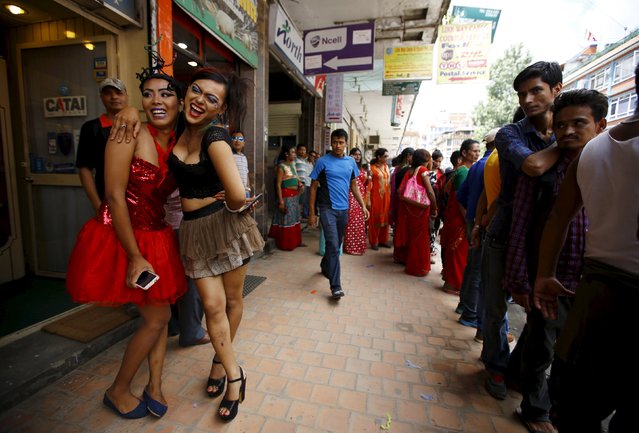
People look at revellers (L) waiting to take part in a LGBT (lesbian, gay, bisexual and transgender) pride parade to mark Gaijatra Festival, also known as the festival of cows, in Kathmandu, Nepal, August 30, 2015. (Photo by Navesh Chitrakar/Reuters)

People look at revellers (L) waiting to take part in a LGBT (lesbian, gay, bisexual and transgender) pride parade to mark Gaijatra Festival, also known as the festival of cows, in Kathmandu, Nepal, August 30, 2015. Hundreds of lesbians, gays, bisexuals and transvestites paraded through Nepal's capital Sunday to demand that rights for sexual minorities be included in the country's new constitution that is being finalized. (Photo by Navesh Chitrakar/Reuters)
Details
31 Aug 2015 12:26:00
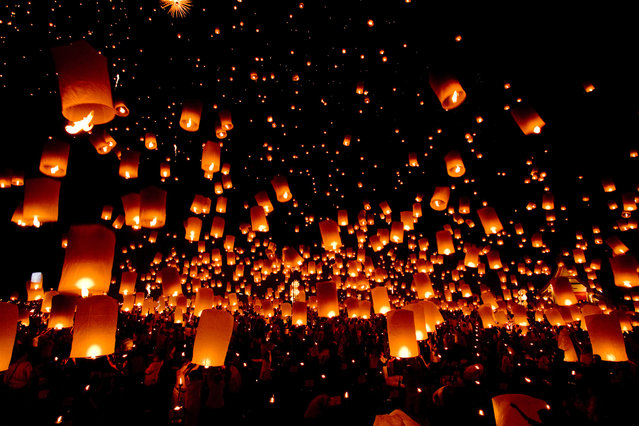
Loi Krathong Festival In Thailand

We are all drawn to fire, entranced by its beauty and ferociousness. Its brilliance draws us in like moths to a candle flame. Thus, many of the celebrations that humans have involve lighting fires. They can be big or small; there could be many little lights or one giant inferno; they may float on water, burn on land, or rise high into the skies. Loi Krathong is a festival that is held each year in Thailand and a number of other places. During this festival thousands of little fires are lighted, presenting a marvelous sight for all the onlookers. It is believed that this tradition is an adaptation of Brahmanical festival, which was adopted by Thai Buddhists to honor Buddha.
Details
30 Jan 2015 10:38:00
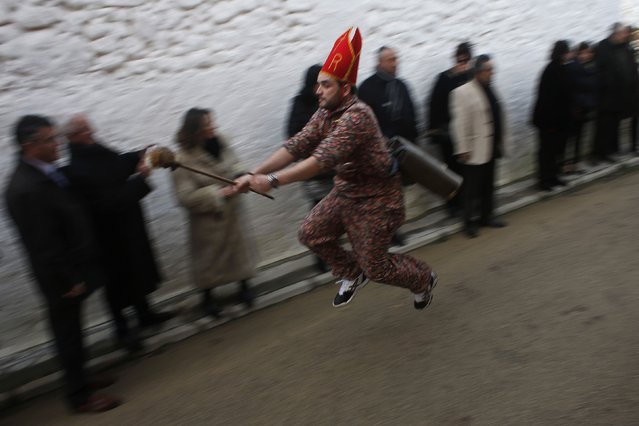
A believer dressed as a “diablo” (devil) jumps at the San Blas' (Saint Blaise) procession during the “Endiablada” festival in Almonacid del Marquesado, in central Spain February 3, 2015. In the “Endiablada”, an undated traditional festival in honour of the Candelaria Virgin and San Blas. (Photo by Susana Vera/Reuters)

A believer dressed as a “diablo” (devil) jumps at the San Blas' (Saint Blaise) procession during the “Endiablada” festival in Almonacid del Marquesado, in central Spain February 3, 2015. In the “Endiablada”, an undated traditional festival in honour of the Candelaria Virgin and San Blas, believers are dressed in colourful costumes, wear a mitre with lead cowbells tied to their waists that ring as they wander around the village and in front of the saints' statues during their processions. (Photo by Susana Vera/Reuters)
Details
05 Feb 2015 12:02:00
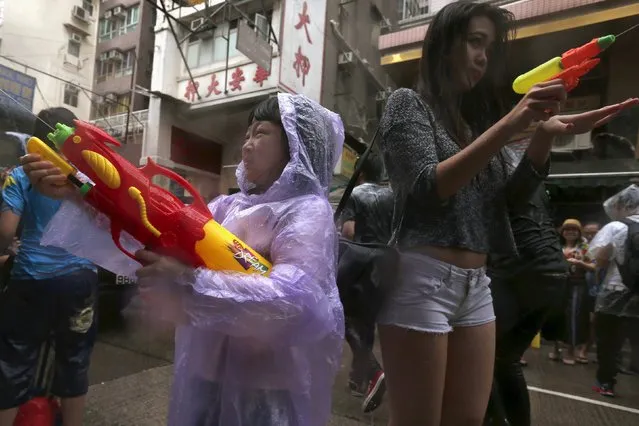
Revellers use water guns as they participate in a water fight during Songkran Festival celebrations at Kowloon City district, known as Little Thailand as there is large number of restaurants and shops run by Thais, in Hong Kong April 12, 2015. (Photo by Tyrone Siu/Reuters)

Revellers use water guns as they participate in a water fight during Songkran Festival celebrations at Kowloon City district, known as Little Thailand as there is large number of restaurants and shops run by Thais, in Hong Kong April 12, 2015. The Songkran festival, also known as the water festival, marks the start of Thailand's traditional New Year and is believed to wash away bad luck. (Photo by Tyrone Siu/Reuters)
Details
13 Apr 2015 12:52:00
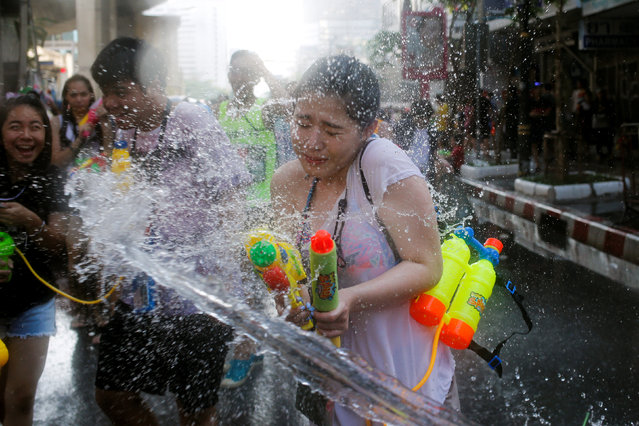
A reveller reacts during a water fight at Songkran Festival celebrations in Bangkok April 13, 2016. (Photo by Jorge Silva/Reuters)

A reveller reacts during a water fight at Songkran Festival celebrations in Bangkok April 13, 2016. The three-day Songkran Festival starts on 13-15 April annually and is celebrated with splashing water and putting powder on each others faces as a symbolic sign of cleansing and washing away the sins from the old year. (Photo by Jorge Silva/Reuters)
Details
14 Apr 2016 12:18:00
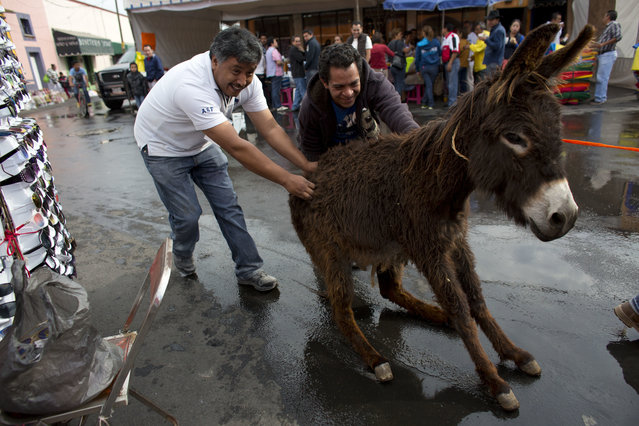
In this May 1, 2016 photo, a reluctant donkey is alternately pushed and pulled and enticed with carrots toward town hall in order to be dressed for the costume competition at the annual donkey festival in Otumba, Mexico state, Mexico. Otumba was an important donkey market during Spanish colonial times, standing at the crossroads of major roads leading to Mexico City, where the beasts pulled heavy loads and carried travelers. Today, however, farmers use tractors and pickup trucks, and the donkey population is in decline. (Photo by Rebecca Blackwell/AP Photo)

In this May 1, 2016 photo, a reluctant donkey is alternately pushed and pulled and enticed with carrots toward town hall in order to be dressed for the costume competition at the annual donkey festival in Otumba, Mexico state, Mexico. Otumba was an important donkey market during Spanish colonial times, standing at the crossroads of major roads leading to Mexico City, where the beasts pulled heavy loads and carried travelers. Today, however, farmers use tractors and pickup trucks, and the donkey population is in decline. (Photo by Rebecca Blackwell/AP Photo)
Details
04 May 2016 11:55:00