Loading...
Done
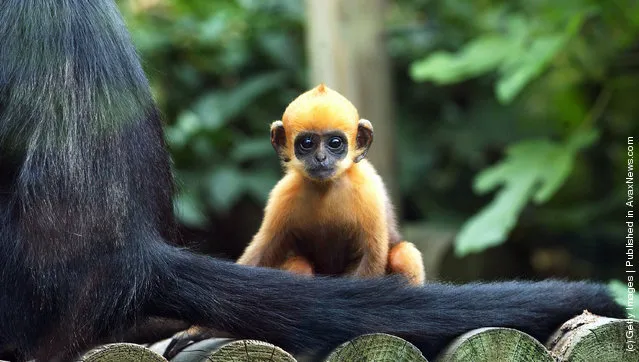
Baby Francois' Langur

“Francois' langur is one of several species of leaf monkeys. Over 50% of its diet is made up of young leaves. It will also consume fruits (17.2%), seeds, flowers, stems, roots, bark and occasionally minerals and insects off of rock surfaces and cliffs. This langur consumes its favorite food, young leaves, at the highest rate during the dry season, April through September, also known as the young leaf-lean period”. – Wikipedia

Photo: An endangered baby Francois' Langur monkey called Laa Laa settles in following her July 6 birth at London Zoo, Regent's Park on August 5, 2004 in London. The bright ginger youngster was born to glossy black parents Max and Shaneka and has the typical orange baby coat which is in stark contrast against the black of her parent's and older brother Grub's fur. (Photo by Steve Finn/Getty Images)
Details
22 Sep 2011 11:28:00
The Ivanpah Solar Electric Generating System is seen in an aerial view on February 20, 2014 in the Mojave Desert in California near Primm, Nevada. (Photo by Ethan Miller/Getty Images)

The Ivanpah Solar Electric Generating System is seen in an aerial view on February 20, 2014 in the Mojave Desert in California near Primm, Nevada. The largest solar thermal power-tower system in the world, owned by NRG Energy, Google and BrightSource Energy, opened last week in the Ivanpah Dry Lake and uses 347,000 computer-controlled mirrors to focus sunlight onto boilers on top of three 459-foot towers, where water is heated to produce steam to power turbines providing power to more than 140,000 California homes. (Photo by Ethan Miller/Getty Images)
Details
14 Apr 2014 11:01:00
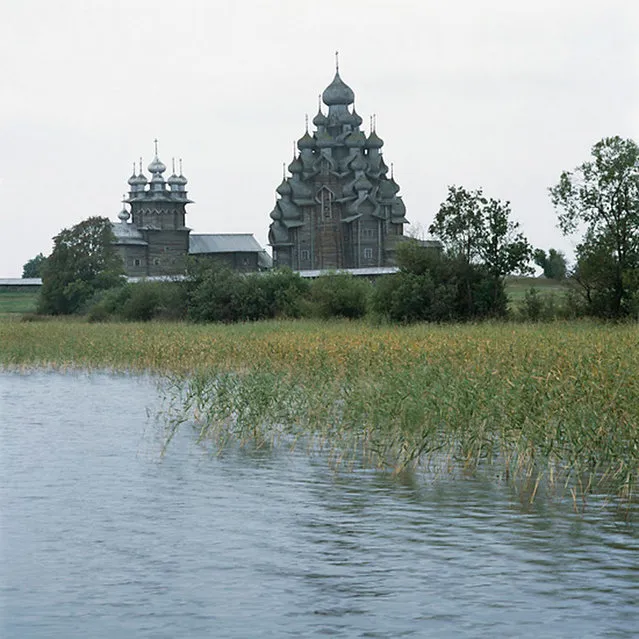
Wooden Churches - Travelling In The Russian North By Richard Davies Part 1

While communism, collectivism, worms, dry rot and casual looting failed to destroy the majestic wooden churches of Russia, it may be ordinary neglect that finally does them in. Dwindled now to several hundred remaining examples, these glories of vernacular architecture lie scattered amid the vastness of the world’s largest country. Just over a decade ago, Richard Davies, a British architectural photographer, struck out on a mission to record the fragile and poetic structures. Austerely beautiful and haunting, “Wooden Churches: Traveling in the Russian North” (White Sea Publishing; $132) is the result. Covering thousands of miles, Mr. Davies described how he and the writer Matilda Moreton tracked down the survivors from among the thousands of onion-domed structures built after Prince Vladimir converted to Christianity in 988.
Details
25 Nov 2013 12:47:00
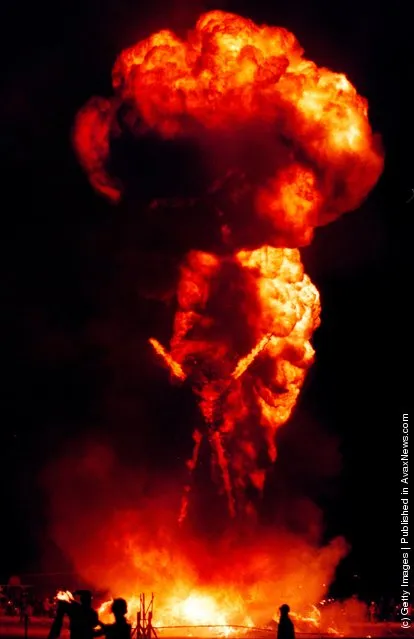
Burning Man Festival

“Burning Man is a week-long annual event held in the Black Rock Desert in northern Nevada, in the United States. The event starts on the Monday before the American Labor Day holiday, and ends on the holiday itself. It takes its name from the ritual burning of a large wooden effigy on Saturday evening. The event is described by many participants as an experiment in community, radical self-expression, and radical self-reliance”. – Wikipedia

Photo: A fireball billows up from a 52-foot tall wooden man as it goes up in flames September 2, 2000 during the15th annual Burning Man festival in the Black Rock Desert near Gerlach, Nevada. Despite high winds, dust storms, and a bit of rain, some 27,000 people camped out on a remote desert playa, or dry lake, for the week-long counter-cultural celebration of art and “radical self-expression”. (Photo by David McNew/Newsmakers)
Details
15 Oct 2011 10:41:00
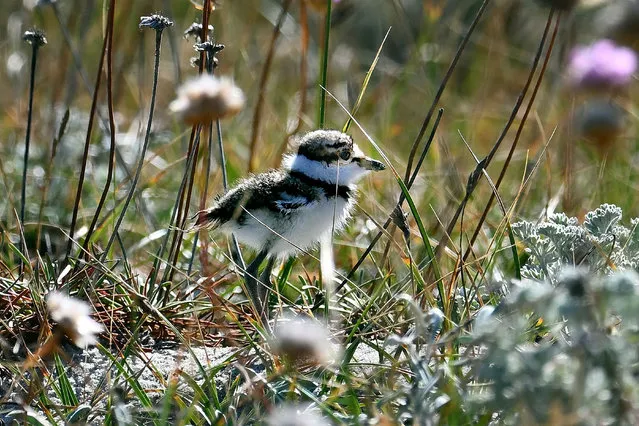
A killdeer (Charadrius vociferus) chick on sand dunes in Pacific Grove, California, US on June 21, 2023. The killdeer gets its name from its shrill, loud call. (Photo by Rory Merry/ZUMA Press Wire/Rex Features/Shutterstock)

A killdeer (Charadrius vociferus) chick on sand dunes in Pacific Grove, California, US on June 21, 2023. The killdeer gets its name from its shrill, loud call. (Photo by Rory Merry/ZUMA Press Wire/Rex Features/Shutterstock)
Details
02 Jul 2023 03:03:00
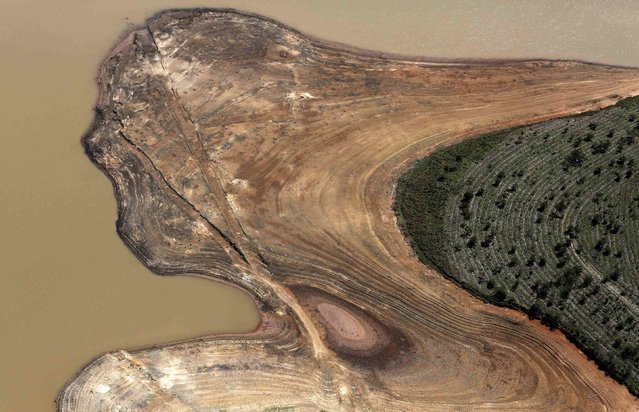
An aerial view of the Atibainha dam, part of the Cantareira reservoir, during a drought in Nazare Paulista, Sao Paulo state November 18, 2014. (Photo by Nacho Doce/Reuters)

An aerial view of the Atibainha dam, part of the Cantareira reservoir, during a drought in Nazare Paulista, Sao Paulo state November 18, 2014. Brazil's worst drought in 80 years has left the Cantareira system, that provides greater Sao Paulo with most of its water, with the lowest water level on record, with daily rationing becoming common in the region's smaller cities, according to the state authorities and the two main reservoirs serving metropolitan Sao Paulo, South America's largest city, could dry out by February if relief does not arrive in the upcoming rainy season. (Photo by Nacho Doce/Reuters)
Details
20 Nov 2014 12:19:00
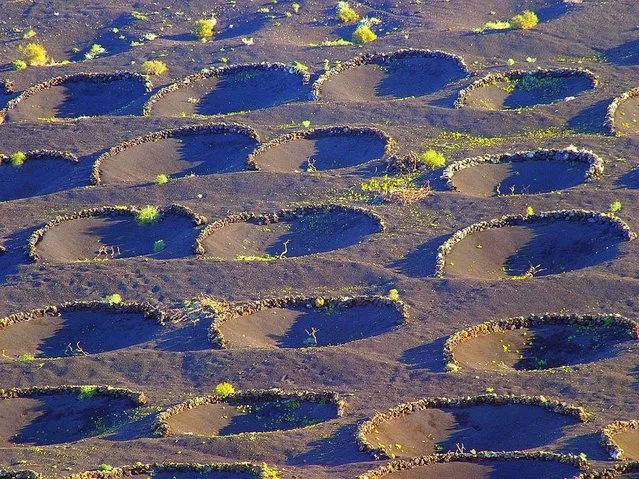
Grapes Born of Volcano In Lanzarote, Spanish

The valley of La Geria, which has been declared a 'Protected Area', is Lanzarote’s main wine-growing region, occupying about 20 square miles (52 square kilometres) and stretching on both sides of the road from Masdache to Uga and right up to the volcanic slopes. This area produces most of Lanzarote’s excellent wines, of which 75 per cent are made from the Malvasía grape, one of the oldest known grape varieties. Best known as a honey-coloured, very sweet wine with a rich flavour, already praised by Shakespeare hundreds of years ago, today the Malvasía grape produces a wide variety of quality white, red or rosé wines, from very sweet to very dry.
Details
31 Oct 2013 09:10:00


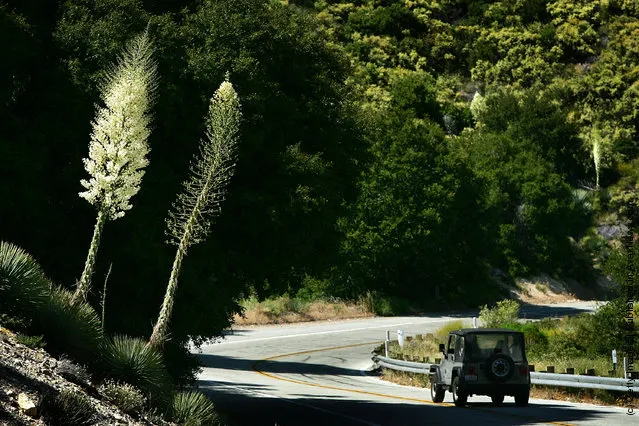
“Yucca is a genus of perennial shrubs and trees in the agave family, Agavaceae. Its 40-50 species are notable for their rosettes of evergreen, tough, sword-shaped leaves and large terminal panicles of white or whitish flowers. They are native to the hot and dry (arid) parts of North America, Central America, South America, and the Caribbean. Early reports of the species were confused with the cassava (Manihot esculenta). Consequently, Linnaeus mistakenly derived the generic name from the Carib word for the latter, yuca. It is also colloquially known in the midwest United States as “Ghosts in the graveyard”, as it is commonly found growing in rural graveyards and when in bloom the flowers appear as an apparition floating.” – Wikipedia

Photo: A yucca standing among flowers bursts forth a very large stalk of flowers as a heavy wildflower bloom on June 21, 2005 in the Angeles National Forest northwest of La Canada, California. (Photo by David McNew/Getty Images)
Details
29 Mar 2011 07:31:00