Loading...
Done
Pineapple

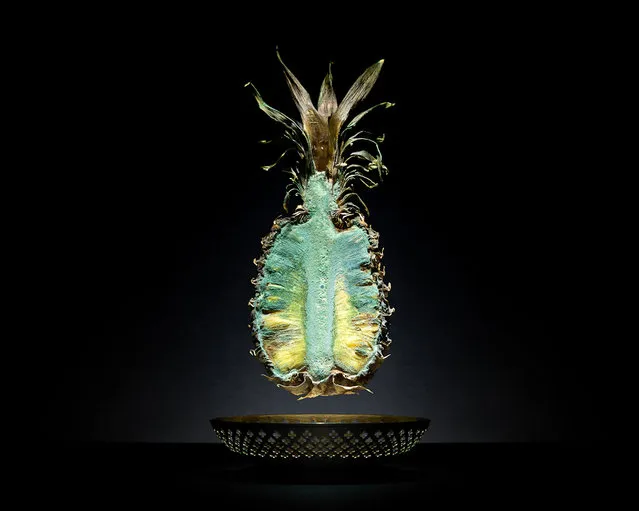
“One Third” – a project on food waste by an Austrian photography Klaus Pichler. According to a UN study one third of the world's food goes to waste – the largest part thereof in the industrialized nations of the global north. Equally, 925 million people around the world are threatened by starvation. The series “One Third” describes the connection between individual wastage of food and globalized food production.

Photo: Pineapple. Place of production: Guayaquil, Ecuador. Cultivation method: Outdoor plantation • Time of harvest: All- season. Transporting distance: 10.666 km (linear distance) • Means of transportation: Aircraft, truck. Carbon footprint (total) per kg: 11,94 kg • Water requirement (total) per kg: 360 l. Price: 2,10 € / kg. (Photo by Klaus Picher)
Details
02 May 2012 11:01:00
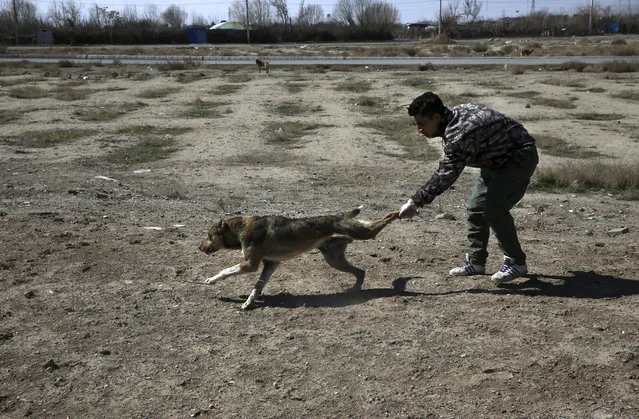
In this picture taken on Sunday, March 5, 2017, a Tehran's urban animal control worker catches a stray dog after being shot with his anesthetic dart on the outskirts of the capital Tehran, Iran. (Photo by Vahid Salemi/AP Photo)

In this picture taken on Sunday, March 5, 2017, a Tehran's urban animal control worker catches a stray dog after being shot with his anesthetic dart on the outskirts of the capital Tehran, Iran. The shelter has been hired by the Tehran city government to take a new, more humane approach to deal with the burgeoning problem of stray dogs in the capital. It’s a sign of changing attitudes among officials in a country where Islamic authorities long saw dogs as “un-Islamic” and would at times confiscate them from people who kept them as pets. (Photo by Vahid Salemi/AP Photo)
Details
17 Mar 2017 00:03:00
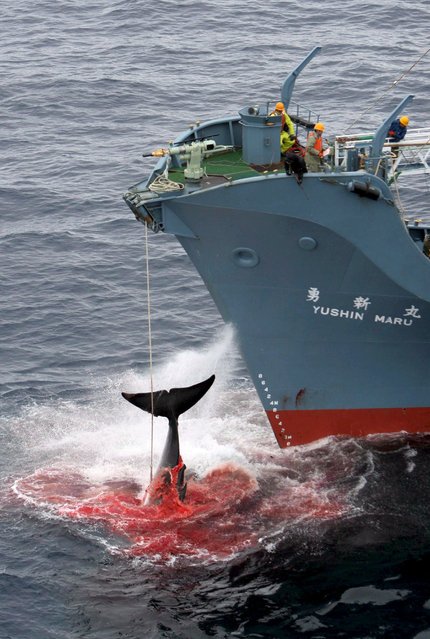
A file photograph dated 07 January 2006 and released by Greenpeace, showing the Yushin Maru, a factory ship in a Japanese whaling fleet, injuring a whale with it's first harpoon attempt. A UN court in The Hague on 31 March 2014 halted Japan's much-criticized whaling programme, ruling that it contravenes a 1986 moratorium on whale hunting. Japan must end its 'research whaling' programme, the International Court of Justice (ICJ) said. (Photo by Kate Davison/EPA)

A file photograph dated 07 January 2006 and released by Greenpeace, showing the Yushin Maru, a factory ship in a Japanese whaling fleet, injuring a whale with it's first harpoon attempt. A UN court in The Hague on 31 March 2014 halted Japan's much-criticized whaling programme, ruling that it contravenes a 1986 moratorium on whale hunting. Japan must end its 'research whaling' programme, the International Court of Justice (ICJ) said. Japan said the programme was for scientific research and permitted under international conventions. Australia had brought the case to the ICJ in 2010, charging that Japan was breaching international law by killing hundreds of whales every year for commercial purposes. Japan was “deeply disappointed” by the ruling, an unnamed government official was quoted by the Kyodo News agency as saying. But the official said Japan would stand by the ruling. (Photo by Kate Davison/EPA)
Details
01 Apr 2014 08:38:00
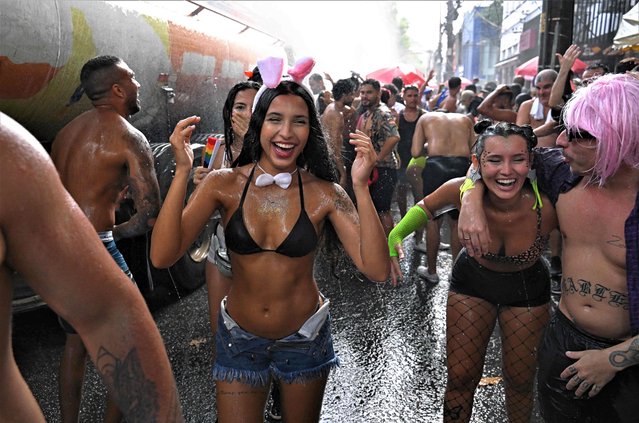
Revellers are sprayed by a water cannon during a street party called “Bloco Das Barbas” in Rio de Janeiro, Brazil on February 18, 2023. Hundreds of street parties traditionally take place every year in the city before and during Rio de Janeiro's carnival. (Photo by Carl de Souza/AFP Photo)

Revellers are sprayed by a water cannon during a street party called “Bloco Das Barbas” in Rio de Janeiro, Brazil on February 18, 2023. Hundreds of street parties traditionally take place every year in the city before and during Rio de Janeiro's carnival. (Photo by Carl de Souza/AFP Photo)
Details
11 May 2024 05:33:00
Queen of drums, Sabrina Sato of Unidos de Vila Isabel samba school during the Champions Parade on the last day of Rio de Janeiro 2022 Carnival at Marques de Sapucai Sambadrome on May 01, 2022 in Rio de Janeiro, Brazil. Rio de Janeiro's iconic carnival returns to the sambodrome after a two year suspension and postponements due to the coronavirus pandemic. (Photo by Wagner Meier/Getty Images)

Queen of drums, Sabrina Sato of Unidos de Vila Isabel samba school during the Champions Parade on the last day of Rio de Janeiro 2022 Carnival at Marques de Sapucai Sambadrome on May 01, 2022 in Rio de Janeiro, Brazil. Rio de Janeiro's iconic carnival returns to the sambodrome after a two year suspension and postponements due to the coronavirus pandemic. (Photo by Wagner Meier/Getty Images)
Details
18 Aug 2023 03:38:00
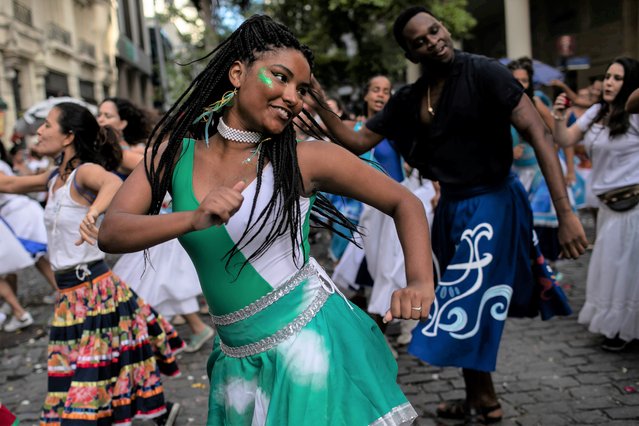
A woman dances during a rehearsal by the group “Tambores de Olokun” in Rio de Janeiro, Brazil, Sunday, April 17, 2022. The Brazilian municipalities of Rio de Janeiro and Sao Paulo postponed the traditional parades of the carnival samba schools to April 22 - 23, as a result of the COVID-19 pandemic. (Photo by Bruna Prado/AP Photo)

A woman dances during a rehearsal by the group “Tambores de Olokun” in Rio de Janeiro, Brazil, Sunday, April 17, 2022. The Brazilian municipalities of Rio de Janeiro and Sao Paulo postponed the traditional parades of the carnival samba schools to April 22 - 23, as a result of the COVID-19 pandemic. (Photo by Bruna Prado/AP Photo)
Details
19 Apr 2022 05:56:00
A member of Viradouro samba school performs during the first night of Rio's Carnival parade at the Sambadrome Marques de Sapucai in Rio de Janeiro, Brazil on April 22, 2022. (Photo by Carl de Souza/AFP Photo)

A member of Viradouro samba school performs during the first night of Rio's Carnival parade at the Sambadrome Marques de Sapucai in Rio de Janeiro, Brazil on April 22, 2022. (Photo by Carl de Souza/AFP Photo)
Details
29 May 2022 04:12:00
Takeoka Chisaka, Hiroshima, Japan. “One morning in August 1945, I was walking home from the night shift at a factory in Hiroshima. As I reached my door, there was a huge explosion. When I came to, my head was bleeding and I had been blasted 30m away”. (Photo and caption by Sasha Maslov)

Takeoka Chisaka, Hiroshima, Japan. “One morning in August 1945, I was walking home from the night shift at a factory in Hiroshima. As I reached my door, there was a huge explosion. When I came to, my head was bleeding and I had been blasted 30m away. The atomic bomb had detonated. When I found my mother, her eyes were badly burned. A doctor said they had to come out, but he didn’t have the proper tools so used a knife instead. It was hellish. I became a peace-worker after the war. In the 1960s, at a meeting at the UN, I met one of the people who created the atomic bomb. He apologised”. (Photo and caption by Sasha Maslov)
Details
11 May 2015 11:56:00