Loading...
Done
Russia's New Tram Of The Future

The Russian One is a new commuter tram that looks like something from a Sci-Fi film. The futuristic tram features LED cabin lighting, felt-covered sofas, wooden handrails, and sliding glass doors that operate by touchscreen. Luckily, photographer Ilya Varlamov was able to snap some pictures of the new Russian One prototype, right from the showroom floor.
Details
10 Jul 2014 11:31:00
Russian President Vladimir Putin, right, and North Korea's leader Kim Jong Un pose for photographers during their meeting in Vladivostok, Russia, Thursday, April 25, 2019. Putin and Kim are set to have one-on-one meeting at the Far Eastern State University on the Russky Island across a bridge from Vladivostok. The meeting will be followed by broader talks involving officials from both sides. (Photo by Alexander Zemlianichenko/AP Photo/Pool)

Russian President Vladimir Putin, right, and North Korea's leader Kim Jong Un pose for photographers during their meeting in Vladivostok, Russia, Thursday, April 25, 2019. Putin and Kim are set to have one-on-one meeting at the Far Eastern State University on the Russky Island across a bridge from Vladivostok. The meeting will be followed by broader talks involving officials from both sides. (Photo by Alexander Zemlianichenko/AP Photo/Pool)
Details
30 Dec 2019 00:01:00
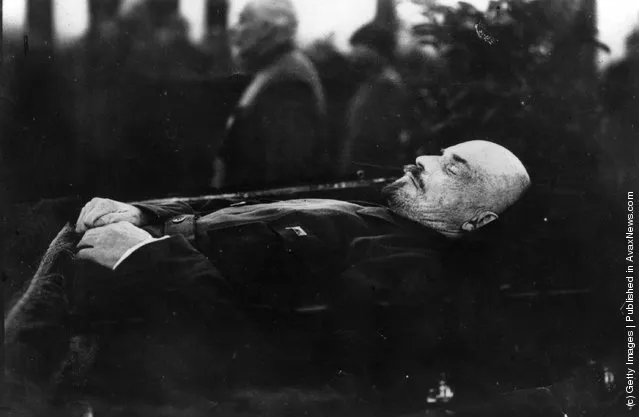
1924:  Vladimir Ilyich Lenin lying in state in the Kremlin

Photo: Vladimir Ilyich Lenin (1870 – 1924) lying in state in the Kremlin. (Photo by Hulton Archive/Getty Images). 1924

Important! For the same article in Russian language click here.

Something quite intriguing is happening within Russian-speaking internet during the last few – should you type a fully academic inquiry (at least, according to Russian academic requirements) in national search engines for "Lenin's mausoleum" – the first thing you get (even in top 10 searches) is website pages talking about black magic and occult. Website authors view this construction differently, but unconditionally agree on one thing: the mausoleum of the "leader of the world proletariat” – the essence of a magical artifact, a sort of “energy vampire”. It was built with a certain purpose: to drain the energy out of miserable Soviet citizens on one hand; and to poison the anthroposphere of one-sixth part of the earth with its vibes (the exact territory that was occupied by the former Soviet Union), depriving the Russian people of will to resist on the other hand. Complete nonsense? No doubt. Nevertheless, an intriguing one. Well, probably because some oddities do exist in mausoleum's history. These oddities are the thing we are going to discuss this time. First, let me refresh you memory on the subject.
Details
16 Oct 2011 11:27:00


When The Dog And Cat Stays At Home Alone
Details
18 Mar 2014 13:26:00
In this third of seven sequential photos, Elian Gonzalez is held in a closet by Donato Dalrymple, one of the two men who rescued the boy from the ocean, right, as government officials search the home of Lazaro Gonzalez for the young boy, early morning, April 22, 2000, in Miami, Florida. Armed federal agents seized Elian Gonzalez from the home of his Miami relatives before dawn, firing tear gas into an angry crowd as they left the scene with the weeping 6-year-old boy. This photo won the Prize in 2001. (Photo by Alan Diaz/AP Photo)

In this third of seven sequential photos, Elian Gonzalez is held in a closet by Donato Dalrymple, one of the two men who rescued the boy from the ocean, right, as government officials search the home of Lazaro Gonzalez for the young boy, early morning, April 22, 2000, in Miami, Florida. Armed federal agents seized Elian Gonzalez from the home of his Miami relatives before dawn, firing tear gas into an angry crowd as they left the scene with the weeping 6-year-old boy. This photo won the Prize in 2001. (Photo by Alan Diaz/AP Photo)
Details
22 Aug 2014 12:18:00
Lola is seen at left in everyday clothes – and then at right in her work clothes. She works as a clown in Paris. (Photo by Bruno Fert/Picturetank)

“The series of photos called Workwears, by French photographer Bruno Fert, visually juxtaposes people’s private lives with their lives at work. A firefighter, a fisherman, a nurse, a diver, a judge. One by one, Fert’s photos show people in their homes wearing everyday clothing – followed by another photo showing them dressed in the clothing of their chosen professions. Our reaction, Fert said, reminds us how tightly humans hold on to certain stereotypes about some professions. “I like to break those stereotypes”, he said”. – Thom Patterson via CNN. Here: Lola is seen at left in everyday clothes – and then at right in her work clothes. She works as a clown in Paris. (Photo by Bruno Fert/Picturetank)
Details
29 Oct 2014 12:40:00
An air raid drill at Seattle College caught students William Bates, left, and Edna Mae Farrell, right, while they were eating their lunch in the school café, but they simply took shelter under the table and continued eating in Seattle, Washington, March 17, 1942. Air raid wardens said 350 students left their classrooms and assembled in shelters within one minute in first at the college. (Photo by AP Photo)

An air raid drill at Seattle College caught students William Bates, left, and Edna Mae Farrell, right, while they were eating their lunch in the school café, but they simply took shelter under the table and continued eating in Seattle, Washington, March 17, 1942. Air raid wardens said 350 students left their classrooms and assembled in shelters within one minute in first at the college. (Photo by AP Photo)
Details
19 Sep 2018 00:01:00
Joaldunaks return in a trailer to their town at the end of Carnival between of the Pyrenees villages of Ituren and Zubieta, northern Spain, Monday, February 1, 2016. In one of the most ancient carnivals in Europe, dating from before the Roman empire, companies of Joaldunak (cowbells) made up of residents of two towns, Ituren and Zubieta, parade the streets costumed in sandals, lace petticoats, sheepskins around the waist and shoulders, coloured neckerchiefs, conical caps with ribbons and a hyssop of horsehair in their right hands and cowbells hung across their lower back. (Photo by Alvaro Barrientos/AP Photo)

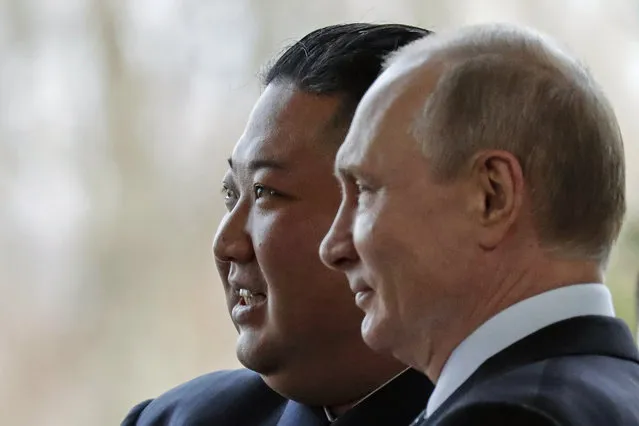
Joaldunaks return in a trailer to their town at the end of Carnival between of the Pyrenees villages of Ituren and Zubieta, northern Spain, Monday, February 1, 2016. In one of the most ancient carnivals in Europe, dating from before the Roman empire, companies of Joaldunak (cowbells) made up of residents of two towns, Ituren and Zubieta, parade the streets costumed in sandals, lace petticoats, sheepskins around the waist and shoulders, coloured neckerchiefs, conical caps with ribbons and a hyssop of horsehair in their right hands and cowbells hung across their lower back. (Photo by Alvaro Barrientos/AP Photo)
Details
02 Feb 2016 13:07:00