Loading...
Done
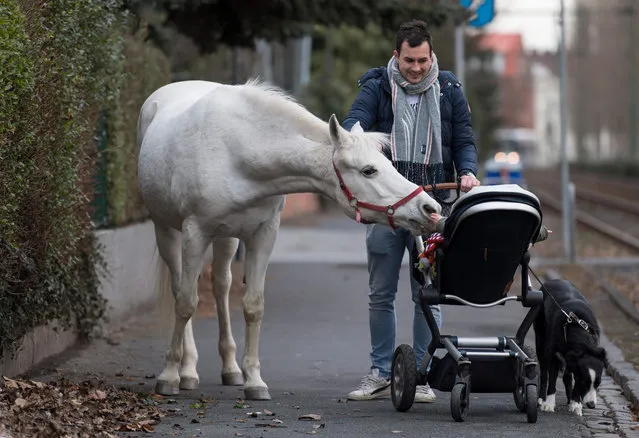
The Arabian mare “Jenny” curiously sniffs at the child of Raphael Wöllstein, who is on his way to the train, on her daily walk through the Fechenheim district of Frankfurt, Germany on March 8, 2019. Her owner opens the stable door for the 22-year-old horse every morning. Then the animal can decide for itself where it wants to spend the day. So that nobody thinks she's escaped, a sign with the inscription “My name is Jenny, didn't run away, just go for a walk” is on the halter. (Photo by Boris Roessler/dpa)

The Arabian mare “Jenny” curiously sniffs at the child of Raphael Wöllstein, who is on his way to the train, on her daily walk through the Fechenheim district of Frankfurt, Germany on March 8, 2019. Her owner opens the stable door for the 22-year-old horse every morning. Then the animal can decide for itself where it wants to spend the day. So that nobody thinks she's escaped, a sign with the inscription “My name is Jenny, didn't run away, just go for a walk” is on the halter. (Photo by Boris Roessler/dpa)
Details
10 Mar 2019 00:07:00
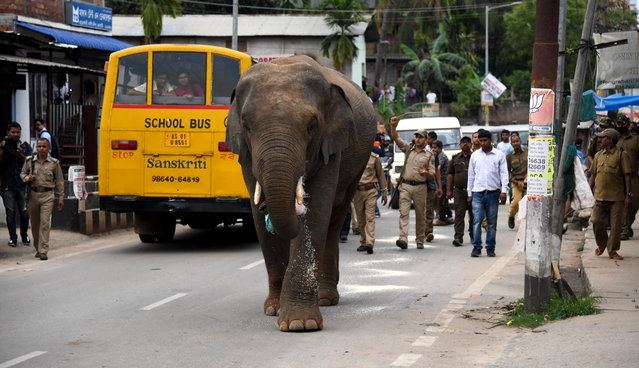
Indian forest officials and police personnel try to chase away a wild male elephant at Hengrabari area in Guwahati on April 30, 2019. The elephant came down from Amchang Wildlife Sanctuary in search of food and later forest official tranquillized it, local media reported. As the pressure of population pushes human habitation closer to forests incidents of wild animals straying into cities is increasingly reported. (Photo by Biju Boro/AFP Photo)

Indian forest officials and police personnel try to chase away a wild male elephant at Hengrabari area in Guwahati on April 30, 2019. The elephant came down from Amchang Wildlife Sanctuary in search of food and later forest official tranquillized it, local media reported. As the pressure of population pushes human habitation closer to forests incidents of wild animals straying into cities is increasingly reported. (Photo by Biju Boro/AFP Photo)
Details
02 May 2019 00:07:00
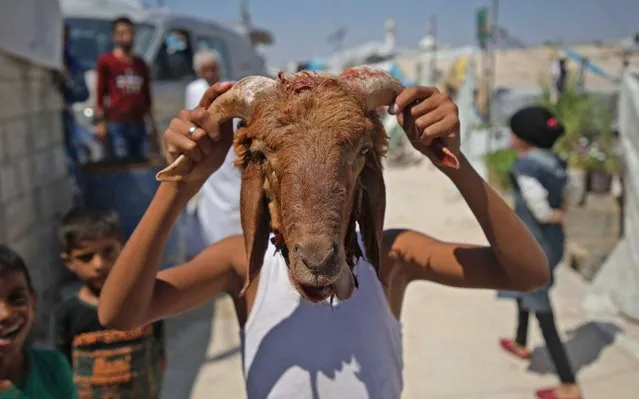
A Syrian boy plays with the head of a sacrificed sheep at a DIP camp for Interally Displaced Persons near the town of Aqrabat in Syria's northern Idlib province on August 12, 2019. Known as the “big” festival, Eid Al-Adha is celebrated each year by Muslims sacrificing various animals according to religious traditions, including cows, camels, goats and sheep. The festival marks the end of the Hajj pilgrimage to Mecca and commemorates Prophet Abraham's readiness to sacrifice his son to show obedience to God. (Photo by Aaref Watad/AFP Photo)

A Syrian boy plays with the head of a sacrificed sheep at a DIP camp for Interally Displaced Persons near the town of Aqrabat in Syria's northern Idlib province on August 12, 2019. Known as the “big” festival, Eid Al-Adha is celebrated each year by Muslims sacrificing various animals according to religious traditions, including cows, camels, goats and sheep. The festival marks the end of the Hajj pilgrimage to Mecca and commemorates Prophet Abraham's readiness to sacrifice his son to show obedience to God. (Photo by Aaref Watad/AFP Photo)
Details
15 Aug 2019 00:05:00
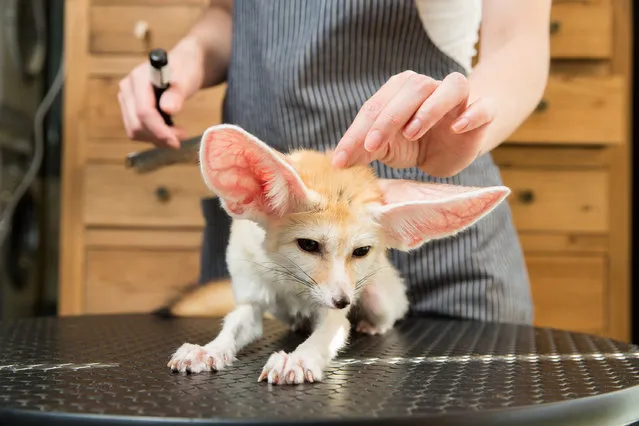
A fennec fox (Vulpes zerda) is groomed in a pet store in central Beijing. Native to the Sahara in North Africa, the species became a popular pet after being depicted as a character in Disney’s 2016 animated movie Zootopia. Individuals can cost between $2,000–$3,000. (Photo by Sean Gallagher/The Guardian)

A dramatic rise in owning exotic pets in China is fuelling global demand for threatened species. The growing trade in alligators, snakes, monkeys, crocodiles and spiders is directly linked to species loss in some of the world’s most threatened ecosystems. Here: A fennec fox (Vulpes zerda) is groomed in a pet store in central Beijing. Native to the Sahara in North Africa, the species became a popular pet after being depicted as a character in Disney’s 2016 animated movie Zootopia. Individuals can cost between $2,000–$3,000. (Photo by Sean Gallagher/The Guardian)
Details
23 Sep 2017 08:04:00
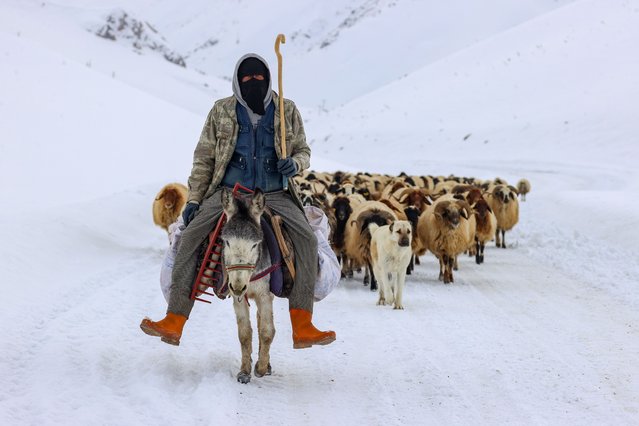
A shepherd rides a donkey as he leads sheep during winter in Van, Turkiye on February 19, 2022. Despite the terrible winter weather and the hard geology of the region, breeders in Van's Gurpnar district, where livestock is the most important source of revenue, do not disregard the care of their animals. Livestock farmers in the Cepkenli and Topcudegirmeni neighborhoods have the similar difficulties as those in rural areas, where the snow depth reaches one meter. (Photo by Ozkan Bilgin/Anadolu Agency via Getty Images)

A shepherd rides a donkey as he leads sheep during winter in Van, Turkiye on February 19, 2022. Despite the terrible winter weather and the hard geology of the region, breeders in Van's Gurpnar district, where livestock is the most important source of revenue, do not disregard the care of their animals. Livestock farmers in the Cepkenli and Topcudegirmeni neighborhoods have the similar difficulties as those in rural areas, where the snow depth reaches one meter. (Photo by Ozkan Bilgin/Anadolu Agency via Getty Images)
Details
04 Mar 2022 06:01:00
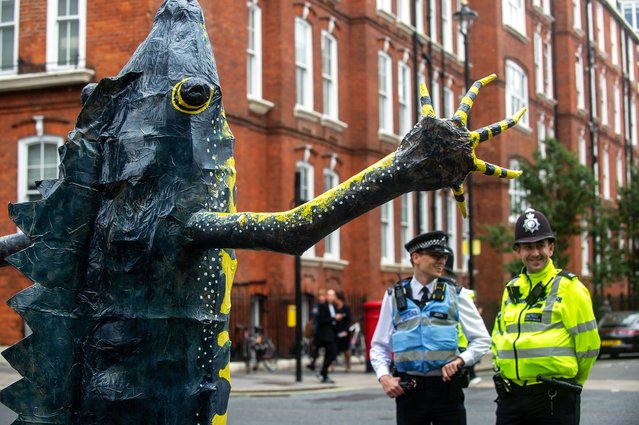
Hundreds of people from a range of NGOs and campaign groups protest to demand the immediate restoration of nature at DEFRA – Department for Environment Food & Rural Affairs on September 28, 2023 in London, England. The 2023 State of Nature Report revealed that approximately one in six species in Great Britain, including turtle doves and hazel dormice, are at risk of extinction, citing climate change, intensive farming, and pollution as major threats, with a 19% average decline in monitored plant and animal populations since 1970. (Photo by Guy Smallman/Getty Images)

Hundreds of people from a range of NGOs and campaign groups protest to demand the immediate restoration of nature at DEFRA – Department for Environment Food & Rural Affairs on September 28, 2023 in London, England. The 2023 State of Nature Report revealed that approximately one in six species in Great Britain, including turtle doves and hazel dormice, are at risk of extinction, citing climate change, intensive farming, and pollution as major threats, with a 19% average decline in monitored plant and animal populations since 1970. (Photo by Guy Smallman/Getty Images)
Details
09 Dec 2024 04:11:00
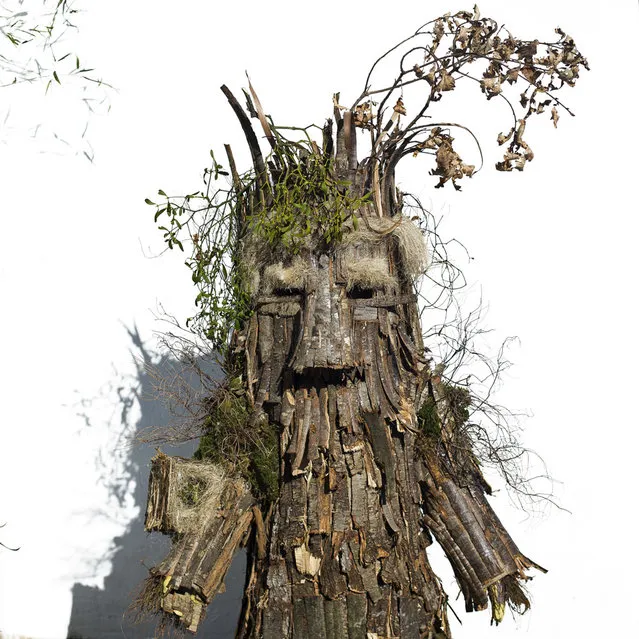
A man dressed as a  “Trapajon”, representing entities of nature, poses for a picture after taking part in the Vijanera Festival in Silio, northern Spain, Sunday, Jan. 6, 2013. The Vijanera masquerade, of pre-Roman origin, is the first carnival of the year in Europe symbolizing the triumph of good over evil and involving the participation of crowds of residents wearing different masks, animal skins and brightly colored clothing with its own complex function and symbolism and becoming the living example of the survival of archaic cults to nature. (Photo by Daniel Ochoa de Olza/AP Photo)

A man dressed as a “Trapajon”, representing entities of nature, poses for a picture after taking part in the Vijanera Festival in Silio, northern Spain, Sunday, Jan. 6, 2013. The Vijanera masquerade, of pre-Roman origin, is the first carnival of the year in Europe symbolizing the triumph of good over evil and involving the participation of crowds of residents wearing different masks, animal skins and brightly colored clothing with its own complex function and symbolism and becoming the living example of the survival of archaic cults to nature. (Photo by Daniel Ochoa de Olza/AP Photo)
Details
19 Jan 2013 13:01:00
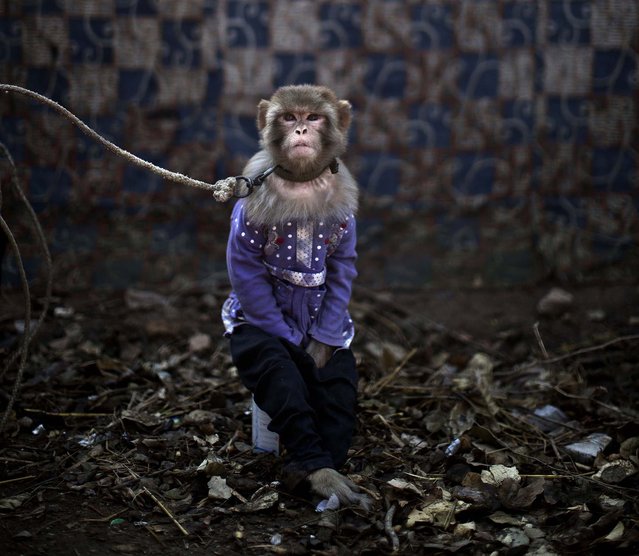
In this Tuesday, February 11, 2014, photo, a trained monkey, that makes a living for her Pakistani owner by performing to a crowd in public and private places, sits held by a leash, in Rawalpindi, Pakistan. For Pakistanis who raise and train the monkeys they are an important source of income in an impoverished country, and they form a strong bond with the animals. The monkeys are usually captured in the wild when they are babies and then trained. A trained monkey can fetch 20,000 to 30,000 rupees ($190 to $285). (Photo by Muhammed Muheisen/Associated Press)

In this Tuesday, February 11, 2014, photo, a trained monkey, that makes a living for her Pakistani owner by performing to a crowd in public and private places, sits held by a leash, in Rawalpindi, Pakistan. For Pakistanis who raise and train the monkeys they are an important source of income in an impoverished country, and they form a strong bond with the animals. The monkeys are usually captured in the wild when they are babies and then trained. A trained monkey can fetch 20,000 to 30,000 rupees ($190 to $285). (Photo by Muhammed Muheisen/Associated Press)
Details
23 Feb 2014 09:50:00