Loading...
Done
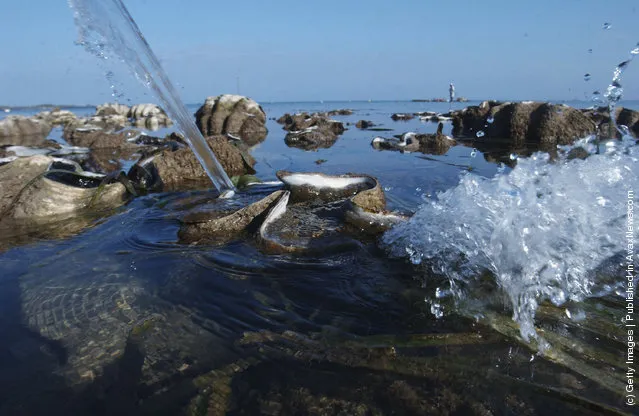
Tridacna Gigas, or Giant Clams

“The giant clam, Tridacna gigas (known as pā’ua in Cook Islands Māori), is the largest living bivalve mollusc. T. gigas is one of the most endangered clam species. It was mentioned as early as 1825 in scientific reports. One of a number of large clam species native to the shallow coral reefs of the South Pacific and Indian oceans, they can weigh more than 200 kilograms (440 lb) measure as much as 120 cm (47 in) across, and have an average lifespan in the wild of 100 years or more”. – Wikipedia

Photo: Tridacna Gigas, or Giant Clams spew water as a traditional fisherman passes by a small sanctuary on January 23, 2004 near Bolinao in the Northern Philippines. The clams, prime builders for coral reefs and providing shelter for spawning fish and other marine life, are exposed by low tides in the sanctuary. Overfishing and pollution throughout the country are not only threatening food security, but are also starting to choke one of the few working clam sanctuaries in the world. (Photo by David Greedy/Getty Images)
Details
01 Oct 2011 13:10:00
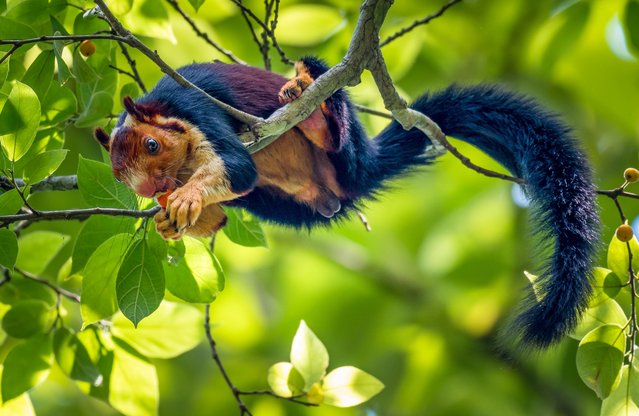
Its main predators are the birds of prey and the leopard. The Giant Squirrel is mostly active in the early hours of the morning and in the evening, resting in the midday. They are typically solitary animals that only come together for breeding. (Photo by Kaushik Vijayan/South West News Service)

The Malabar Giant squirrel – double the size of their grey relatives and measuring up to 36 inches (91.5 cm) from head to tail – lives deep in the forests of India. The athletic animals can leap an incredible 20 feet (6 m) between trees. Photographer Kaushik Vijayan, 39, snapped the animals in their native habit to produce these stunning images. Kaushik, from Kerala State, India, said: “Up until that point I had never heard about a squirrel like that or seen one. The sight was an absolute feast for my eyes. The squirrels fascinated me and I got excited to capture this beauty on my camera”. (Photo by Kaushik Vijayan/South West News Service)
Details
04 Apr 2019 00:03:00
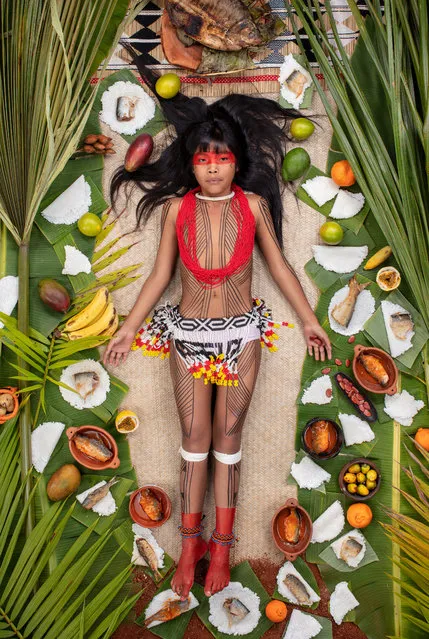
Kawakanih Yawalapiti, 9, Upper Xingu region of Mato Grosso, Brazil, 2018: Kawakanih lives with her tribe, the Yawalapiti, in Xingu national park, a preserve in the Amazon basin of Brazil. The Yawalapiti collect seeds to preserve species unique to their ecosystem, which lies between the rain forest and savannah. Kawakanih’s diet is simple, consisting mainly of fish, cassava, porridge, fruit and nuts. “It takes five minutes to catch dinner”, says Kawakanih. “When you’re hungry, you just go to the river with your net”. (Photo by Gregg Segal/The Guardian)

Photographer Gregg Segal travelled the world to document children and the food they eat in a week. Partly inspired by the increasing problems of childhood obesity, he tracked traditional regional diets as yet unaffected by globalisation, and ironically, found that the healthiest diets were often eaten by the least well off. (Photo by Gregg Segal/The Guardian)
Details
03 Jul 2019 00:03:00
Revellers attend the 25th edition of the Sziget Festival on August 9, 2017 in Budapest, Hungary. (Photo by Laszlo Mudra/Rockstar Photographers)

Revellers attend the 25th edition of the Sziget Festival on August 9, 2017 in Budapest, Hungary. The Sziget Festival, one of the largest music and cultural festivals in Europe, celebrates its 25th anniversary in 2017, taking place from August 9-16 on the Hajogyari Sziget in Budapest. (Photo by Laszlo Mudra/Rockstar Photographers)
Details
11 Aug 2017 07:41:00
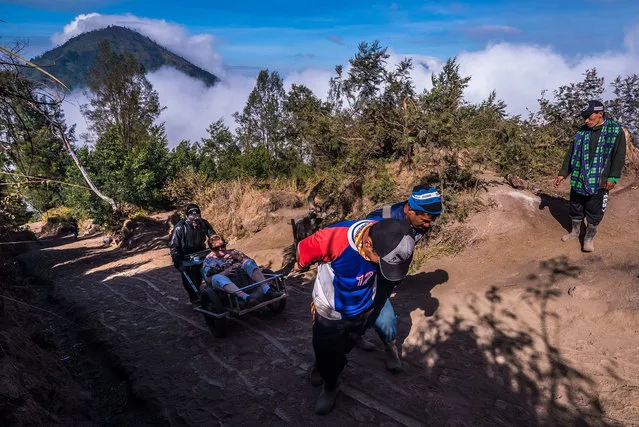
Miners pulling up lazy tourists to the rim of Kawah Ijen (Ijen Volcano), East Java, Indonesia on September 21, 2017. They will earn as much as they would bring down a load of sulfur. Nomadic Explorer, Cultural Lifestyle Photographer Claudio Sieber captured striking images of miners working at Ijen volcanic range in East Java, Indonesia. The sulphur miners risk their lives daily as they climb the active volcano carrying heavy loads, which they sell to sugar refineries. Shortly after midnight curious tourists are flocking in hundreds through the gate of Ijen's foothills to be right on time, driven by the images others took before them. Kawah Ijen is the one of the world's largest acidic volcanic crater lake; famous for its turquoise color as well as the unreal atmosphere it offers during darkness. A dusty path zigzags 3 kilometers up to the crater rim. This doesn't mean anything challenging; in particular, special sights have to be deserved anyway. The irritating smell of sulfur announces the near of the crater's existence. Arriving on the crater's rim the reward for the torture becomes visible. Blue fire darts its tongues through the fumes of sulfur dioxide. Somehow, the spectacle isn't as romantic as expected, since it is also the rough working space of approx. 150 sulfur miners who start their shift at 1 am. Lately, harvesting the abundance of devil's gold received international attention. This did obviously not really improve a miner's lifestyle; neither did it contribute to a better wage. (Photo by Claudio Sieber/Barcroft Images)

Miners pulling up lazy tourists to the rim of Kawah Ijen (Ijen Volcano), East Java, Indonesia on September 21, 2017. They will earn as much as they would bring down a load of sulfur. Nomadic Explorer, Cultural Lifestyle Photographer Claudio Sieber captured striking images of miners working at Ijen volcanic range in East Java, Indonesia. The sulphur miners risk their lives daily as they climb the active volcano carrying heavy loads, which they sell to sugar refineries. (Photo by Claudio Sieber/Barcroft Images)
Details
02 Oct 2017 08:31:00
Rihanna holds the pregnant belly of Spc. Ariel Evans during an event promoting her Rogue Man cologne at Ft. Belvoir Exchange on Wednesday, November 12, 2014 in Ft. Belvoir, Va. (Photo by Kevin Wolf/AP Photo)

Rihanna holds the pregnant belly of Spc. Ariel Evans during an event promoting her Rogue Man cologne at Ft. Belvoir Exchange on Wednesday, November 12, 2014 in Ft. Belvoir, Va. (Photo by Kevin Wolf/AP Photo)
Details
15 Nov 2014 12:19:00
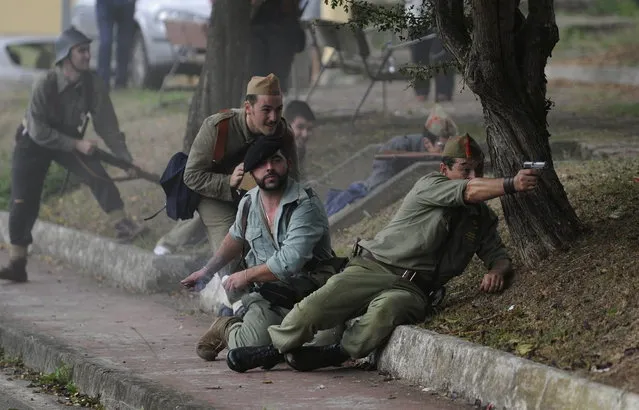
Actors take part in a re-enactment of the "Battle of Areces" that took place during the Spanish Civil War, in Grullos, north of Spain, September 14, 2013. The re-enactment of the historic 1937 battle was organised by the Frente del Nalon Association. (Photo by Eloy Alonso/Reuters)

“The Spanish Civil War (The Crusade among Nationalists, Fourth Carlist War among Carlists, The Rebellion or Uprising among Republicans) was a major conflict fought in Spain from 17 July 1936 to 1 April 1939. An estimated total of 500,000 people lost their lives as a consequence of the War”. – Wikipedia. Photo: Actors take part in a re-enactment of the “Battle of Areces” that took place during the Spanish Civil War, in Grullos, north of Spain, September 14, 2013. The re-enactment of the historic 1937 battle was organised by the Frente del Nalon Association. (Photo by Eloy Alonso/Reuters)
Details
17 Sep 2013 09:06:00
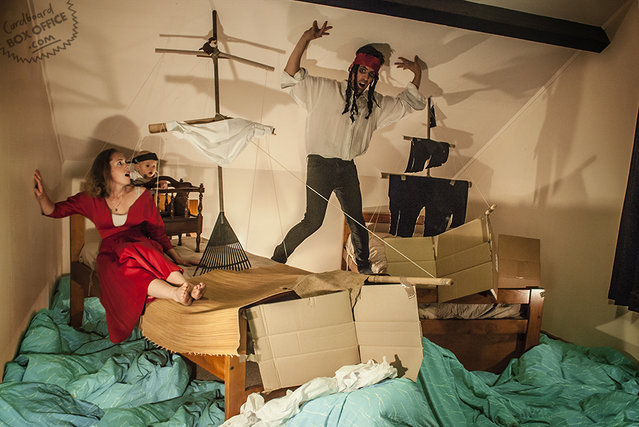
Cardboard Box Office By Lilly, Leon And Baby Orson

Welcome to Cardboard Box Office – our homemade creations of some of your favorite movie scenes built from some of our favorite domestic junk. The project began after finding that we had accumulated both a lot of cardboard boxes (due to moving to a new country) and a baby (due to giving birth). With our social lives drastically altered we decided to find a way to make some of those housebound weekends a little more fun. The costumes, props, and sets in Cardboard Box Office are created entirely out of everyday household items, toys, cardboard, and three individuals slowly losing their sanity. Enjoy!

Lilly, Leon, & (baby) Orson
Details
21 Jan 2014 17:53:00