Loading...
Done
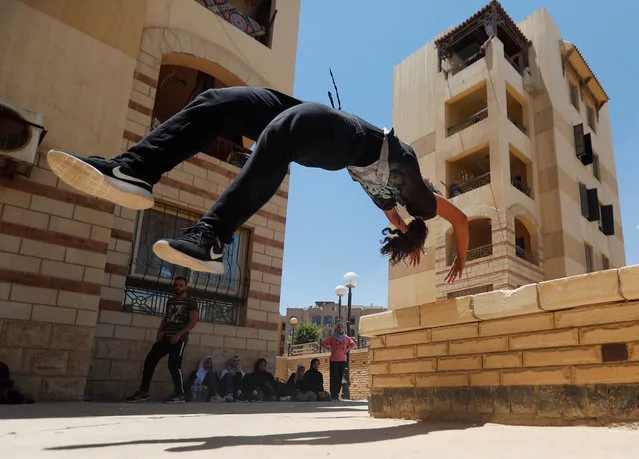
Mariam Emad from Parkour Egypt “PKE” practices her parkour skills around buildings on the outskirts of Cairo, Egypt on July 20, 2018. A group of Egyptian women gather at an abandoned park in a Cairo suburb once a week, climbing walls and jumping around in the strenuous physical discipline known as Parkour, while also challenging the country's conservative social norms. (Photo by Amr Abdallah Dalsh/Reuters)

Mariam Emad from Parkour Egypt “PKE” practices her parkour skills around buildings on the outskirts of Cairo, Egypt on July 20, 2018. A group of Egyptian women gather at an abandoned park in a Cairo suburb once a week, climbing walls and jumping around in the strenuous physical discipline known as Parkour, while also challenging the country's conservative social norms. (Photo by Amr Abdallah Dalsh/Reuters)
Details
25 Jul 2018 00:01:00
Corona del Mar High School students Kim Robertson, Pat Auvenshine and Pam Pepin wear “hippie” fashions, 1969. (Photo by Arthur Schatz/Time & Life Pictures/Getty Images)

“By 1969, the fashion choices of tens of millions of young American men and women were as variegated and ever-evolving as the world around them. Cultural transformation was an irresistible force during the Sixties, and across America and around the globe civil rights, women’s and gay liberation, the sexual revolution and, of course, the explosive soundtrack of R&B, soul and rock and roll informed everything from politics to fashion”. – LIFE. Photo: Corona del Mar High School students Kim Robertson, Pat Auvenshine and Pam Pepin wear “hippie” fashions, 1969. (Photo by Arthur Schatz/Time & Life Pictures)
Details
11 Aug 2013 12:43:00
North Korean women in colorful traditional dresses are surrounded by flower blossoms known as “Kimilsungia” as they wait to guide guests at a flower exhibition in Pyongyang, North Korea, April 14, 2014. The flowers, named after Kim Il Sung, are on display to celebrate the late leader's official birth date of April 15, 1912. (Photo by David Guttenfelder/AP Photo)

North Korean women in colorful traditional dresses are surrounded by flower blossoms known as “Kimilsungia” as they wait to guide guests at a flower exhibition in Pyongyang, North Korea, April 14, 2014. The flowers, named after Kim Il Sung, are on display to celebrate the late leader's official birth date of April 15, 1912. (Photo by David Guttenfelder/AP Photo)
Details
28 Apr 2014 12:21:00
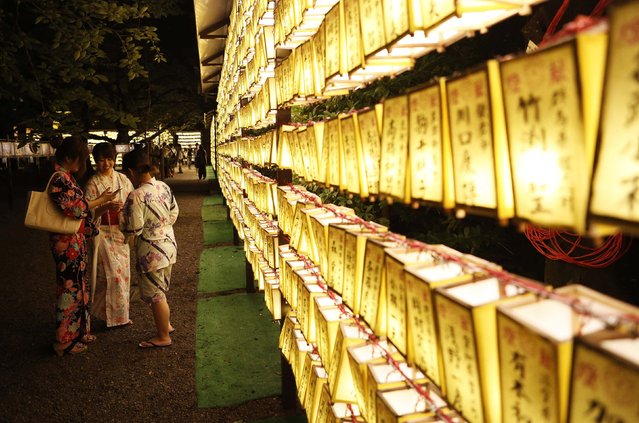
Women in kimonos look at pictures they took in front of paper lanterns during the annual Mitama Festival at the Yasukuni Shrine in Tokyo July 13, 2014. Over 30,000 lanterns light up the precincts of the shrine, where more than 2.4 million war dead are enshrined, during the four-day festival. The festival goes on till July 16. (Photo by Yuya Shino/Reuters)

Women in kimonos look at pictures they took in front of paper lanterns during the annual Mitama Festival at the Yasukuni Shrine in Tokyo July 13, 2014. Over 30,000 lanterns light up the precincts of the shrine, where more than 2.4 million war dead are enshrined, during the four-day festival. The festival goes on till July 16. (Photo by Yuya Shino/Reuters)
Details
15 Jul 2014 10:41:00
Young Japanese women dressed in colourful Kimonos take a photo of themselves as they gather for a ceremony marking the 'Coming of Age Day' at the Toshimaen Amusement Park in Tokyo, Japan, 11 January 2016. The Coming of Age Day is the day to celebrate young people who turn 20 years old while the age of 20 is considered the beginning of adulthood and is the minimum legal age for voting, drinking and smoking in Japan. (Photo by Kiyoshi Ota/EPA)

Young Japanese women dressed in colourful Kimonos take a photo of themselves as they gather for a ceremony marking the “Coming of Age Day” at the Toshimaen Amusement Park in Tokyo, Japan, 11 January 2016. The Coming of Age Day is the day to celebrate young people who turn 20 years old while the age of 20 is considered the beginning of adulthood and is the minimum legal age for voting, drinking and smoking in Japan. (Photo by Kiyoshi Ota/EPA)
Details
13 Jan 2016 08:02:00
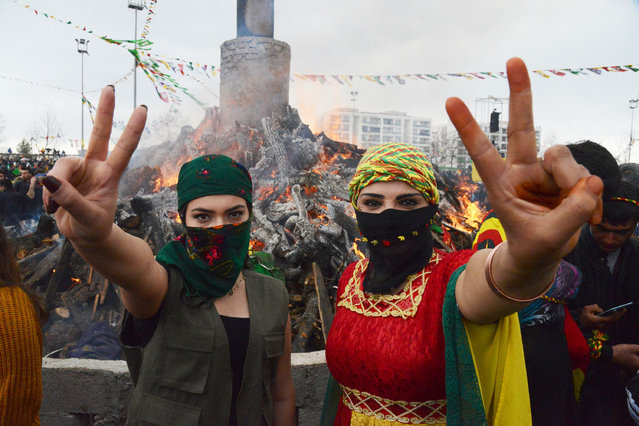
Young women flash the victory sign in front of a bonfire as Turkish Kurds gather during Newroz celebrations for the new year in Diyarbakir, southeastern Turkey, on March 21, 2017. Newroz (also known as Nawroz or Nowruz) is an ancient Persian festival, which is also celebrated by Kurdish people, marking the first day of spring, which falls on March 21. (Photo by Ilyas Akengin/AFP Photo)

Young women flash the victory sign in front of a bonfire as Turkish Kurds gather during Newroz celebrations for the new year in Diyarbakir, southeastern Turkey, on March 21, 2017. Newroz (also known as Nawroz or Nowruz) is an ancient Persian festival, which is also celebrated by Kurdish people, marking the first day of spring, which falls on March 21. (Photo by Ilyas Akengin/AFP Photo)
Details
22 Mar 2017 09:51:00
Iraqi women cry over their brother's body, who was killed by a mortar shell fired by Islamic State (IS) group jihadists on civilians who were gathered to receive aid, in Al-Risala neighbourhood on March 22, 2017, as an ongoing offensive by Iraqi forces to retake the city from the group continues. Iraqi forces launched a major operation to recapture west Mosul – the most-populated urban area still held by IS – on February 19, and have retaken a series of neighbourhoods from the jihadists. (Photo by Ahmad Al-Rubaye/AFP Photo)

Iraqi women cry over their brother's body, who was killed by a mortar shell fired by Islamic State (IS) group jihadists on civilians who were gathered to receive aid, in Al-Risala neighbourhood on March 22, 2017, as an ongoing offensive by Iraqi forces to retake the city from the group continues. Iraqi forces launched a major operation to recapture west Mosul – the most-populated urban area still held by IS – on February 19, and have retaken a series of neighbourhoods from the jihadists. (Photo by Ahmad Al-Rubaye/AFP Photo)
Details
27 Mar 2017 08:30:00
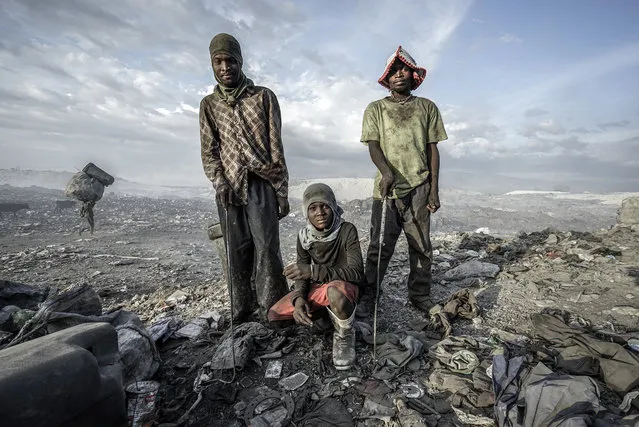
In a 200-acre-plus dump 5 kilometers north of Haiti’s capital, Port-au-Prince, hundreds of men, women and children scavenge day and night through the burning wasteland. They earn $12 to $15 a day – on a good day – for recycling plastics as well as clothing, household items and aluminum (for smelting). Some 5,000 tons of waste is created each day in the Port-au-Prince area. (Photo and caption by Giles Clarke/Getty Images Reportage)

In a 200-acre-plus dump 5 kilometers north of Haiti’s capital, Port-au-Prince, hundreds of men, women and children scavenge day and night through the burning wasteland. They earn $12 to $15 a day – on a good day – for recycling plastics as well as clothing, household items and aluminum (for smelting). Some 5,000 tons of waste is created each day in the Port-au-Prince area. (Photo and caption by Giles Clarke/Getty Images Reportage)
Details
02 Feb 2015 11:21:00