Loading...
Done
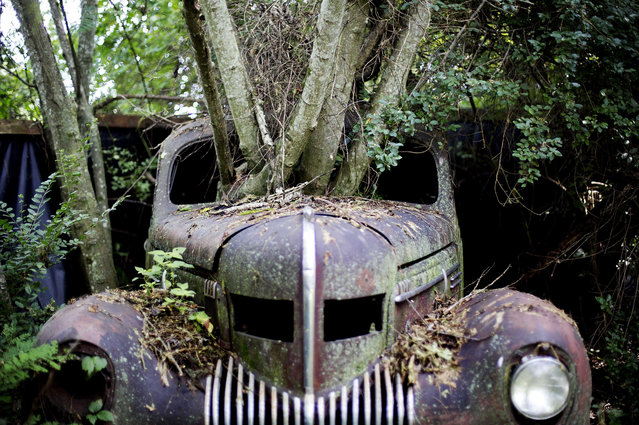
Trees grow through the windshield of a 1937 Chrysler Imperial as it sits at Old Car City, the world's largest known classic car junkyard Thursday, July 16, 2015, in White, Ga. Many of the cars have never moved in over 30 years and in some cases, trees now grow through them, even lifting some off the ground. (Photo by David Goldman/AP Photo)

Trees grow through the windshield of a 1937 Chrysler Imperial as it sits at Old Car City, the world's largest known classic car junkyard Thursday, July 16, 2015, in White, Ga. Over 4,000 classic cars decorate 32 acres of forest which have been turned into a junkyard museum by owner Walter Dean Lewis. The two grew up playing in the cars on the lot which started as a general store selling auto parts in 1931 by Lewis' parents. Lewis stopped selling parts about six years ago when he realized he could sustain the business more as a museum, charging $15 for visitors just looking, and $25 for photographers. Many of the cars have never moved in over 30 years and in some cases, trees now grow through them, even lifting some off the ground. (Photo by David Goldman/AP Photo)
Details
17 Jul 2015 13:14:00
People take pictures of the Tribute in Light while it is illuminated next to the Statue of Liberty (C), One World Trade Center and the Empire State Building during events marking the 14th anniversary of the 9/11 attacks on the World Trade Center in New York September 11, 2015. (Photo by Eduardo Munoz/Reuters)

People take pictures of the Tribute in Light while it is illuminated next to the Statue of Liberty (C), One World Trade Center and the Empire State Building during events marking the 14th anniversary of the 9/11 attacks on the World Trade Center in New York September 11, 2015. (Photo by Eduardo Munoz/Reuters)
Details
13 Sep 2015 12:22:00
A visitor jumps for a photograph on the world's highest and longest glass-bottomed bridge  above a valley in Zhangjiajie in China's Hunan Province on August 21, 2016. The bridge, which opened to the public on a trial basis on Saturday, spans 430 meters (1,410 feet) and rises about 300 meters (984 feet) above a valley in a scenic zone, making it the world's highest and longest glass-bottomed bridge according to Chinese state media. (Photo by Fred Dufour/AFP Photo)

A visitor jumps for a photograph on the world's highest and longest glass-bottomed bridge above a valley in Zhangjiajie in China's Hunan Province on August 21, 2016. The bridge, which opened to the public on a trial basis on Saturday, spans 430 meters (1,410 feet) and rises about 300 meters (984 feet) above a valley in a scenic zone, making it the world's highest and longest glass-bottomed bridge according to Chinese state media. (Photo by Fred Dufour/AFP Photo)
Details
22 Aug 2016 13:19:00
Revellers take part in the Children's Day parade of the Notting Hill Carnival in London, Britain, 28 August 2016. The street festival celebrates this year its 52nd anniversary and more than a million people are expected to attend on 28 and 29 August. (Photo by Will Oliver/EPA)

Revellers take part in the Children's Day parade of the Notting Hill Carnival in London, Britain, 28 August 2016. The street festival celebrates this year its 52nd anniversary and more than a million people are expected to attend on 28 and 29 August. (Photo by Will Oliver/EPA)
Details
29 Aug 2016 07:32:00
A dhobi, or a washerman washes cloths on the banks of the River Gomti in Lucknow, India, Saturday, September 12, 2020. Dhobis are traditional laundry workers who wash clothes by hand and dry them in the sun, an occupation which has been in existence for generations. Most cities in India have a Dhobi Ghat, or washermen's area, where the city's pile of clothes is laundered. This practice is still popular in India, despite of modern technology. Around 1,000 families work in Lucknow's Dhobi Ghat. However, in light of the novel coronavirus, their wages have decreased drastically. With each family earning around US$100-200 per month. (Photo by Rajesh Kumar Singh/AP Photo)

A dhobi, or a washerman washes cloths on the banks of the River Gomti in Lucknow, India, Saturday, September 12, 2020. Dhobis are traditional laundry workers who wash clothes by hand and dry them in the sun, an occupation which has been in existence for generations. Most cities in India have a Dhobi Ghat, or washermen's area, where the city's pile of clothes is laundered. This practice is still popular in India, despite of modern technology. Around 1,000 families work in Lucknow's Dhobi Ghat. However, in light of the novel coronavirus, their wages have decreased drastically. With each family earning around US$100-200 per month. (Photo by Rajesh Kumar Singh/AP Photo)
Details
25 Sep 2020 00:03:00
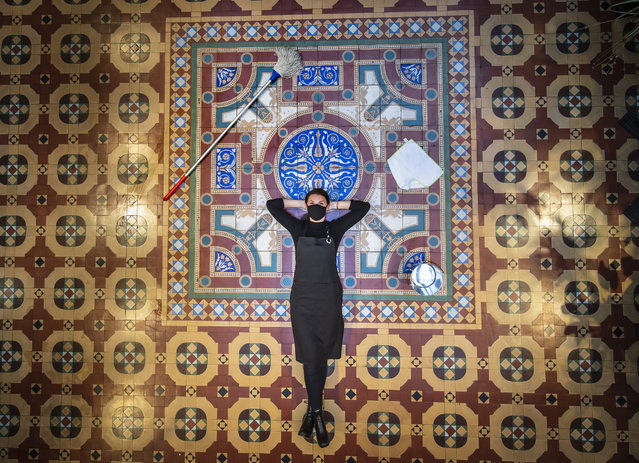
Bar Convent employee Lauren Masterman relaxes after cleaning a historic George and Arthur Maw tiled floor created in 1867, one of only two surviving examples of this assemblage of tiles, at England's oldest living convent Bar Convent on October 13, 2020. Visitors to the convent are being invited to follow in the footsteps of residents from the last 150 years and enjoy the historic space decorated with rare 19th century floor tiles. (Photo by Danny Lawson/PA Images via Getty Images)

Bar Convent employee Lauren Masterman relaxes after cleaning a historic George and Arthur Maw tiled floor created in 1867, one of only two surviving examples of this assemblage of tiles, at England's oldest living convent Bar Convent on October 13, 2020. Visitors to the convent are being invited to follow in the footsteps of residents from the last 150 years and enjoy the historic space decorated with rare 19th century floor tiles. (Photo by Danny Lawson/PA Images via Getty Images)
Details
15 Oct 2020 00:07:00
A CIT guard carries his gun handgun while bringing a bag containing cash inside an armoured vehicle during a money collection in Johannesburg's CBD, on December 8, 2020. As the Christmas festive season approaches, cash-in-transit (CIT) companies are gearing up as they continue to be target of crime, with about 3000 money vans traveling daily nationwide. Despite the COVID-19 lockdown, there have been 260 cash-in-transit heist incidents in South Africa this year, with 19 CIT crew members killed. Cash-in-transit heists in the country are often military-style planned operations with criminals recurring to bomb making and assault rifles attacks. (Photo by Michele Spatari/AFP Photo)

A CIT guard carries his gun handgun while bringing a bag containing cash inside an armoured vehicle during a money collection in Johannesburg's CBD, on December 8, 2020. As the Christmas festive season approaches, cash-in-transit (CIT) companies are gearing up as they continue to be target of crime, with about 3000 money vans traveling daily nationwide. Despite the COVID-19 lockdown, there have been 260 cash-in-transit heist incidents in South Africa this year, with 19 CIT crew members killed. Cash-in-transit heists in the country are often military-style planned operations with criminals recurring to bomb making and assault rifles attacks. (Photo by Michele Spatari/AFP Photo)
Details
18 Dec 2020 00:01:00
Two men look at the sea while taking part in the annual New Year's dive into the North Sea in Scheveningen, Netherlands on January 1, 2020. (Photo by Piroschka van de Wouw/Reuters)

Two men look at the sea while taking part in the annual New Year's dive into the North Sea in Scheveningen, Netherlands on January 1, 2020. (Photo by Piroschka van de Wouw/Reuters)
Details
29 Dec 2020 00:01:00