Loading...
Done
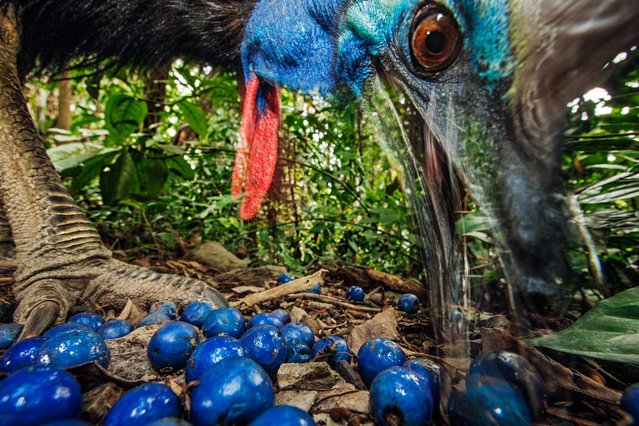
“Cassowaries are large, flightless birds related to emus and (more distantly) to ostriches, rheas, and kiwis”, writes Olivia Judson in the September issue of National Geographic magazine. (Photo by Christian Ziegler/National Geographic)

“Cassowaries are large, flightless birds related to emus and (more distantly) to ostriches, rheas, and kiwis”, writes Olivia Judson in the September issue of National Geographic magazine. How large? People-size: Adult males stand well over five foot five and top 110 pounds. Females are even taller, and can weigh more than 160 pounds. Dangerous when roused, they’re shy and peaceable when left alone. But even birds this big and tough are prey to habitat loss. The dense New Guinea and Australia rain forests where they live have dwindled. Today cassowaries might number 1,500 to 2,000. And because they help shape those same forests – by moving seeds from one place to another – “if they vanish”, Judson writes, “the structure of the forest would gradually change” too. (Photo by Christian Ziegler/National Geographic)
Details
06 Jan 2014 12:21:00
Indian dancers paint their body like tigers as they perform a Tiger dance during the International day of the Tiger in Calcutta, India, July 29, 2015. Students of Calcutta are taking part in an awareness campaign aiming to draw attention to the threats that tigers face due to habitat loss and poaching. (Photo by Piyal Adhikary/EPA)

Indian dancers paint their body like tigers as they perform a Tiger dance during the International day of the Tiger in Calcutta, India, July 29, 2015. Students of Calcutta are taking part in an awareness campaign aiming to draw attention to the threats that tigers face due to habitat loss and poaching. (Photo by Piyal Adhikary/EPA)
Details
30 Jul 2015 12:47:00
A woman sits as she gets a tattoo on her leg during the annual Panama City Ink Fest in Panama City August 16, 2015. (Photo by Carlos Jasso/Reuters)

A woman sits as she gets a tattoo on her leg during the annual Panama City Ink Fest in Panama City August 16, 2015. (Photo by Carlos Jasso/Reuters)
Details
18 Aug 2015 14:40:00
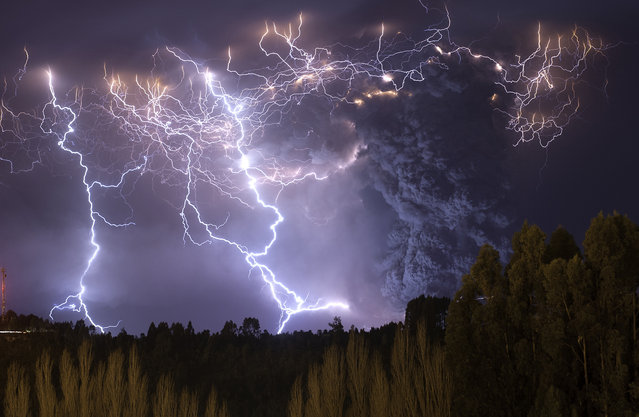
The eruption of Cordon Caulle began on June 4, 2011, located in the Region of Los Rios in Chile. For about 12 months, people and animals became accustomed to living with the daily fall of ash, which also caused problems in the air traffic in South America. The explosions and lightning during first days of the eruption could be seen from hundreds of miles around. This photograph was taken on the second night of eruption from the town of Lago Ranco. (Photo and caption by Francisco Negroni/National Geographic Traveler Photo Contest)

The eruption of Cordon Caulle began on June 4, 2011, located in the Region of Los Rios in Chile. For about 12 months, people and animals became accustomed to living with the daily fall of ash, which also caused problems in the air traffic in South America. The explosions and lightning during first days of the eruption could be seen from hundreds of miles around. This photograph was taken on the second night of eruption from the town of Lago Ranco. (Photo and caption by Francisco Negroni/National Geographic Traveler Photo Contest)

ATTENTION! All pictures are presented in high resolution. To see Hi-Res images – just TWICE click on any picture. In other words, click small picture – opens the BIG picture. Click BIG picture – opens VERY BIG picture.
Details
23 Jun 2013 11:24:00
Models walk down the runway during the Addition Elle/Ashley Graham Lingerie Collection fashion show during the Spring 2016 Style 360 on September 15, 2016 in New York City. (Photo by Fernando Leon/Getty Images)

Models walk down the runway during the Addition Elle/Ashley Graham Lingerie Collection fashion show during the Spring 2016 Style 360 on September 15, 2016 in New York City. (Photo by Fernando Leon/Getty Images)
Details
16 Sep 2015 14:22:00
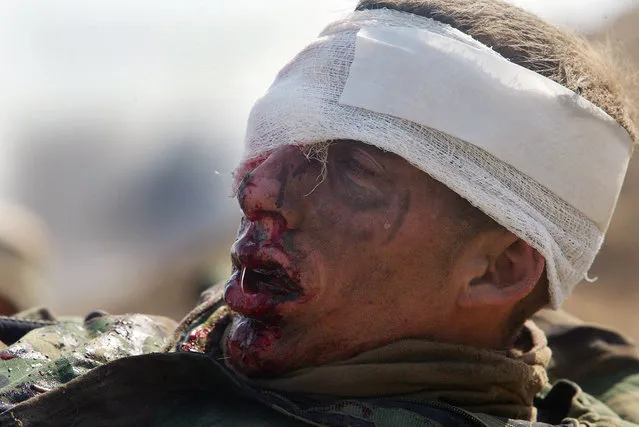
U.S. Marine Lt. Ben Reid from 1/2 Charlie Company of Task Force Tarawa waits to be medivaced after being hit with shrapnel and a machine gun round, in the southern Iraqi city of Nasiriyah, on March 23, 2003. The Marines suffered a number of deaths and casualties during gun battles throughout the city. (Photo by Joe Raedle/The Atlantic)

U.S. Marine Lt. Ben Reid from 1/2 Charlie Company of Task Force Tarawa waits to be medivaced after being hit with shrapnel and a machine gun round, in the southern Iraqi city of Nasiriyah, on March 23, 2003. The Marines suffered a number of deaths and casualties during gun battles throughout the city. (Photo by Joe Raedle via The Atlantic)
Details
20 Mar 2013 08:50:00