Loading...
Done
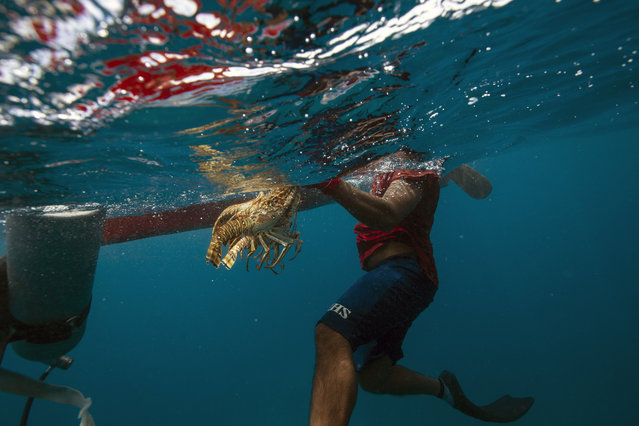
In this September 9, 2018 photo, a diver holds onto his catch of lobsters during a fishing journey in the Miskito coast near Cay Savannah, Honduras. A diver makes 75 lempiras ($3) per pound of lobster. An average 10-pound daily haul of lobster is a windfall for people in one of the most impoverished regions of the Americas, so many take the risk, and many suffer for it. (Photo by Rodrigo Abd/AP Photo)

In this September 9, 2018 photo, a diver holds onto his catch of lobsters during a fishing journey in the Miskito coast near Cay Savannah, Honduras. A diver makes 75 lempiras ($3) per pound of lobster. An average 10-pound daily haul of lobster is a windfall for people in one of the most impoverished regions of the Americas, so many take the risk, and many suffer for it. (Photo by Rodrigo Abd/AP Photo)
Details
23 Jan 2019 00:01:00
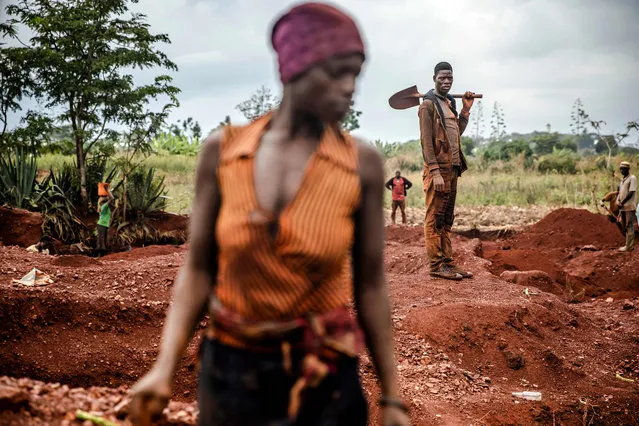
A gold miner observes from the distance how some women miners work at an open-pit gold mine in Nyarugusu, Geita Region, Tanzania on May 27, 2022. Tanzania is a land rich in minerals and one of the main gold producers in Africa, with gold representing more than 90% of the country's mineral exports. Artisanal and small-scale gold mining have culturally and historically relegated women's participation. The extractive sector in Tanzania has historically been a male-dominated industry with high levels of harassment, sеxual abuse, discrimination and misconceptions over women's involvement, and contributions following traditional beliefs. (Photo by Luis Tato/AFP Photo)

A gold miner observes from the distance how some women miners work at an open-pit gold mine in Nyarugusu, Geita Region, Tanzania on May 27, 2022. Tanzania is a land rich in minerals and one of the main gold producers in Africa, with gold representing more than 90% of the country's mineral exports. Artisanal and small-scale gold mining have culturally and historically relegated women's participation. The extractive sector in Tanzania has historically been a male-dominated industry with high levels of harassment, sеxual abuse, discrimination and misconceptions over women's involvement, and contributions following traditional beliefs. (Photo by Luis Tato/AFP Photo)
Details
13 Jun 2022 04:31:00
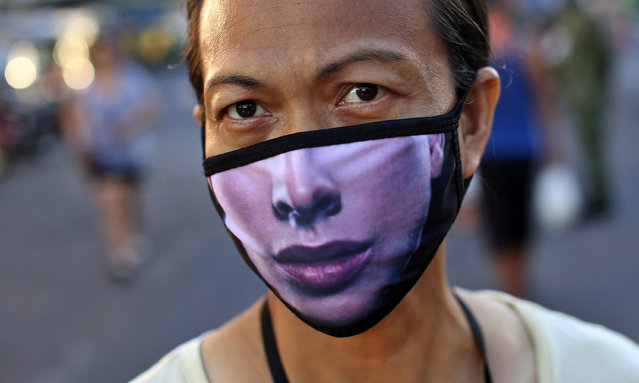
A Filipino woman wears a mask to try and protect against the spread of coronavirus in Malate district, Manila City on March 24, 2020. The Philippines has taken drastic measures to combat the spread of Covid-19. The entire country is under strict quarantine and the army is on the streets to monitor compliance. According to official figures, there are 462 positive cases and 33 dead in the Philippines, but it is thought that thousands of cases remain undetected due to lack of resources in a country where millions of people have no access to health care. In the poorest and most crowded areas, it’s almost impossible to adhere to the physical distancing required during quarantine. (Photo by Alejandro Ernesto/The Guardian)

A Filipino woman wears a mask to try and protect against the spread of coronavirus in Malate district, Manila City on March 24, 2020. The Philippines has taken drastic measures to combat the spread of Covid-19. The entire country is under strict quarantine and the army is on the streets to monitor compliance. According to official figures, there are 462 positive cases and 33 dead in the Philippines, but it is thought that thousands of cases remain undetected due to lack of resources in a country where millions of people have no access to health care. In the poorest and most crowded areas, it’s almost impossible to adhere to the physical distancing required during quarantine. (Photo by Alejandro Ernesto/The Guardian)
Details
08 Apr 2020 00:01:00
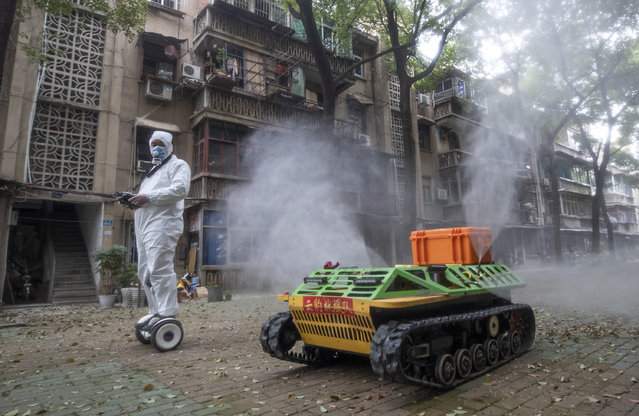
A volunteer operates a remote controlled disinfection robot to disinfect a residental area amid the COVID-19 coronavirus outbreak in Wuhan in China's central Hubei province on March 16, 2020. China tightened quarantine measures for international arrivals on March 16 as the country worries about a rise in imported cases of the deadly coronavirus and anger rages online at how Europe and the United States are handling the pandemic. (Photo by AFP Photo/China Stringer Network)

A volunteer operates a remote controlled disinfection robot to disinfect a residental area amid the COVID-19 coronavirus outbreak in Wuhan in China's central Hubei province on March 16, 2020. China tightened quarantine measures for international arrivals on March 16 as the country worries about a rise in imported cases of the deadly coronavirus and anger rages online at how Europe and the United States are handling the pandemic. (Photo by AFP Photo/China Stringer Network)
Details
18 Mar 2020 00:07:00
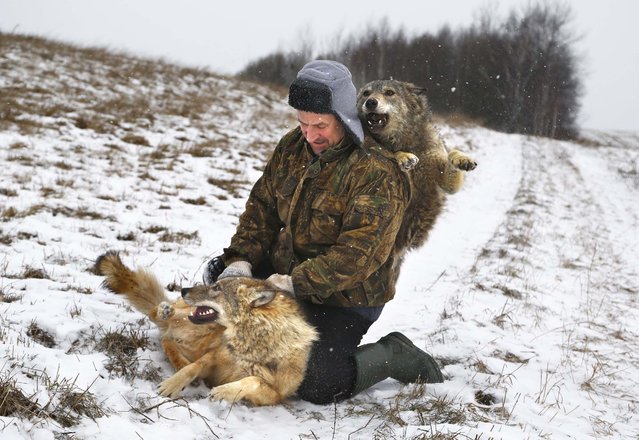
Belarusian Sergei Selekh plays with his 6-month-old tamed wolves on the outskirts of the village of Gaina, 45 kilometers (28 miles) north of Belarus capital Minsk, Wednesday, December 31, 2014. Selekh owns a farmstead, where sheep, wolves and an ethnographic museum serve as entertainment for guests. (Photo by Sergei Grits/AP Photo)

Belarusian Sergei Selekh plays with his 6-month-old tamed wolves on the outskirts of the village of Gaina, 45 kilometers (28 miles) north of Belarus capital Minsk, Wednesday, December 31, 2014. Selekh owns a farmstead, where sheep, wolves and an ethnographic museum serve as entertainment for guests. (Photo by Sergei Grits/AP Photo)
Details
03 Jan 2015 12:51:00
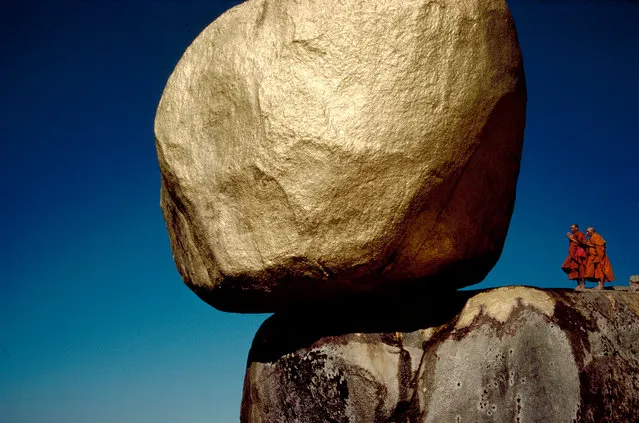
Kyaiktiyo, Burma, 1978. The Golden Rock at Shwe Pyi Daw (the Golden Country), the Buddhist holy place. Hiroji Kubota writes: “I was desperate to keep a distance from America for a while; luckily, I found Burma and its gentle and compassionate people. In the spring of 1978, on the top of the hill where I took this photo, I had two Leica bodies: the one with Tri-X and the other with Kodachrome 64. Soon after, I realised that the colour one looked very colourful and was more powerful. That was my decisive moment, to become a colour photographer”. (Photo by Hiroji Kubota/Magnum Photos)

Kyaiktiyo, Burma, 1978. The Golden Rock at Shwe Pyi Daw (the Golden Country), the Buddhist holy place. Hiroji Kubota writes: “I was desperate to keep a distance from America for a while; luckily, I found Burma and its gentle and compassionate people. In the spring of 1978, on the top of the hill where I took this photo, I had two Leica bodies: the one with Tri-X and the other with Kodachrome 64. Soon after, I realised that the colour one looked very colourful and was more powerful. That was my decisive moment, to become a colour photographer”. (Photo by Hiroji Kubota/Magnum Photos)
Details
10 Jun 2016 13:30:00
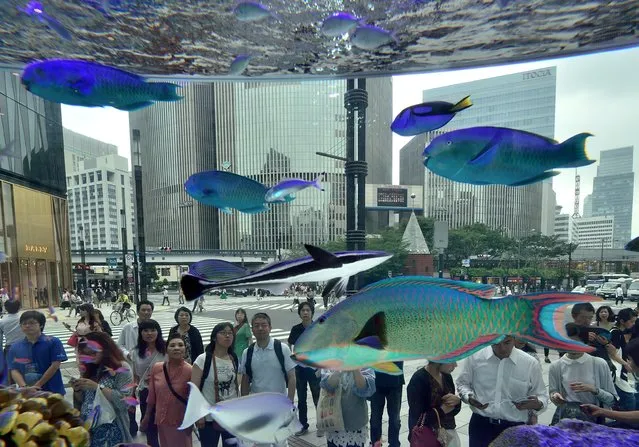
Visitors look at tropical fish transported from Japan's southern island of Okinawa displayed in a giant 14-ton fish tank at the Sony Square event space in Tokyo on July 17, 2016. The 45-day-long summer exhibition will be held through August 28 to display sea creatures common to the waters around Okinawa. (Photo by Kazuhiro Nogi/AFP Photo)

Visitors look at tropical fish transported from Japan's southern island of Okinawa displayed in a giant 14-ton fish tank at the Sony Square event space in Tokyo on July 17, 2016. The 45-day-long summer exhibition will be held through August 28 to display sea creatures common to the waters around Okinawa. (Photo by Kazuhiro Nogi/AFP Photo)
Details
18 Jul 2016 13:05:00
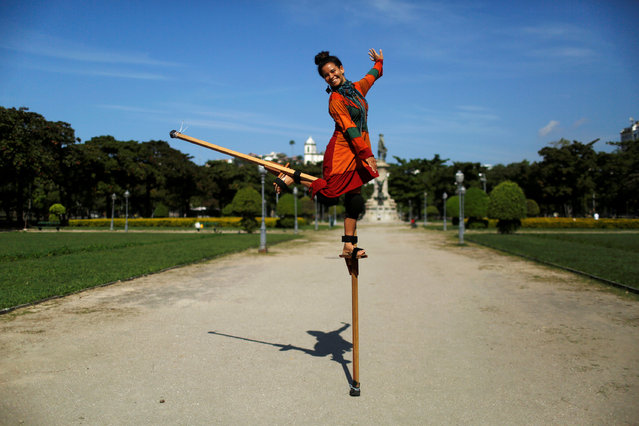
Raquel Poti, a 32-year-old street artist, poses at a park in Rio de Janeiro, Brazil, June 25, 2016. Raquel thinks the Olympics promotes a lifestyle that combines sports, culture and education. She is concerned about the large investment for the event while the population needs improvements in basic services. (Photo by Pilar Olivares/Reuters)

Just a week before Rio de Janeiro hosts South America's first Olympics, city residents expressed mixed feelings about the cost and security of the Games, while holding out hope they will bring joy to a nation facing economic and political crises. The conflicted thoughts mirror a recent survey by the Datafolha polling group showing that half of Brazilians were opposed to holding the Games, while 63 percent think the costs of hosting the event will outweigh benefits. (Photo by Pilar Olivares/Reuters)
Details
03 Aug 2016 11:51:00