Loading...
Done
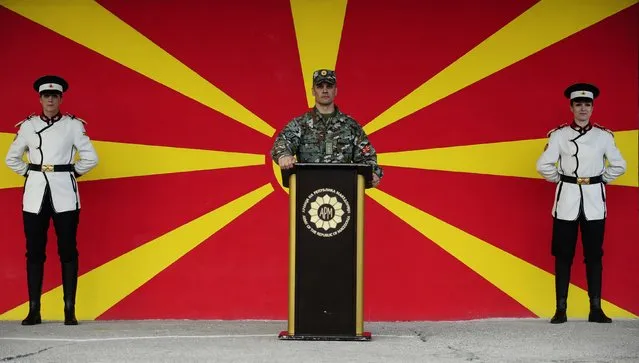
Corporals Verica Zlatevska (L) and Dragana Kitanovska (R) attend an honour guard training session at an army barracks in Skopje March 4, 2015. REUTERS/Ognen Teofilovski (MACEDONIA  - Tags: MILITARY SOCIETY)

Corporals Verica Zlatevska (L) and Dragana Kitanovska (R) attend an honour guard training session at an army barracks in Skopje March 4, 2015. Macedonia's honour army battalion, the ceremonial uniformed guard that receives every foreign president, dignitaries and delegations, but also sees off and welcomes the head of state every time he leaves the country, has a different glow. For the first time in the history of Macedonia's army, the honour guard has two women in its ranks. There has not been an event in which one of them is not in the first row. Zlatevska joined the army in 2003, Kitanovska in 2006. Picture taken March 4, 2015. REUTERS/Ognen Teofilovski (MACEDONIA - Tags: MILITARY SOCIETY)
Details
12 Mar 2015 11:05:00
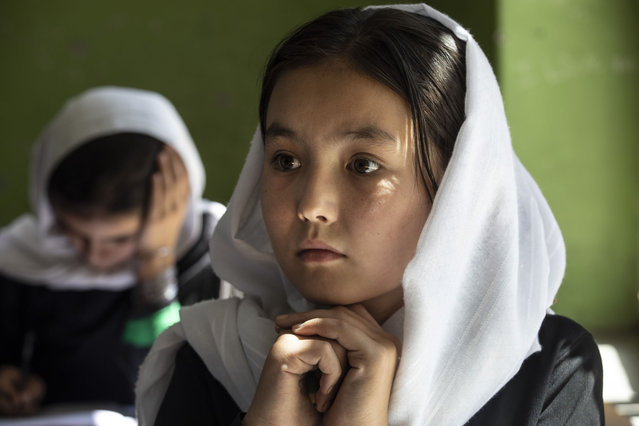
Behishta,11, listens during 4th grade class at the Zarghoona high school on July 25 2021 in Kabul, Afghanistan. The Zarghoona girls high school is the largest in Kabul with 8,500 female students attending classes. The school opened after a nearly two-month break due to the coronavirus (COVID-19) pandemic. Currently there is widespread fear that the Taliban who already control around half the country will reintroduce its notorious system barring girls and women from almost all work, and access to education. The Ministry of Education has announced the opening of schools, but there are  mixed reports in many areas where the Taliban have taken control or where fighting is ongoing. (Photo by Paula Bronstein/Getty Images)

Behishta,11, listens during 4th grade class at the Zarghoona high school on July 25 2021 in Kabul, Afghanistan. The Zarghoona girls high school is the largest in Kabul with 8,500 female students attending classes. The school opened after a nearly two-month break due to the coronavirus (COVID-19) pandemic. (Photo by Paula Bronstein/Getty Images)
Details
12 Aug 2021 08:41:00
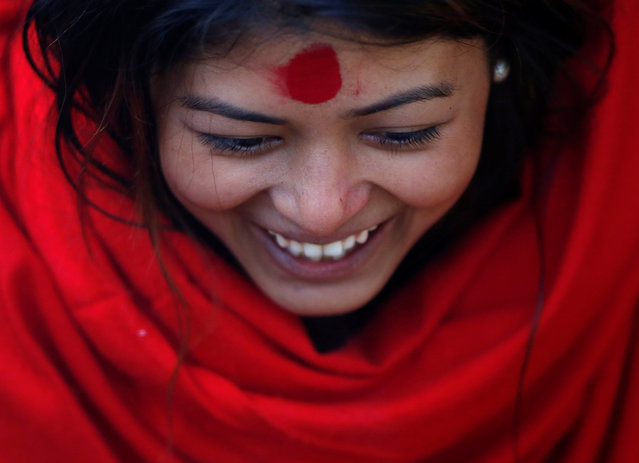
A devotee smiles as she offers prayers during the Swasthani Brata Katha festival in Kathmandu, Nepal January 12, 2017. (Photo by Navesh Chitrakar/Reuters)

A devotee smiles as she offers prayers during the Swasthani Brata Katha festival in Kathmandu, Nepal January 12, 2017. (Photo by Navesh Chitrakar/Reuters)
Details
08 Feb 2017 00:00:00
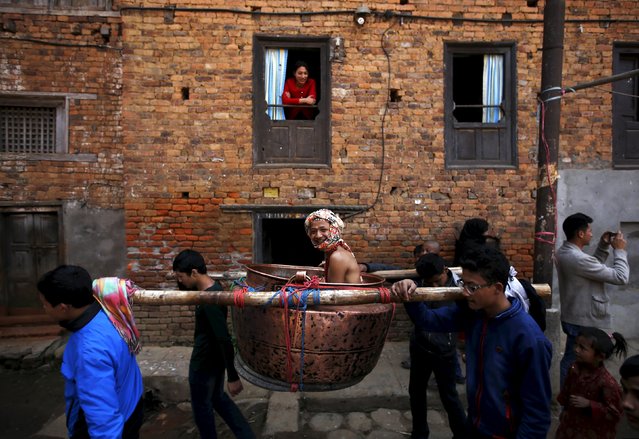
A devotee is carried around town in a vessel as part of rituals during the Swasthani Bratakatha festival at Thecho in Lalitpur, Nepal, February 19, 2016. During the month long festival, devotees recite one chapter of a Hindu tale daily from the 31-chapter sacred Swasthani Brata Katha book that is dedicated to God Madhavnarayan and Goddess Swasthani, alongside various other gods and goddess and the miraculous feats performed by them. (Photo by Navesh Chitrakar/Reuters)

A devotee is carried around town in a vessel as part of rituals during the Swasthani Bratakatha festival at Thecho in Lalitpur, Nepal, February 19, 2016. During the month long festival, devotees recite one chapter of a Hindu tale daily from the 31-chapter sacred Swasthani Brata Katha book that is dedicated to God Madhavnarayan and Goddess Swasthani, alongside various other gods and goddess and the miraculous feats performed by them. (Photo by Navesh Chitrakar/Reuters)
Details
21 Feb 2016 11:32:00
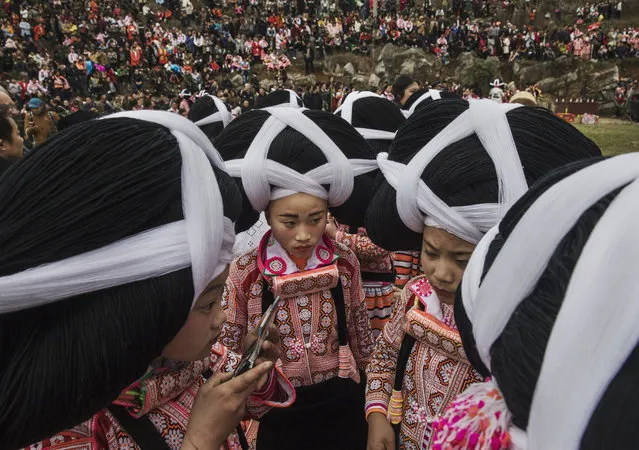
Girls of the Long Horn Miao ethnic minority group wear headdresses as they prepare gather for Tiaohua or Flower Festival as part of the Lunar New Year on February 6, 2017 in Longga village, Guizhou province, southern China. The Long Horn Miao are recognized for their declining practice of wrapping a blend of linen, wool, and the hair of their ancestors around animal horns or a wooden clip to make headdresses. Many young women say they now wear the headdresses only for special occasions and festivals, as the ornaments, which are attached by the horns to their real hair, have proved impractical for modern daily life in a fast changing world. China officially recognizes 56 different ethnic minorities, and statistics show over 7 million Chinese identifying themselves as Miao. But the small Long Horn Miao community counts only around 5000 people living in 12 villages, whose age-old traditions, language, and culture are fading. It is increasingly difficult in a modernizing China, as young people are drawn from remote rural villages to opportunities in bigger cities amongst wide-scale urbanization. Farming and labour remain the mainstays of life for the Long Horn Miao, leaving the area relatively poor in comparison with many parts of China. The government has invested significant amounts into local infrastructure and the tourism industry to try to bolster the local economy. (Photo by Kevin Frayer/Getty Images)

Girls of the Long Horn Miao ethnic minority group wear headdresses as they prepare gather for Tiaohua or Flower Festival as part of the Lunar New Year on February 6, 2017 in Longga village, Guizhou province, southern China. (Photo by Kevin Frayer/Getty Images)
Details
13 Feb 2017 00:01:00
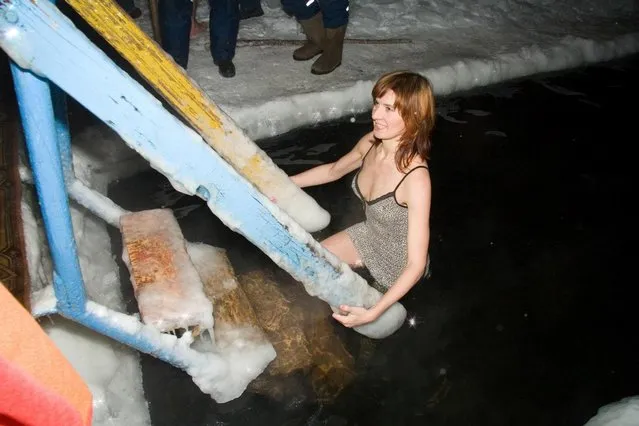
In an observance of Epiphany, Russian Orthodox believers swim in an icy pond outside Nizhny Novgorod, Russia. (Photo by Olga “Zwezdochka”)

In an observance of Epiphany, Russian Orthodox believers swim in an icy pond outside Nizhny Novgorod, Russia. (Photo by Olga “Zwezdochka”)
Details
19 Jan 2013 10:07:00
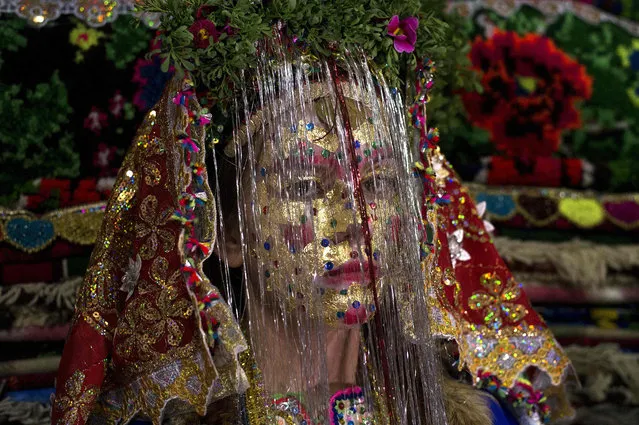
Emilia Pechinkova, a 24-years-old Bulgarian Pomak (Bulgarian speaking Muslims) bride poses for a photograph following the “gelina” or face painting ceremony carried out by female guests and relatives in preparation for her three-day wedding ceremony in the village of Draginovo, 100 kms southeast of Sofia on April 22, 2016. Bulgaria's Muslim population is one of the highest in the European Union. (Photo by Nikolay Doychinov/AFP Photo)

Emilia Pechinkova, a 24-years-old Bulgarian Pomak (Bulgarian speaking Muslims) bride poses for a photograph following the “gelina” or face painting ceremony carried out by female guests and relatives in preparation for her three-day wedding ceremony in the village of Draginovo, 100 kms southeast of Sofia on April 22, 2016. Bulgaria's Muslim population is one of the highest in the European Union. During the Communist regime religious rituals were not tolerated, and Muslims were forced to abandon wearing their traditional wedding outfits. Recently, more young Pomak women want to include traditional wedding customs that were forbidden during the regime, regardless of their secular lifestyles and the high cost of such a wedding. (Photo by Nikolay Doychinov/AFP Photo)
Details
25 Apr 2016 09:55:00
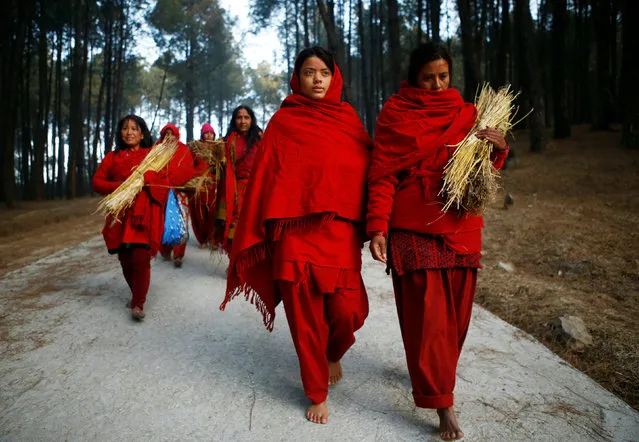
Devotees walk through the woods of Changu Narayan as they arrive to perform rituals and prayers during the Swasthani Bratakatha festival in Bhaktapur, Nepal February 8, 2017. (Photo by Navesh Chitrakar/Reuters)

Devotees walk through the woods of Changu Narayan as they arrive to perform rituals and prayers during the Swasthani Bratakatha festival in Bhaktapur, Nepal February 8, 2017. (Photo by Navesh Chitrakar/Reuters)
Details
12 Feb 2017 00:05:00