Loading...
Done
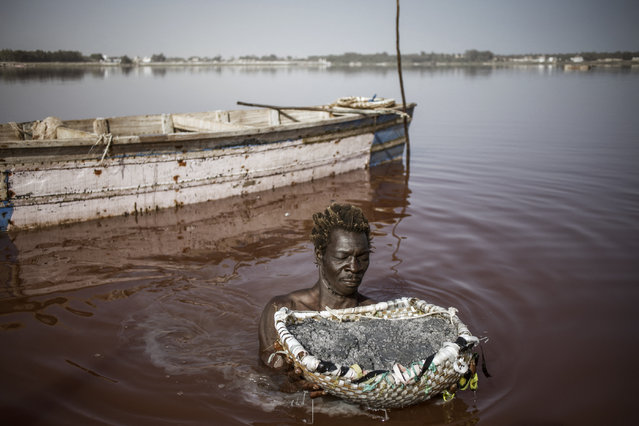
Toure, a Gambian salt harvester, holds a basket filled with  the salt collected from the crust of the bottom of the Lake Retba (Pink Lake) in Senegal on March 16, 2021. Lake Retba, divided from the Atlantic Ocean by a narrow corridor of dunes, owes its name to the pink waters caused by the Dunaliella salina algae and is known for its high salt content, up to 40% in some areas. (Photo by Marco Longari/AFP Photo)

Toure, a Gambian salt harvester, holds a basket filled with the salt collected from the crust of the bottom of the Lake Retba (Pink Lake) in Senegal on March 16, 2021. Lake Retba, divided from the Atlantic Ocean by a narrow corridor of dunes, owes its name to the pink waters caused by the Dunaliella salina algae and is known for its high salt content, up to 40% in some areas. (Photo by Marco Longari/AFP Photo)
Details
24 Mar 2021 10:29:00
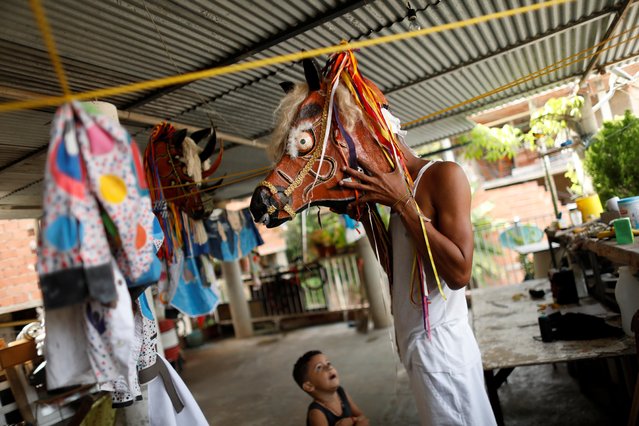
A member of Venezuelan brotherhood “Dancing Devils” wears a horse mask while his nephew looks at him during their annual Corpus Christi celebration with a call for the end of the coronavirus disease (COVID-19), in Naiguata, Venezuela on June 3, 2021. (Photo by Leonardo Fernandez Viloria/Reuters)

A member of Venezuelan brotherhood “Dancing Devils” wears a horse mask while his nephew looks at him during their annual Corpus Christi celebration with a call for the end of the coronavirus disease (COVID-19), in Naiguata, Venezuela on June 3, 2021. (Photo by Leonardo Fernandez Viloria/Reuters)
Details
20 Jul 2021 08:51:00
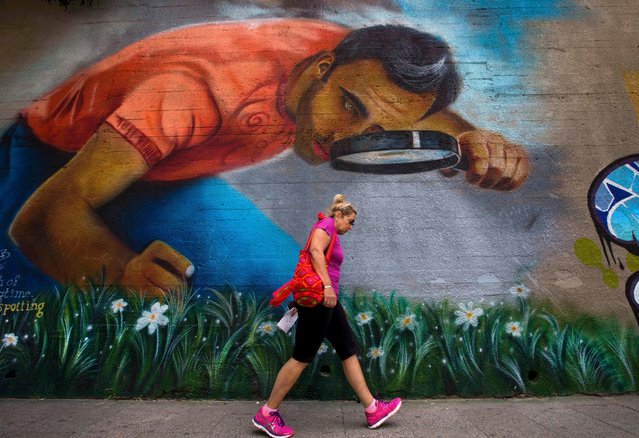
A woman walks past graffiti in Beirut, Lebanon, Wednesday, May 4, 2016. Graffiti artists have been trying to re-engage disillusioned youth in a debate about the country's latest wave of political turmoil. (Photo by Hassan Ammar/AP Photo)

A woman walks past graffiti in Beirut, Lebanon, Wednesday, May 4, 2016. Graffiti artists have been trying to re-engage disillusioned youth in a debate about the country's latest wave of political turmoil. (Photo by Hassan Ammar/AP Photo)
Details
05 May 2016 14:07:00
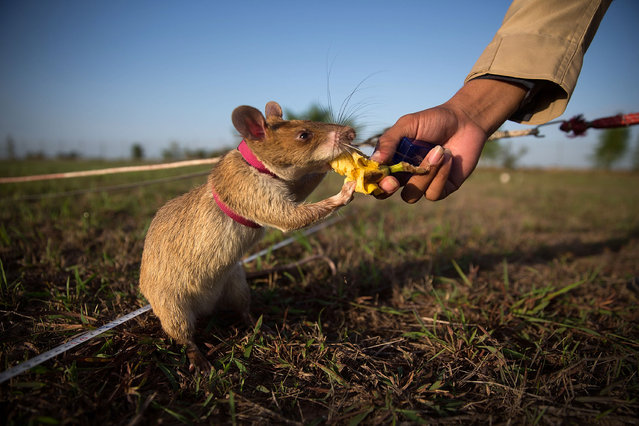
A mine detection rat is given banana as a reward after successfully identifying an inactive mine on July 2, 2015 in Siem Reap, Cambodia. (Photo by Taylor Weidman/Getty Images)

A mine detection rat is given banana as a reward after successfully identifying an inactive mine on July 2, 2015 in Siem Reap, Cambodia. The Cambodian Mine Action Center (CMAC) working with the Belgian NGO APOPO has recently begun testing the feasability of using large mine detection rats from Tanzania to help clear fields of mines and unexploded ordnance in one of the most bombed and mined countries in the world. (Photo by Taylor Weidman/Getty Images)
Details
03 Jul 2015 13:31:00
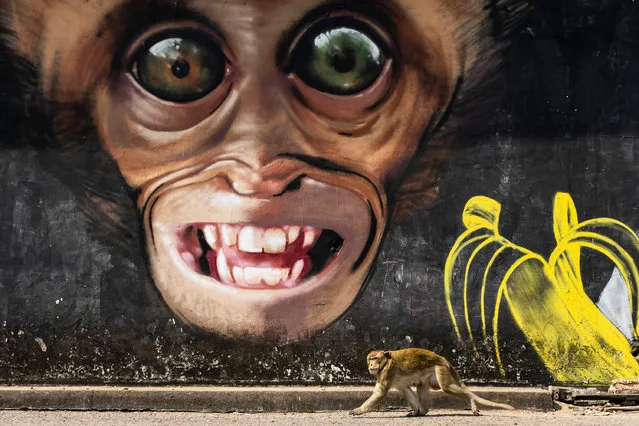
Natural world and wildlife shortlist. Lop Buri in Thailand is home to hundreds of macaques, which local residents consider to be disciples of the Hindu god Hanuman. While some people love them, others fear or even hate them. Despite the inconvenience they often cause, the macaques are generally respected and considered sacred. (Photo by Joan de la Malla/Sony World Photography Awards)

Natural world and wildlife shortlist. Lop Buri in Thailand is home to hundreds of macaques, which local residents consider to be disciples of the Hindu god Hanuman. While some people love them, others fear or even hate them. Despite the inconvenience they often cause, the macaques are generally respected and considered sacred. (Photo by Joan de la Malla/Sony World Photography Awards)
Details
15 Feb 2020 00:05:00
Emily Hicks (not pictured) of Charleston holds her dog Murphy along the waterfront ahead of the arrival of Hurricane Dorian in Charleston, South Carolina, U.S., September 4, 2019. (Photo by Randall Hill/Reuters)

Emily Hicks (not pictured) of Charleston holds her dog Murphy along the waterfront ahead of the arrival of Hurricane Dorian in Charleston, South Carolina, U.S., September 4, 2019. (Photo by Randall Hill/Reuters)
Details
08 Sep 2019 00:03:00
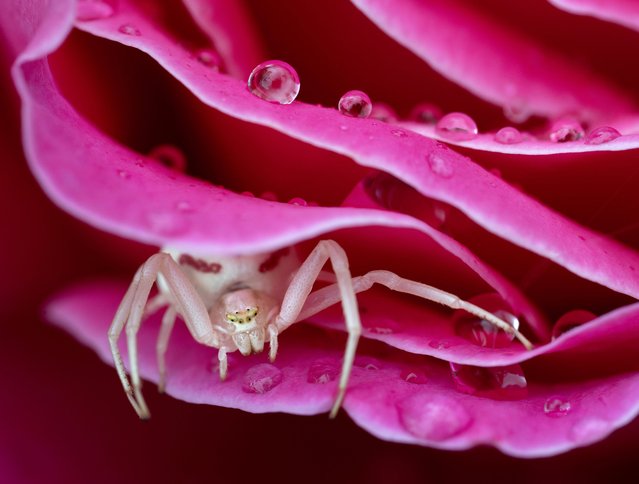
A white crab spider hides between the petals of a rain spotted rose blossom in the garden of a home near Oakland in southwestern Oregon on August 23, 2024. Crab spiders are ambush predators and wait patiently for their prey to approach. (Photo by Robin Loznak/ZUMA Press Wire/Rex Features/Shutterstock)

A white crab spider hides between the petals of a rain spotted rose blossom in the garden of a home near Oakland in southwestern Oregon on August 23, 2024. Crab spiders are ambush predators and wait patiently for their prey to approach. (Photo by Robin Loznak/ZUMA Press Wire/Rex Features/Shutterstock)
Details
31 Aug 2024 03:16:00
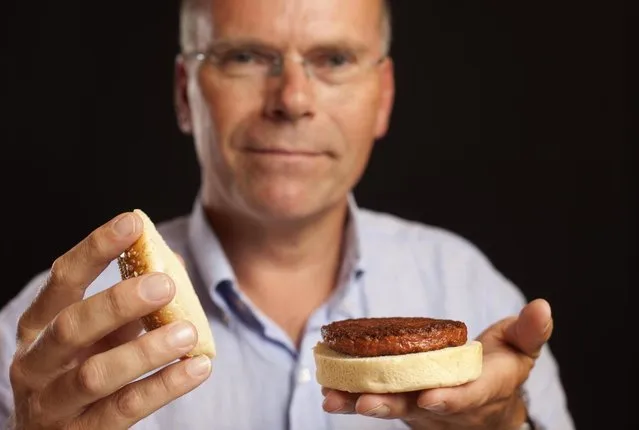
In this handout image provided by Ogilvy, a burger made from cultured beef, which has been developed by Professor Mark Post of Maastricht University in the Netherlands (pictured) is shown to the media during a press conference on August 5, 2013 in London, England. Cultured Beef could help solve the coming food crisis and combat climate change with commercial production of Cultured Beef beginning within ten to twenty years. (Photo by David Parry via Getty Images)

In this handout image provided by Ogilvy, a burger made from cultured beef, which has been developed by Professor Mark Post of Maastricht University in the Netherlands (pictured) is shown to the media during a press conference on August 5, 2013 in London, England. The in-vitro burger, cultured from cattle stem cells, the first example of what its creator says could provide an answer to global food shortages and help combat climate change, was fried in a pan and tasted by two volunteers. The burger is the result of years of research by Dutch scientist Mark Post, a vascular biologist at the University of Maastricht, who is working to show how meat grown in petri dishes might one day be a true alternative to meat from livestock.The meat in the burger has been made by knitting together around 20,000 strands of protein that has been cultured from cattle stem cells in Post's lab. (Photo by David Parry)
Details
06 Aug 2013 08:48:00