Loading...
Done
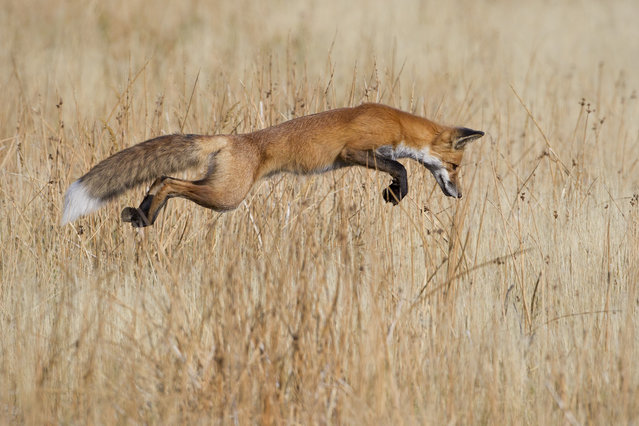
Canada: “Lucky pounce”. (Photo by Connor Stefanison/Wildlife Photographer of the Year 2013)

The winners of The London’s Natural History Museum's prestigious Wildlife Photographer of the Year for 2013 have finally been unveiled. Selected from almost 43,000 entries from 96 countries, the winners offer a glimpse of the stunning array of natural beauty on our planet. Photo: Canada: “Lucky pounce”. “Anticipating the pounce – that was the hardest part”, says Connor, who had come to Yellowstone National Park, Wyoming, USA, in search of wildlife as much as the spectacular landscape. He had found this fox, his first ever, on his last day in the park. It was so absorbed in hunting that Connor had plenty of time to get out of the car and settle behind a rock. It quartered the grassland, back and forth, and then started staring intently at a patch of ground, giving Connor just enough warning of the action to come. When it sprung up, Connor got his shot. And when it landed, the fox got his mouse. (Photo by Connor Stefanison/Wildlife Photographer of the Year 2013)
Details
17 Oct 2013 08:12:00
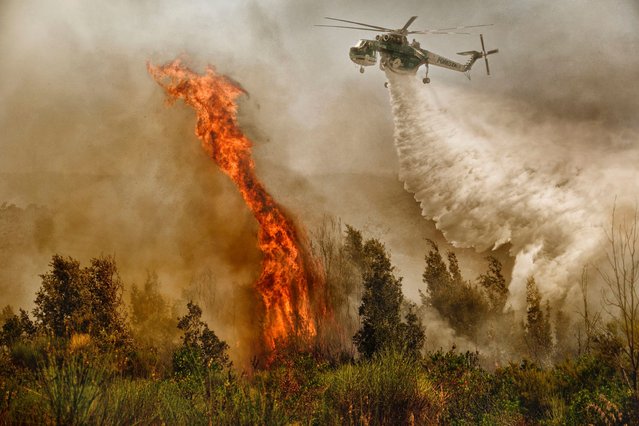
On target: Brave pilots are on a course straight into these enormous flames as they release tonnes of water onto the fire. (Photo by Antonio Grambone/Caters News Agency Ltd)

These are incredible pictures of skilled aircraft pilots flying through raging infernos to put out enormous flames. Daredevil Italian photographer Antonio Grambone, 46, jumped up close to the blaze to capture the incredible images of forest fires in the National Park of Cilento and Vallo di Diano, in the province of Salerno in Italy. At great risk to himself, Antonio captured these incredible shots making them appear like Italian masterpieces.

Photo: On target: Brave pilots are on a course straight into these enormous flames as they release tonnes of water onto the fire. (Photo by Antonio Grambone/Caters News Agency Ltd)
Details
02 Jun 2015 12:14:00
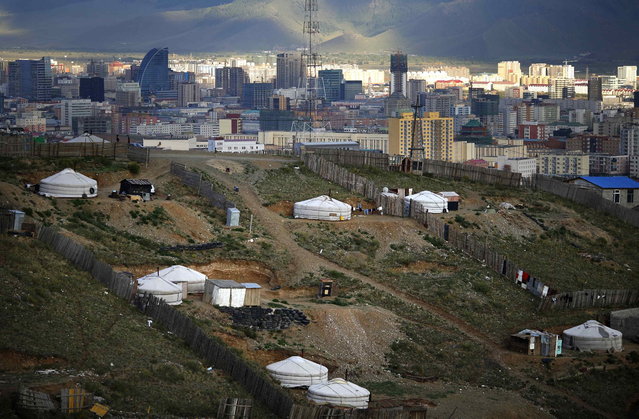
Gers, traditional Mongolian tents, are seen on a hill in an area known as a ger district in Ulan Bator June 26, 2013. (Photo by Carlos Barria/Reuters)

Gers, traditional Mongolian tents, are seen on a hill in an area known as a ger district in Ulan Bator June 26, 2013. Approximately 60 percent of the population of Ulan Bator live in settlements known as ger districts and in many cases residents have limited access to basic services such as water and sanitation. According to a 2010 National Population Center census, every year between thirty and forty thousand people migrate from the countryside to the capital Ulan Bator. Ger districts in the city have been expanding rapidly in recent years. Mongolia is the world's least densely populated country, with 2.8 million people spread across an area around three times the size of France. (Photo by Carlos Barria/Reuters)
Details
11 Aug 2013 11:45:00
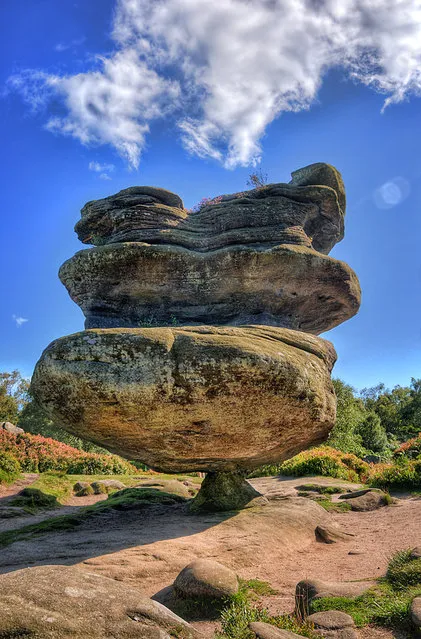
Brimham rocks, Nidderdale North Yorkshire, England

“A balancing rock, also called balanced rock or precarious boulder, is a naturally occurring geological formation featuring a large rock or boulder, sometimes of substantial size, resting on other rocks, bedrock or on glacial till. Some formations known by this name only appear to be balancing but are in fact firmly connected to a base rock by a pedestal or stem”. – Wikipedia

Photo: “The Brimham Rocks are balancing rock formations located on Brimham Moor in North Yorkshire, England. The rocks stand at a height of nearly 30 metres in an area owned by the National Trust which is part of the Nidderdale Area of Outstanding Natural Beauty”. – Wikipedia. (Photo by Tee Time Tony)
Details
06 May 2012 11:45:00
North Korean leader Kim Jong Il inspects a military unit in North Korea

“Kim Jong-il, also written as Kim Jong Il, birth name Yuri Irsenovich Kim (according to Soviet records) (16 February 1941/2 – 17 December 2011), was the supreme Leader of the Democratic People's Republic of Korea (North Korea). He was the General Secretary of the Workers' Party of Korea, the ruling party since 1948, Chairman of the the National Defence Commission of North Korea, and the Supreme Commander of the Korean People's Army, the fourth-largest standing army in the world”. – Wikipedia

Photo: North Korean leader Kim Jong Il inspects a military unit in North Korea. (Photo by Korean Central Television/Yonhap)
Details
19 Dec 2011 10:38:00
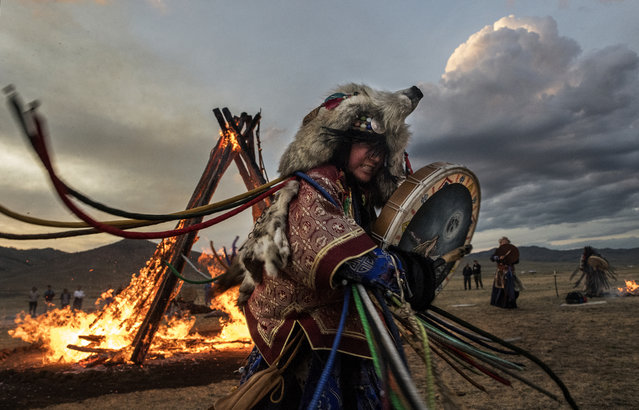
A Mongolian Shamaness or Buu, beats her drum while taking part with others in a fire ritual meant to summon spirits to mark the period of the Summer Solstice in the grasslands on June 22, 2018 outside Ulaanbaatar, Mongolia. (Photo by Kevin Frayer/Getty Images)

A Mongolian Shamaness or Buu, beats her drum while taking part with others in a fire ritual meant to summon spirits to mark the period of the Summer Solstice in the grasslands on June 22, 2018 outside Ulaanbaatar, Mongolia. Banned for 70 years under Communist rule, shamanism has seen a resurgence in Mongolia since 1992, when the ancient practice became protected by the country's Constitution. Known as Tengrism, in which Shamans channel ancestral spirits, it is widely regarded as Mongolia's national religion and part of its indigenous identity. (Photo by Kevin Frayer/Getty Images)
Details
30 Jun 2018 00:05:00
13-year-old Emmanuel Festo from Tanzania poses for a portrait with a plush toy that he says makes him feel safe at night and that he sleeps with, in New York's Staten Island, September 21, 2015. Albino body parts are highly valued in witchcraft and can fetch a high price. Superstition leads many to believe albino children are ghosts who bring bad luck. (Photo by Carlo Allegri/Reuters)

13-year-old Emmanuel Festo from Tanzania poses for a portrait with a plush toy that he says makes him feel safe at night and that he sleeps with, in New York's Staten Island, September 21, 2015. Albino body parts are highly valued in witchcraft and can fetch a high price. Superstition leads many to believe albino children are ghosts who bring bad luck. Some believe the limbs are more potent if the victims scream during amputation, according to a 2013 United Nations report. (Photo by Carlo Allegri/Reuters)
Details
03 Oct 2015 08:04:00
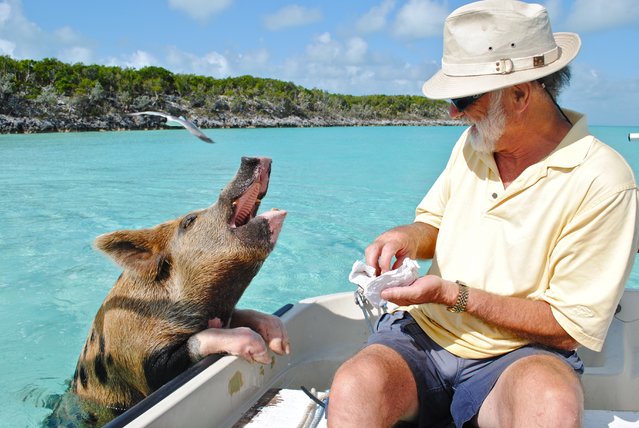
“So you're on a boat in Bahamas and then this pig swims by begging for food”. (Photo and caption by Lisa Larsen/Public Domain)

The Bahamas, the Commonwealth nation of hundreds of islands roughly the size of Connecticut and with population of just a bit over Anaheim, is known for its crystal waters and pristine beaches. This is possibly one of the world’s most beautiful havens of nature, yet people are coming here to see pigs. It is unclear when the pigs first appeared on Exuma Island or where they come from. There’s talk about a daring escape from a shipwreck, or sailors releasing the swine on purpose. In all probability, there were no pigs on this tropical paradise before European settlers came, so their mere presence is the work of human. The intriguing feat of nature, however, is that this population of pigs developed a fine aptitude for swimming. Here: “So you're on a boat in Bahamas and then this pig swims by begging for food”. (Photo and caption by Lisa Larsen/Public Domain)
Details
03 Sep 2015 11:53:00