Loading...
Done
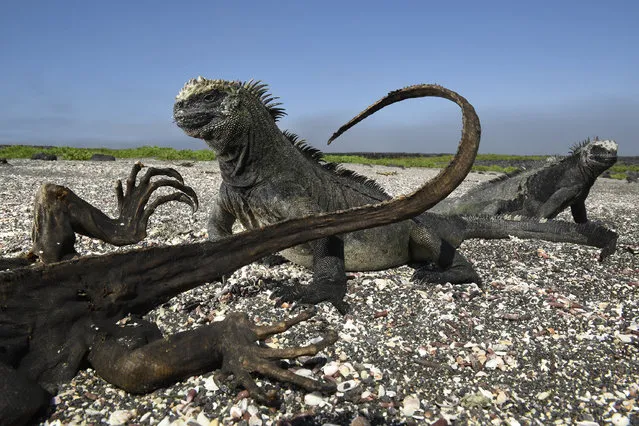
Galapagos – Rocking the Cradle: Four major ocean currents converge along the Galapagos archipelago, creating the conditions for an extraordinary diversity of animal life, April 25, 2016. The islands are home to at least 7,000 flora and fauna species, of which 97 percent of the reptiles, 80 percent of the land birds, 50 percent of the insects and 30 percent of the plants are endemic. The local ecosystem is highly sensitive to the changes in temperature, rainfall and ocean currents that characterize the climatic events known as El Niño and La Niña. These changes cause marked fluctuations in weather and food availability. Many scientists expect the frequency of El Niño and La Niña to increase as a result of climate change, making the Galapagos a possible early-warning location for its effects. (Photo by Thomas P. Peschak for National Geographic/World Press Photo)

Galapagos – Rocking the Cradle: Four major ocean currents converge along the Galapagos archipelago, creating the conditions for an extraordinary diversity of animal life, April 25, 2016. The islands are home to at least 7,000 flora and fauna species, of which 97 percent of the reptiles, 80 percent of the land birds, 50 percent of the insects and 30 percent of the plants are endemic. (Photo by Thomas P. Peschak for National Geographic/World Press Photo)
Details
16 Apr 2018 00:01:00
In this image made from video,  woman protesters march with a sign outside the building housing the Saudi consulate in Sydney, Thursday, January 10, 2019.  Four women held a topless protest in Sydney on Thursday to support runaway Saudi woman Rahaf Mohammed Alqunun, as Australia began considering her bid to settle in the country as a refugee. (Photo by Australia Broadcast Corporation via AP Photo)

In this image made from video, woman protesters march with a sign outside the building housing the Saudi consulate in Sydney, Thursday, January 10, 2019. Four women held a topless protest in Sydney on Thursday to support runaway Saudi woman Rahaf Mohammed Alqunun, as Australia began considering her bid to settle in the country as a refugee. (Photo by Australia Broadcast Corporation via AP Photo)
Details
11 Jan 2019 08:53:00
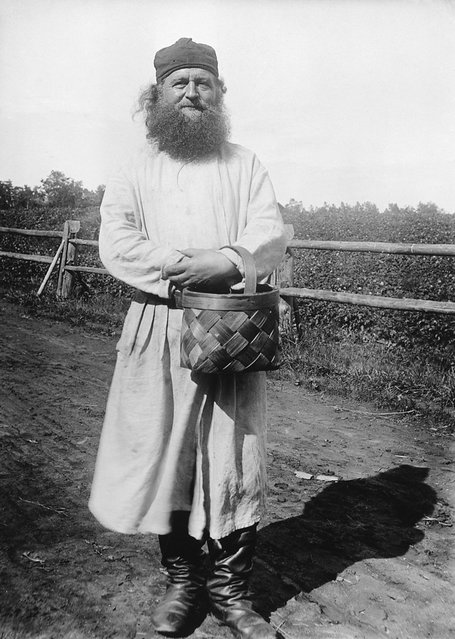
Priest, Valamo Monastery, Karelia, Russia (then Finland), 1930s. Father Venerius with a birchbark basket. (Photo by Einar Erici)

“Einar Erici (1885–1965) was a physician by profession, working at a tuberculosis hospital in Stockholm, even running a private medical practice. He was by then the most renowned Swedish expert of church organs and organ builders, and his archival collection is today held by the Swedish National Heritage Board. This archive includes mostly writings, such as letters and manuscripts for published articles and essays, but also more than 2 000 black and white photos – original prints, glass plates and film negatives”. – Swedish National Heritage Board

Photo: Priest, Valamo Monastery, Karelia, Russia (then Finland), 1930s. Father Venerius with a birchbark basket. (Photo by Einar Erici)
Details
09 Dec 2012 11:41:00
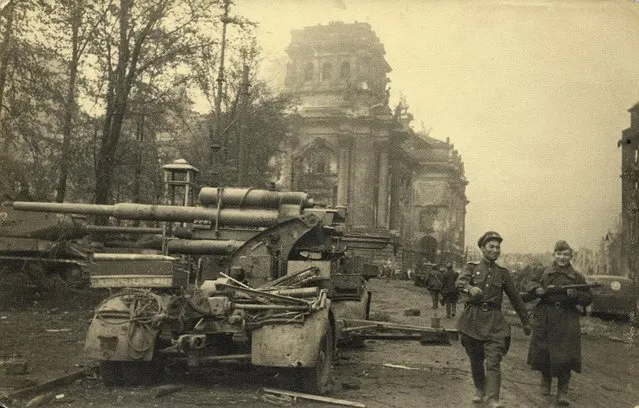
Russian soldiers are pictured next to the Reichstag building in this undated photo taken May 1945 in Berlin. Some 70 years on from the Battle for Berlin, instrumental in the end of World War II, Reuters photographer Fabrizio Bensch unearthed pictures by Red Army photographer Georgiy Samsonov, showing his portrayal of a city laid siege. (Photo by Georgiy Samsonov/Reuters/MHM)

Russian soldiers are pictured next to the Reichstag building in this undated photo taken May 1945 in Berlin. Some 70 years on from the Battle for Berlin, instrumental in the end of World War II, Reuters photographer Fabrizio Bensch unearthed pictures by Red Army photographer Georgiy Samsonov, showing his portrayal of a city laid siege. Bensch bought an exactly equivalent FED camera, a Soviet copy of the German-made Leica II, choosing to use black and white film to capture images of the self-same locations he detected his way to in modern-day Berlin. (Photo by Georgiy Samsonov/Reuters/MHM)
Details
07 May 2015 12:01:00
Shovava Wing Scarves By Roza Khamitova

Roza Khamitova was born into a family of artists in Kazakhstan. After finishing design school in Manhattan, New York, she was working in fashion industry for about 8 years. As a visual artist Roza had always drawn most of her inspiration from the natural world around her in the mountains of Kazakhstan. In 2011 she launched Shovava, her personal line of women’s clothing based on her hand drawn paintings and prints of the animals, plants and patterns found in nature. Roza was enchanted by the beauty of wings, its structure and symbolism. First, she sketches big wide-spread wings on paper with a light pencil, adds black ink to create a three-dimensional feel and fills with stunning watercolors.
Details
06 Dec 2015 10:42:00
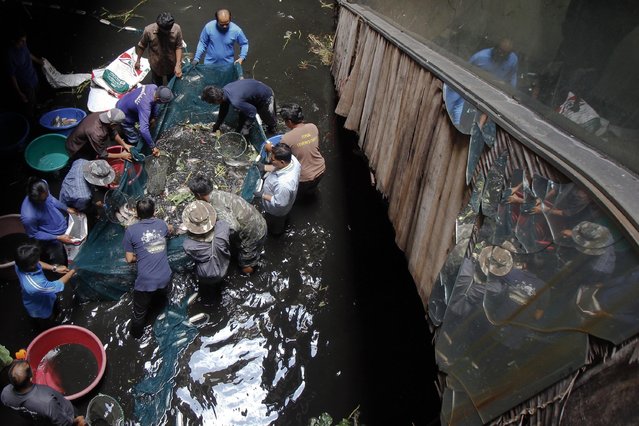
Workers collect fish inside an abandoned department store in Bangkok, Thailand January 13, 2015. Staff from Bangkok Metropolitan Administration (BMA) office were catching fish on Tuesday at the ground floor of the roofless New World department store that was closed down in 1997. (Photo by Chaiwat Subprasom/Reuters)

Workers collect fish inside an abandoned department store in Bangkok, Thailand January 13, 2015. Staff from Bangkok Metropolitan Administration (BMA) office were catching fish on Tuesday at the ground floor of the roofless New World department store that was closed down in 1997. Thousands of fish such as catfishes, fancy carps as well as black and red tilapias were released into the ground floor of the building, flooded with rainwater, as local vendors tried to control mosquitoes in the area, local media reported. BMA recently decided to remove the fish and release the water. (Photo by Chaiwat Subprasom/Reuters)
Details
14 Jan 2015 11:57:00
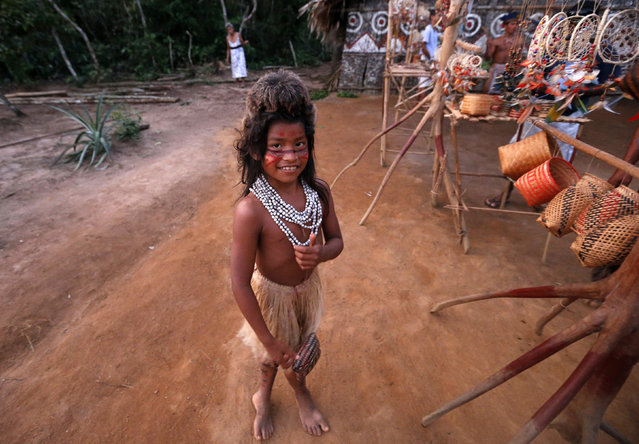
A girl of the Amazonian Tatuyo tribe poses while waiting to sell crafts to tourists in her village in the Rio Negro (Black River) near Manaus city, a World Cup host city, June 23, 2014. Because of their proximity to host city Manaus and their warm welcome, the Tatuyo have enjoyed three weeks of brisk business thanks to the World Cup. Usually, they host between 10 and 30 tourists a day. During the World Cup, this number has rocketed to 250 a day, They have become richer and other communities now come to them to sell them juices and fishes. (Photo by Andres Stapff/Reuters)

A girl of the Amazonian Tatuyo tribe poses while waiting to sell crafts to tourists in her village in the Rio Negro (Black River) near Manaus city, a World Cup host city, June 23, 2014. Because of their proximity to host city Manaus and their warm welcome, the Tatuyo have enjoyed three weeks of brisk business thanks to the World Cup. Usually, they host between 10 and 30 tourists a day. During the World Cup, this number has rocketed to 250 a day, They have become richer and other communities now come to them to sell them juices and fishes. (Photo by Andres Stapff/Reuters)
Details
27 Jun 2014 10:30:00
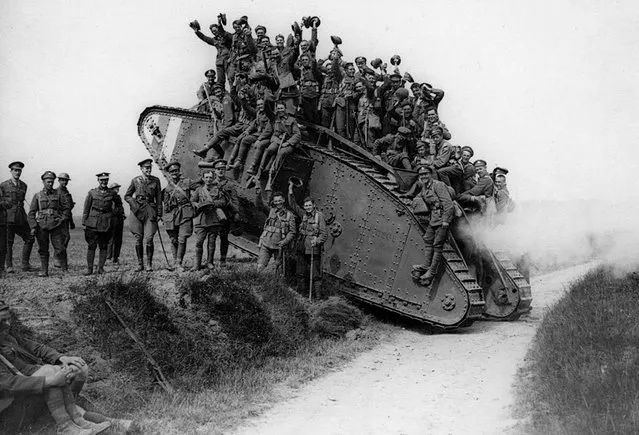
These black-and-white photos are taken from the new book “Armoured Warfare in the First World War 1916 – 1918” by Anthony Tucker-Jones and published by Pen & Sword Military. “Interestingly the British, French and Germans took completely different approaches with varying results”. The British military produced “Little Willie” in Autumn 1915 weighing 18 tonnes, which had a crew of two plus four gunners. “Inspired by a tracked artillery tractor “Little Willie” was referred to as a water tank – hence the name tank – to ensure secrecy”, said Anthony. “This led to the strange looking Mark I with its peculiar rhomboid shape, designed to cross trenches with guns in sponsons on either side. The Germans saw the tank as unchivalrous and were slow to grasp its utility. They favoured the Stormtrooper (specialist soldiers used to infiltrate enemy trenches) and artillery, not the tank”, said Anthony. “However, they didn’t hesitate to make use of captured British tanks. Although the tank helped secure victory and German soldiers dubbed it “Germany’s Downfall” the country was ultimately brought to its knees by the Allies blockade”. Here: British troops hitch a ride on a Mark IV after the massed tank fleet spearheading attack at Cambrai on November 20, 1917. (Photo by Anthony Tucker-Jones/Mediadrumworld.com)

These black-and-white photos are taken from the new book “Armoured Warfare in the First World War 1916 – 1918” by Anthony Tucker-Jones and published by Pen & Sword Military. Here: British troops hitch a ride on a Mark IV after the massed tank fleet spearheading attack at Cambrai on November 20, 1917. (Photo by Anthony Tucker-Jones/Mediadrumworld.com)
Details
23 Feb 2017 00:02:00