A tamed hawk sits on a chair next to a participant during a traditional hunting contest in Almaty, Kazakhstan on December 1, 2018. (Photo by Pavel Mikheyev/Reuters)
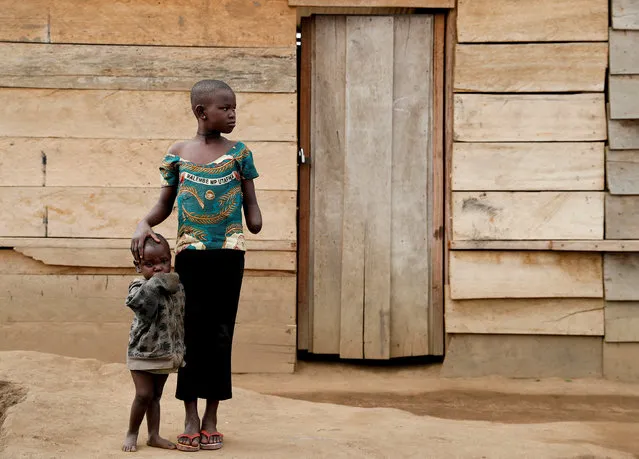
Mave Grace, 11, who had part of her arm chopped off by militiamen when they attacked the village of Tchee, stands with her sister Racahele-Ngabausi, aged two, in an Internally Displaced Camp in Bunia, Ituri province, eastern Democratic Republic of Congo, April 12, 2018. (Photo by Goran Tomasevic/Reuters)
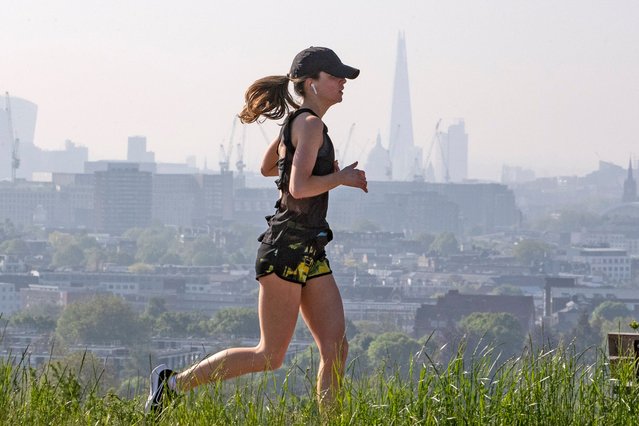
A jogger is seen running at Hampstead Heath with London in the background on June 1, 2021. Britain sees temperatures increasing for the second day in a row after the mercury hit 25C (77 Fahrenheit) for the warmest day of the year so far on Bank Holiday Monday. (Photo by Joshua Bratt/London News Pictures)
Hindu married women offer prayers and tie a thread around a banyan tree during the festival of Vat Purnima amid the spread of the coronavirus disease (COVID-19), in Mumbai, India, June 24, 2021. (Photo by Francis Mascarenhas/Reuters)
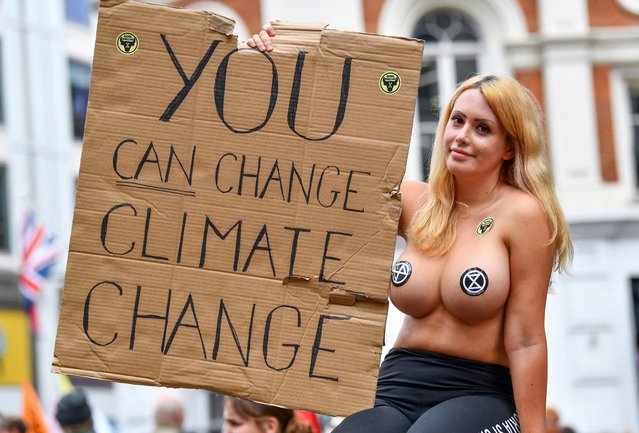
An Extinction Rebellion protestor holds up a sign saying “You Can Change Climate Change” in St Martin's Lane in London, United Kingdom on August 23, 2021. (Photo by James Veysey/Rex Features/Shutterstock)
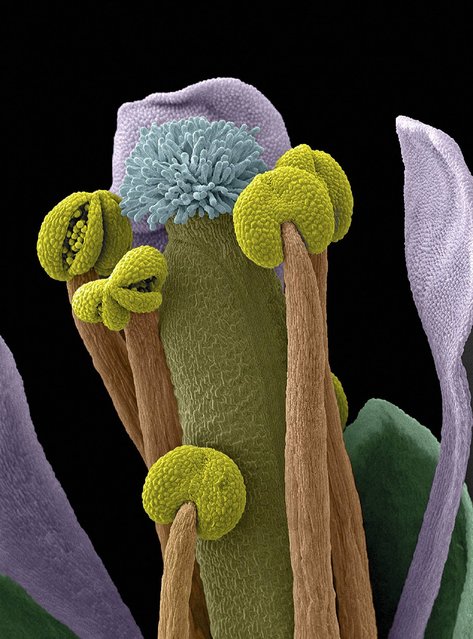
Beautiful, strange and occasionally alarming pictures from the shortlist for this year’s Wellcome image awards – which celebrate the very best in science photography and imaging – from an x-ray of a bat to a micrograph of a kidney stone. The exhibition opens on 12 March at three science centres and the Museum of Science and Industry in Manchester. Photo: Scanning electron micrograph (SEM) of an Arabidopsis thaliana flower, also commonly known as thale cress. Some of the anthers are open, revealing pollen grains ready for dispersal. Arabidopsis was the first plant to have its entire genome sequenced and is widely used as a model organism in molecular and plant biology. Horizontal width of image is 1200 microns. Magnification 100x. (Photo by Stefan Eberhard/Wellcome Images)
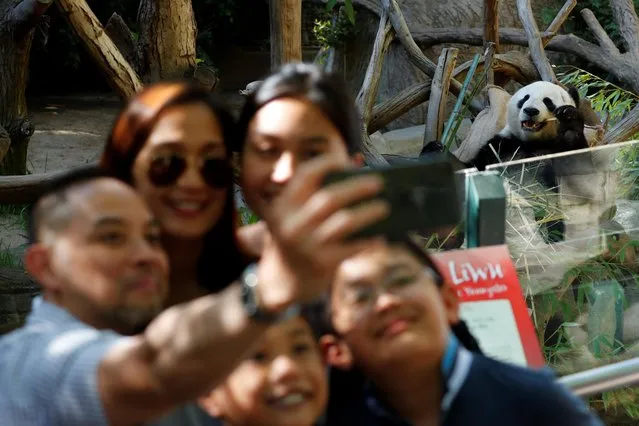
A family take a souvenir picture next to giant male panda Xiao Liwu, who was born at the San Diego Zoo and will be repatriated to China with his mother Bai Yun, bringing an end to a 23-year-long panda research program in San Diego, California, U.S., April 18, 2019. (Photo by Mike Blake/Reuters)