Loading...
Done
Pencil Sculptures - by Jennifer Maestre

Jennifer Maestre (born 1959 in Johannesburg, South Africa) is a Massachusetts-based artist, internationally known for her unique pencil sculptures.
She derives most of her inspiration from the form and texture of the sea urchin. To make the pencil sculptures, Jennifer makes use of a variety pencils, nails and stitching. She takes hundreds of pencils, cuts them into small 1-inch sections, drills a hole in each section, sharpens them all and sews them together.
Details
22 Aug 2012 13:16:00
Leafy sea dragon

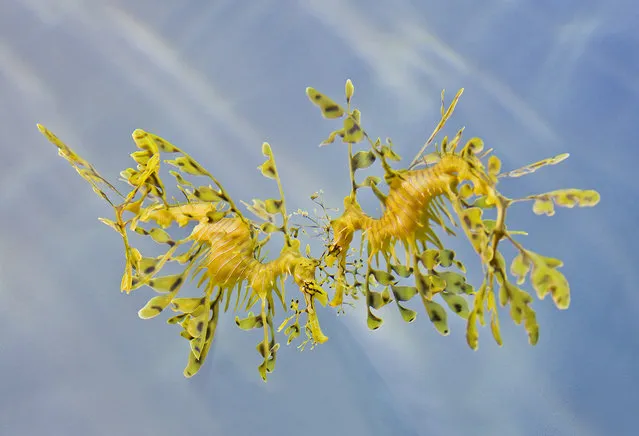
The leafy seadragon or Glauert's seadragon, Phycodurus eques, is a marine fish in the family Syngnathidae, which also includes the seahorses. It is the only member of the genus Phycodurus. It is found along the southern and western coasts of Australia. The name is derived from the appearance, with long leaf-like protrusions coming from all over the body. These protrusions are not used for propulsion; they serve only as camouflage. The leafy seadragon propels itself by means of a pectoral fin on the ridge of its neck and a dorsal fin on its back closer to the tail end. These small fins are almost completely transparent and difficult to see as they undulate minutely to move the creature sedately through the water, completing the illusion of floating seaweed.
Details
05 Sep 2012 08:51:00


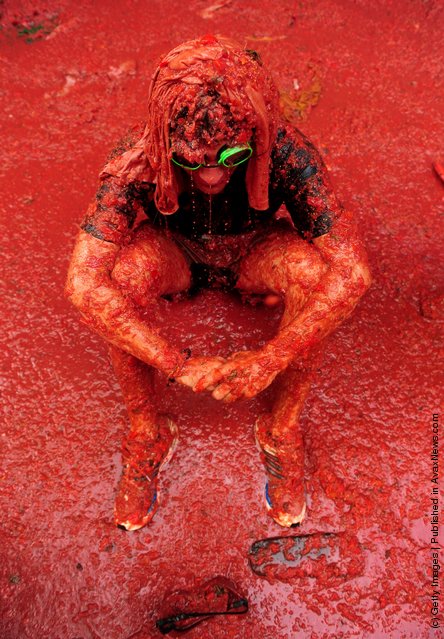
“La Tomatina is a festival that is held in the Valencian town of Buñol, in which participants throw tomatoes at each other”. – Wikipedia

Photo: A man sits in tomato pulp at the end of the world's biggest tomato fight at La Tomatina festival on August 26, 2009 in Bunol, Spain. More than 45000 people from all over the world descended on the small Valencian town to participate La Tomatina festival, with the local town hall estimating that over 100 tons of rotten and over-ripe tomatoes were thrown. (Photo by Jasper Juinen/Getty Images)
Details
24 May 2011 09:27:00
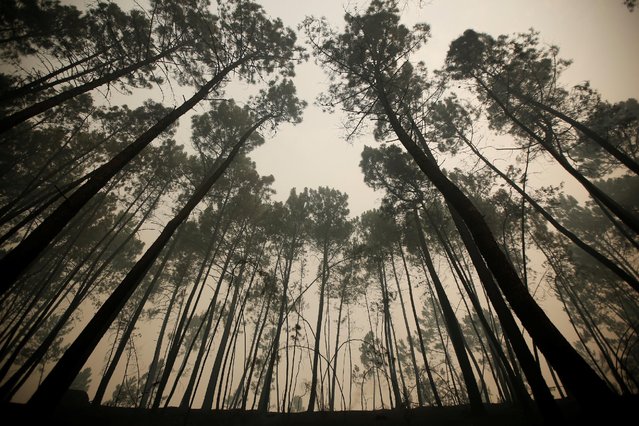
Pine trees are seen after a forest fire near Sao Pedro do Sul, Portugal August 14, 2016. (Photo by Rafael Marchante/Reuters)

Pine trees are seen after a forest fire near Sao Pedro do Sul, Portugal August 14, 2016. Deadly wildfires raging for two weeks in Portugal have destroyed a wooded area the size of 100,000 soccer fields, and the small Iberian nation alone accounts for half of all forests burned in the European Union this year. (Photo by Rafael Marchante/Reuters)
Details
17 Aug 2016 11:07:00
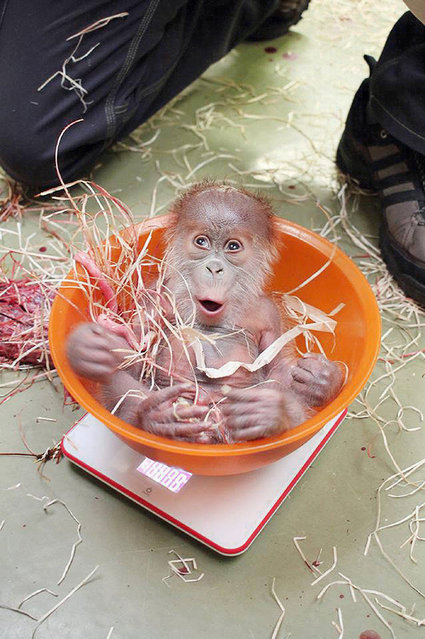
This female orangutan was born at the zoo in the German capital of Berlin.  German online users have fallen in love with Berlin Zoo's most recent addition – this newborn orangutan. (Photo by Europics/Zoo Berlin)

This female orangutan was born at the zoo in the German capital of Berlin. German online users have fallen in love with Berlin Zoo's most recent addition – this newborn orangutan. The female orangutan was born in the early hours of 12th January at the zoo in the German capital of Berlin and weighed a tiny 1.8 kilograms, normally regarded as small for an orangutan baby but nevertheless the infant is healthy and strong. (Photo by Europics/Zoo Berlin)
Details
23 Jan 2015 13:39:00
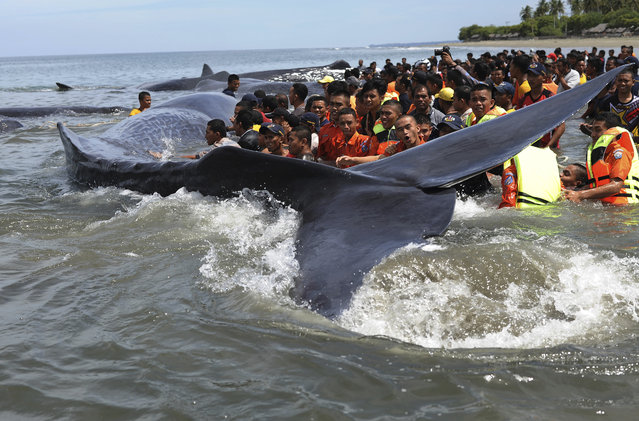
Rescuers attempt attempt to push stranded whales back into the ocean at Ujong Kareng beach in Aceh province, Indonesia, Monday, November 13, 2017. (Photo by AP Photo/Zulkarnaini)

Rescuers attempt attempt to push stranded whales back into the ocean at Ujong Kareng beach in Aceh province, Indonesia, Monday, November 13, 2017. An official said a small pod of whales was stranded at the beach and attracted hundreds of onlookers who posed for pictures with them. (Photo by AP Photo/Zulkarnaini)
Details
14 Nov 2017 08:13:00
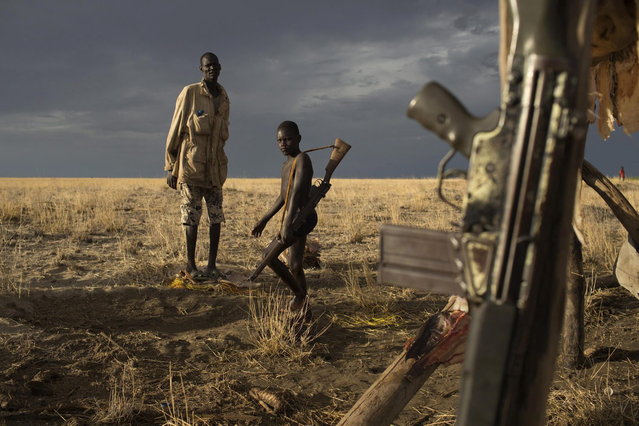
A Turkana man and a boy carrying a gun look on as a G3 battle rifle hangs from a structure used to dry fish at a fishing camp on the shores of Lake Turkana, some kilometres from Todonyang near the Kenya-Ethiopia border in northwestern Kenya October 12, 2013. (Photo by Siegfried Modola/Reuters)

A Turkana man and a boy carrying a gun look on as a G3 battle rifle hangs from a structure used to dry fish at a fishing camp on the shores of Lake Turkana, some kilometres from Todonyang near the Kenya-Ethiopia border in northwestern Kenya October 12, 2013The Turkana are traditionally nomadic pastoralists, but they have seen the pasture that they need to feed their herds suffer from recurring droughts and many have turned to fishing. However, Lake Turkana is overfished, and scarcity of food and pastureland is fuelling long-standing conflict with Ethiopian indigenous Dhaasanac, who have seen grazing grounds squeezed by large-scale government agricultural schemes in southern Ethiopia. The Dhaasanac now venture ever deeper into Kenyan territory in search of fish and grass, clashing with neighbours. Fighting between the communities has a long history, but the conflict has become ever more fatal as automatic weapons from other regional conflicts seep into the area. While the Turkana region is short of basics like grass and ground-water, it contains other resources including oil reserves and massive, newly discovered underground aquifers. (Photo by Siegfried Modola/Reuters)
Details
05 Dec 2013 12:08:00
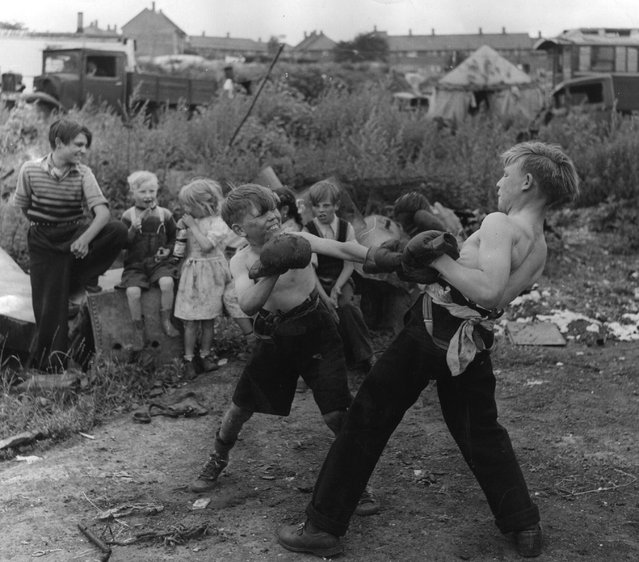
The unromantic gypsies. Children boxing in a gypsy camp in Kent, England on July 1, 1951. Like all boys these gypsy lads like to try their hand at boxing. Encouraged by their friends they fight it out on Corke's Meadow. Few Romanies now live a life of wandering romance. Most are like the three hundred squatters of Corke's Meadow, Kent, which is part of a “gypsy problem” that involves about 100,000 today. Of those about 25,000 can be rightly called gypsies, the rest are Mumpers and Posh-rats and Hobos. Corke's Meadow has both kinds. “Picture Post” cameraman Bert Hardy photographs the Corke's Meadow gypsies in their encampment. (Photo by Hulton-Deutsch Collection/Corbis via Getty Images)

The unromantic gypsies. Children boxing in a gypsy camp in Kent, England on July 1, 1951. Like all boys these gypsy lads like to try their hand at boxing. Encouraged by their friends they fight it out on Corke's Meadow. Few Romanies now live a life of wandering romance. Most are like the three hundred squatters of Corke's Meadow, Kent, which is part of a “gypsy problem” that involves about 100,000 today. Of those about 25,000 can be rightly called gypsies, the rest are Mumpers and Posh-rats and Hobos. Corke's Meadow has both kinds. “Picture Post” cameraman Bert Hardy photographs the Corke's Meadow gypsies in their encampment. (Photo by Hulton-Deutsch Collection/Corbis via Getty Images)
Details
12 Mar 2017 00:01:00