Loading...
Done
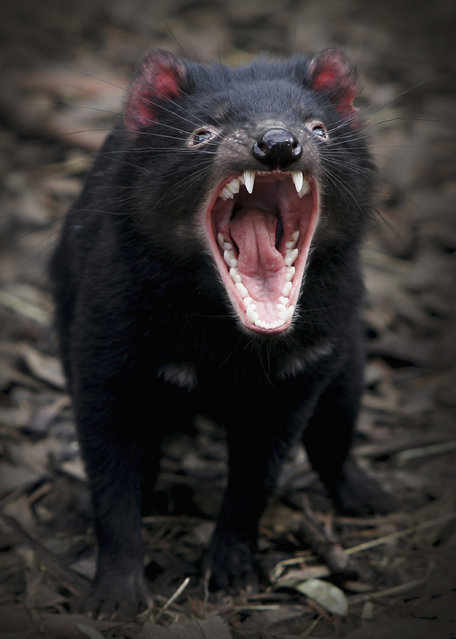
A Tasmanian Devil bears it's teeth at a quarantine facility August 31, 2005 in Hobart, Australia. The Devil, a native marsupial unique to Tasmania, is under threat from Devil Facial Tumor Disease (DFTD) which is decimating numbers throughout Tasmania. (Photo by Ian Waldie/Getty Images)

“The Tasmanian devil (Sarcophilus harrisii) is a carnivorous marsupial of the family Dasyuridae now found in the wild only in the Australian island state of Tasmania. The size of a small dog, it became the largest carnivorous marsupial in the world following the extinction of the thylacine in 1936. It is characterised by its stocky and muscular build, black fur, pungent odour, extremely loud and disturbing screech, keen sense of smell, and ferocity when feeding”. – Wikipedia. Photo: A Tasmanian Devil bears it's teeth at a quarantine facility August 31, 2005 in Hobart, Australia. (Photo by Ian Waldie/Getty Images)
Details
27 Jan 2014 09:45:00
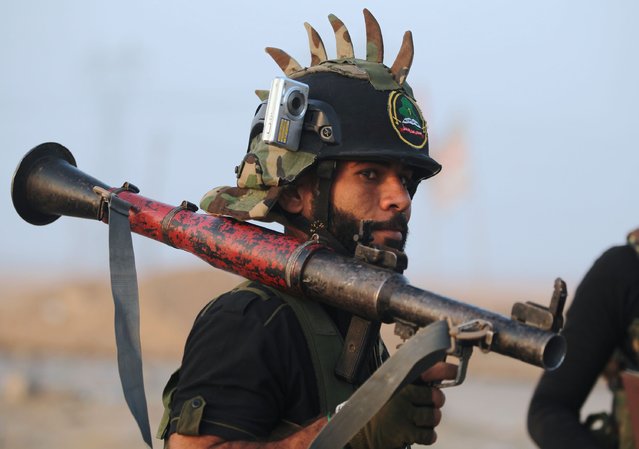
A Shiite fighter from the Hashed al-Shaabi (Popular Mobilisation) patrols in the village of Ayn Nasir, south of Mosul, on October 29, 2016, after recapturing it from Islamic State group jihadists in an ongoing operation to retake the city of Mosul. Iraqi paramilitary forces launched an operation to cut the Islamic State group's supply lines between its Mosul bastion and neighbouring Syria, opening a new front in the nearly two-week-old offensive. (Photo by Ahmad Al-Rubaye/AFP Photo)

A Shiite fighter from the Hashed al-Shaabi (Popular Mobilisation) patrols in the village of Ayn Nasir, south of Mosul, on October 29, 2016, after recapturing it from Islamic State group jihadists in an ongoing operation to retake the city of Mosul. Iraqi paramilitary forces launched an operation to cut the Islamic State group's supply lines between its Mosul bastion and neighbouring Syria, opening a new front in the nearly two-week-old offensive. (Photo by Ahmad Al-Rubaye/AFP Photo)
Details
31 Oct 2016 11:20:00
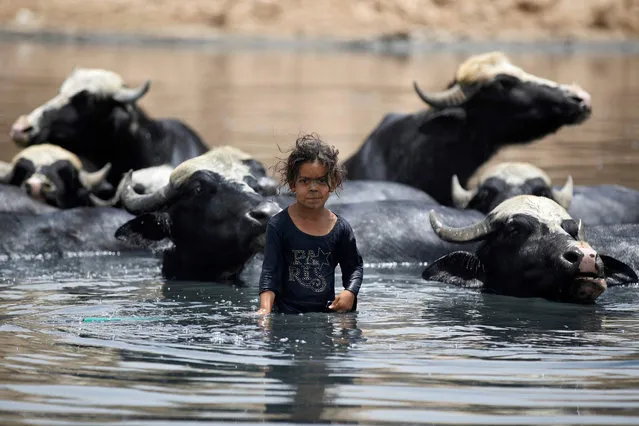
A young Iraqi shepherdess cools down buffaloes in wastewater filling the dried-up Diyala river which was a tributary of the Tigris, in the Al-Fadiliyah district east of Baghdad, on June 26, 2022. Iraq's drought reflects a decline in the level of waterways due to the lack of rain and lower flows from upstream neighboring countries Iran and Turkey. (Photo by Ahmad Al-Rubaye/AFP Photo)

A young Iraqi shepherdess cools down buffaloes in wastewater filling the dried-up Diyala river which was a tributary of the Tigris, in the Al-Fadiliyah district east of Baghdad, on June 26, 2022. Iraq's drought reflects a decline in the level of waterways due to the lack of rain and lower flows from upstream neighboring countries Iran and Turkey. (Photo by Ahmad Al-Rubaye/AFP Photo)
Details
07 Jul 2022 04:21:00
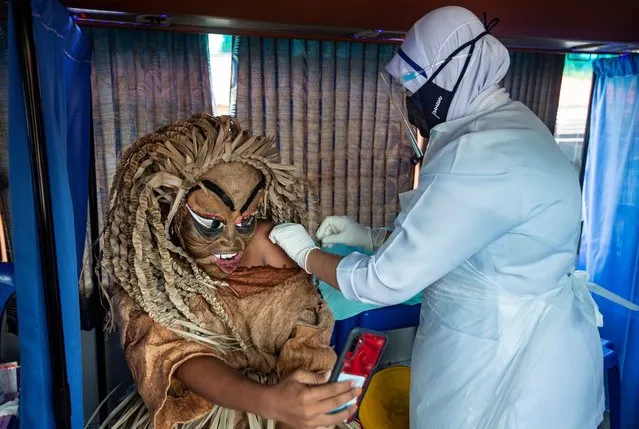
An indigenous man of Mahmeri tribe wearing a costume of Puteri Gunung Ledang character receives a dose of the vaccine against Covid-19 in Banting, near Kuala Lumpur, Malaysia,15 August 2021. Malaysia recorded another 20,670 new Covid-19 cases on 14 August, bringing the cumulative total to 1,384,353 cases. (Photo by Ahmad Yusni/EPA/EFE)

An indigenous man of Mahmeri tribe wearing a costume of Puteri Gunung Ledang character receives a dose of the vaccine against Covid-19 in Banting, near Kuala Lumpur, Malaysia,15 August 2021. Malaysia recorded another 20,670 new Covid-19 cases on 14 August, bringing the cumulative total to 1,384,353 cases. (Photo by Ahmad Yusni/EPA/EFE)
Details
03 Sep 2021 08:25:00
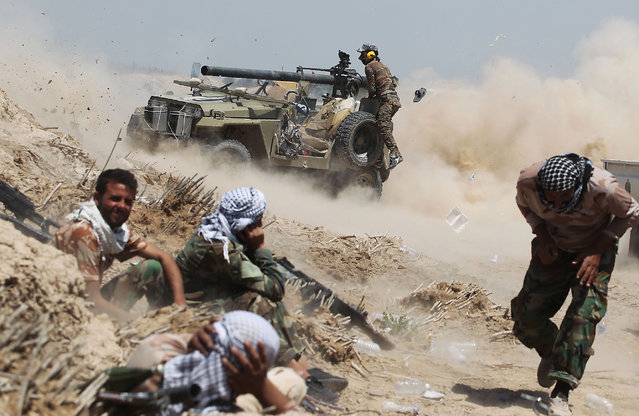
Iraqi pro-government forces fire an anti-tank cannon near al-Sejar village, north-east of Fallujah, on May 25, 2016, as they take part in a major assault to retake the city from the Islamic State (IS) group. Iraqi forces, consisting of special forces, soldiers, police, paramilitary-fighters and pro-government tribesmen, launched a major assault to retake Fallujah, the scene of deadly battles during the US occupation and one of the toughest targets yet in Baghdad's war on the Islamic State group. (Photo by Ahmad Al-Rubaye/AFP Photo)

Iraqi pro-government forces fire an anti-tank cannon near al-Sejar village, north-east of Fallujah, on May 25, 2016, as they take part in a major assault to retake the city from the Islamic State (IS) group. Iraqi forces, consisting of special forces, soldiers, police, paramilitary-fighters and pro-government tribesmen, launched a major assault to retake Fallujah, the scene of deadly battles during the US occupation and one of the toughest targets yet in Baghdad's war on the Islamic State group. (Photo by Ahmad Al-Rubaye/AFP Photo)
Details
26 May 2016 12:42:00
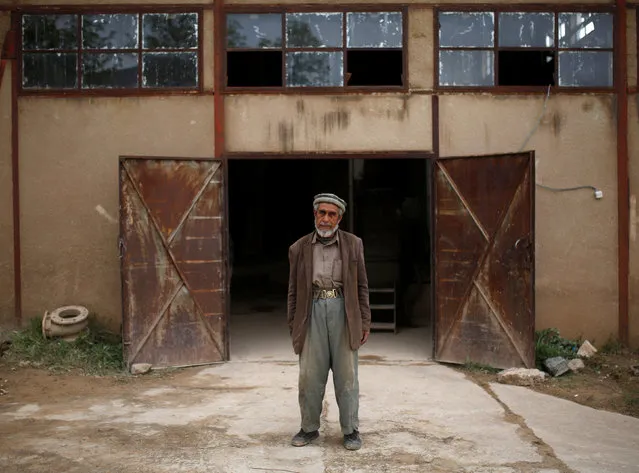
A worker at the Jabal Saraj cement factory poses for a photograph in Jabal Saraj, north of Kabul, Afghanistan April 19, 2016. (Photo by Ahmad Masood/Reuters)

A worker at the Jabal Saraj cement factory poses for a photograph in Jabal Saraj, north of Kabul, Afghanistan April 19, 2016. In an area desperately short of industry and jobs, local workers hope that the relaunch of the plant in Jabal Saraj, built by Czech engineers in 1957 and closed down by the Taliban in 1995, can show that Afghanistan's shattered industry can climb back to its feet after decades of war and destruction. But the outdated state-owned plant some 75 kilometres outside Kabul also shows how far it has to go before that promise can be achieved and there are serious questions over whether it has a viable future unless a new, modern facility is built to replace it. (Photo by Ahmad Masood/Reuters)
Details
31 May 2016 11:29:00
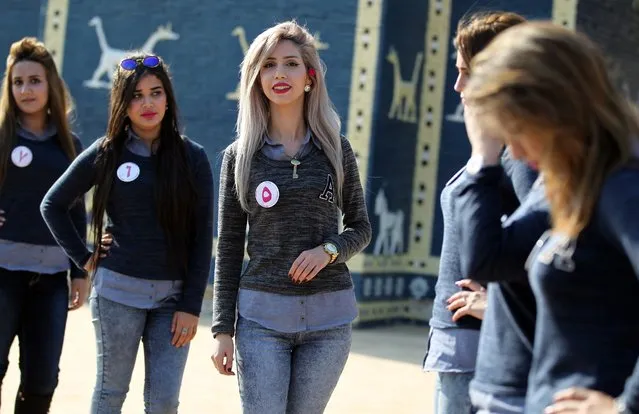
Some Iraqi candidates for Miss Iraq beauty contest pose in front of the Ishtar Gate at the ancient archaeological site of Babylon, outside the modern city of Hilla, south of the capital Baghdad on December 17, 2015. The beauty contest,  which is the first one in more than 40 years, aims to boost tourism in the city and will take place on December 19, 2015. (Photo by Ahmad Al-Rubaye/AFP Photo)

Some Iraqi candidates for Miss Iraq beauty contest pose in front of the Ishtar Gate at the ancient archaeological site of Babylon, outside the modern city of Hilla, south of the capital Baghdad on December 17, 2015. The beauty contest, which is the first one in more than 40 years, aims to boost tourism in the city and will take place on December 19, 2015. (Photo by Ahmad Al-Rubaye/AFP Photo)
Details
19 Dec 2015 10:25:00
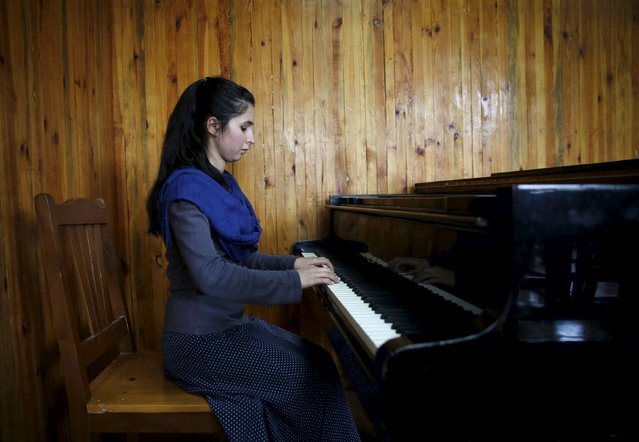
Negin Ekhpulwak, leader of the Zohra orchestra, an ensemble of 35 women, practises on a piano at Afghanistan's National Institute of Music, in Kabul, Afghanistan April 9, 2016. (Photo by Ahmad Masood/Reuters)

Negin Ekhpulwak, leader of the Zohra orchestra, an ensemble of 35 women, practises on a piano at Afghanistan's National Institute of Music, in Kabul, Afghanistan April 9, 2016. Playing instruments was banned under Taliban rule in Afghanistan, and even today, many conservative Muslims frown on most forms of music. Living in an orphanage in the capital, Kabul, 19-year-old Negin Ikhpolwak leads an ensemble of 35 women that plays both Western and Afghan musical instruments. In a country notorious internationally for harsh restrictions on women in most areas of life, Negin's story highlights a double challenge. (Photo by Ahmad Masood/Reuters)
Details
19 Apr 2016 13:47:00