Loading...
Done
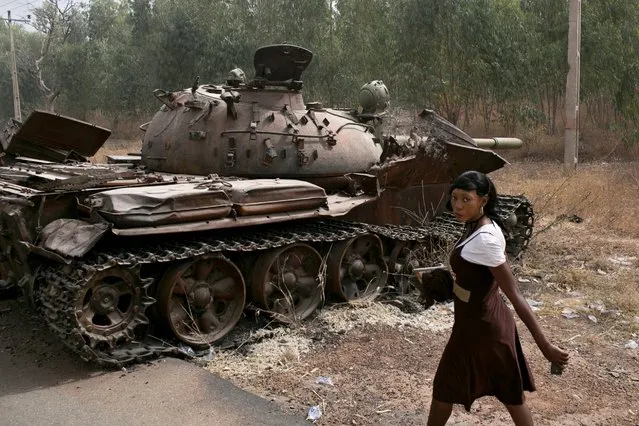
An abandoned tank left by Boko Haram, February 20, 2016, seen on the road to Michika, Nigeria – a town formerly occupied by the insurgents. On April 14, 2014, 300 schoolgirls in the Chibok village in Nigeria were kidnapped by the terrorist group, Boko Haram. Two years later, the majority of these girls are still missing. According to the Global Terrorism Index Report 2015, Boko Haram, which operates mainly in Nigeria, has become the most deadly terrorist group in the world. (Photo by Danielle Villasana)

An abandoned tank left by Boko Haram, February 20, 2016, seen on the road to Michika, Nigeria – a town formerly occupied by the insurgents. On April 14, 2014, 300 schoolgirls in the Chibok village in Nigeria were kidnapped by the terrorist group, Boko Haram. Two years later, the majority of these girls are still missing. According to the Global Terrorism Index Report 2015, Boko Haram, which operates mainly in Nigeria, has become the most deadly terrorist group in the world. (Photo by Danielle Villasana)
Details
22 Apr 2016 13:13:00
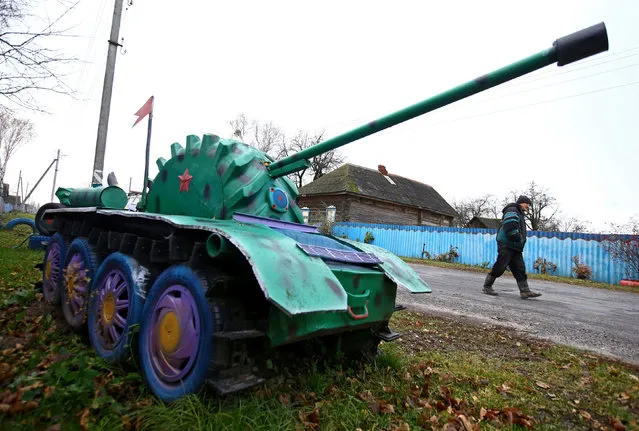
An installation with a copy of a tank is seen at a villager's house in the village of Vits, Belarus November 8, 2016. (Photo by Vasily Fedosenko/Reuters)

Belarus, officially the Republic of Belarus, formerly and sometimes known as Byelorussia, is a landlocked country in Eastern Europe

Please Subscribe To:
Our Youtube Channel
Details
23 Dec 2016 10:59:00
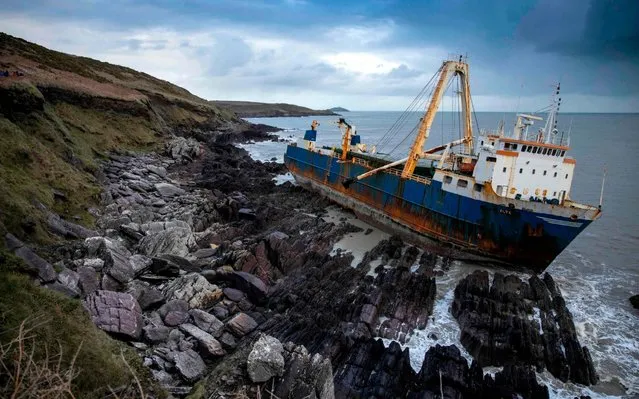
The abandoned 77-metre (250-feet) cargo ship MV Alta is pictured stuck on rocks near the village of Ballycotton south-east of Cork in Southern Ireland on February 18, 2020. A “ghost ship” drifting without a crew for more than a year washed ashore on Ireland's south coast in high seas caused by Storm Dennis, the Republic's coast guard said. (Photo by Cathal Noonan/AFP Photo)

The abandoned 77-metre (250-feet) cargo ship MV Alta is pictured stuck on rocks near the village of Ballycotton south-east of Cork in Southern Ireland on February 18, 2020. A “ghost ship” drifting without a crew for more than a year washed ashore on Ireland's south coast in high seas caused by Storm Dennis, the Republic's coast guard said. (Photo by Cathal Noonan/AFP Photo)
Details
20 Feb 2020 00:07:00
In this November 18, 2014 photo, Murshida, 12, sits on the lap of her mother Marjina as the train leaves for their village in West Bengal, at a railway station in New Delhi, India. Six months ago, Marjina stepped off a train in New Delhi with her two children, hoping to find a better life after her husband abandoned them without so much as a goodbye. (Photo by Altaf Qadri/AP Photo)

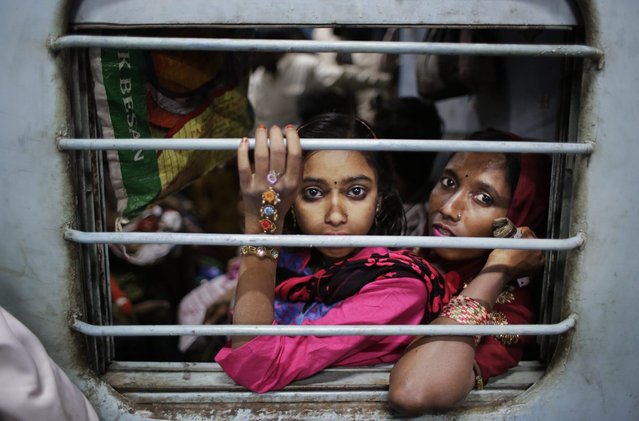
In this November 18, 2014 photo, Murshida, 12, sits on the lap of her mother Marjina as the train leaves for their village in West Bengal, at a railway station in New Delhi, India. Six months ago, Marjina stepped off a train in New Delhi with her two children, hoping to find a better life after her husband abandoned them without so much as a goodbye. The family spent their days at a landfill picking through other people’s garbage to find salvageable bits to resell or recycle. After six months of poverty, illness and shame, they returned to that train station in New Delhi, headed back to an uncertain future to their hometown in West Bengal. (Photo by Altaf Qadri/AP Photo)
Details
09 Dec 2014 09:47:00
Joaldunaks return in a trailer to their town at the end of Carnival between of the Pyrenees villages of Ituren and Zubieta, northern Spain, Monday, February 1, 2016. In one of the most ancient carnivals in Europe, dating from before the Roman empire, companies of Joaldunak (cowbells) made up of residents of two towns, Ituren and Zubieta, parade the streets costumed in sandals, lace petticoats, sheepskins around the waist and shoulders, coloured neckerchiefs, conical caps with ribbons and a hyssop of horsehair in their right hands and cowbells hung across their lower back. (Photo by Alvaro Barrientos/AP Photo)

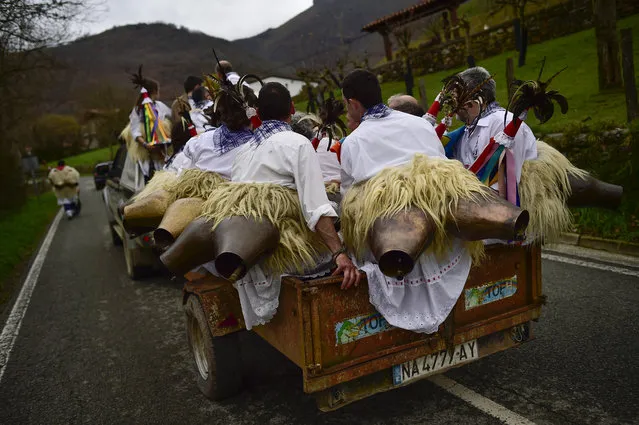
Joaldunaks return in a trailer to their town at the end of Carnival between of the Pyrenees villages of Ituren and Zubieta, northern Spain, Monday, February 1, 2016. In one of the most ancient carnivals in Europe, dating from before the Roman empire, companies of Joaldunak (cowbells) made up of residents of two towns, Ituren and Zubieta, parade the streets costumed in sandals, lace petticoats, sheepskins around the waist and shoulders, coloured neckerchiefs, conical caps with ribbons and a hyssop of horsehair in their right hands and cowbells hung across their lower back. (Photo by Alvaro Barrientos/AP Photo)
Details
02 Feb 2016 13:07:00
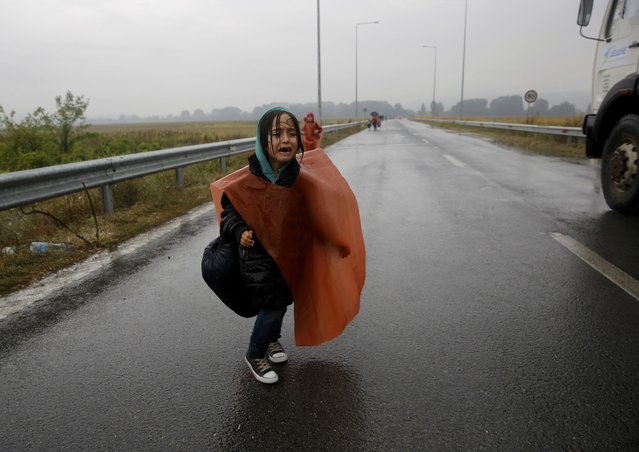
A Syrian refugee girl cries as she walks through a rainstorm towards Greece's border with Macedonia, near the Greek village of Idomeni, September 10, 2015. Most of the people flooding into Europe are refes fleeing violence and persecution in their home countries who have a legal right to seek asylum, the United Nations said on Tuesday. (Photo by Yannis Behrakis/Reuters)

A Syrian refugee girl cries as she walks through a rainstorm towards Greece's border with Macedonia, near the Greek village of Idomeni, September 10, 2015. Most of the people flooding into Europe are refes fleeing violence and persecution in their home countries who have a legal right to seek asylum, the United Nations said on Tuesday. (Photo by Yannis Behrakis/Reuters)
Details
11 Sep 2015 12:57:00
A migrant smokes a cigarette as he waits among others to cross the Croatian border near the village of Berkasovo, Serbia October 19, 2015. (Photo by Marko Djurica/Reuters)

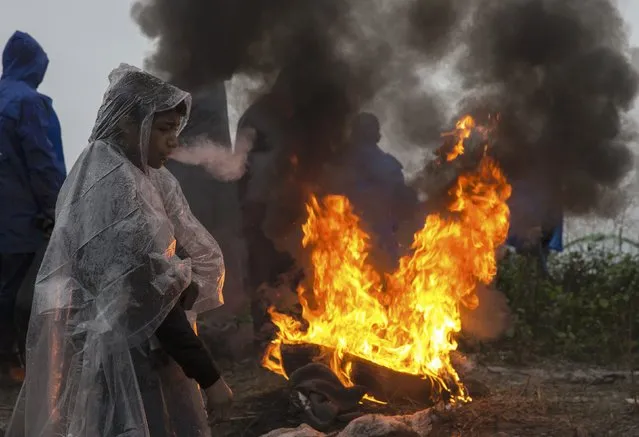
A migrant smokes a cigarette as he waits among others to cross the Croatian border near the village of Berkasovo, Serbia October 19, 2015. Thousands of migrants clamoured to enter European Union member Croatia from Serbia on Monday after a night spent in the cold and mud of no-man's land, their passage west slowed by a Slovenian effort to impose limits on the flow to western Europe. (Photo by Marko Djurica/Reuters)
Details
22 Oct 2015 08:00:00
People dressed in costumes have a break while marching during the Vijanera Festival, in the small village of Silio, northern Spain, Sunday, January 3, 2016. The Vijanera masquerade, of pre-Roman origin, is the first carnival of the year in Europe symbolizing the triumph of good over evil and involving the participation of crowds of residents wearing different masks, animal skins and brightly coloured clothing with its own complex function and symbolism and becoming the living example of the survival of archaic cults to nature. (Photo by Francisco Seco/AP Photo)

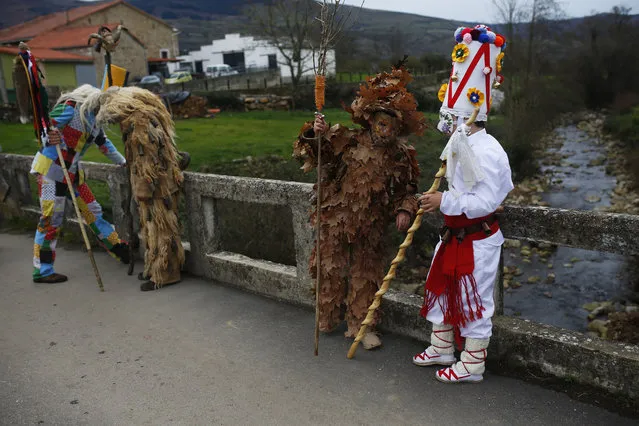
People dressed in costumes have a break while marching during the Vijanera Festival, in the small village of Silio, northern Spain, Sunday, January 3, 2016. The Vijanera masquerade, of pre-Roman origin, is the first carnival of the year in Europe symbolizing the triumph of good over evil and involving the participation of crowds of residents wearing different masks, animal skins and brightly coloured clothing with its own complex function and symbolism and becoming the living example of the survival of archaic cults to nature. (Photo by Francisco Seco/AP Photo)
Details
04 Jan 2016 10:17:00