Loading...
Done
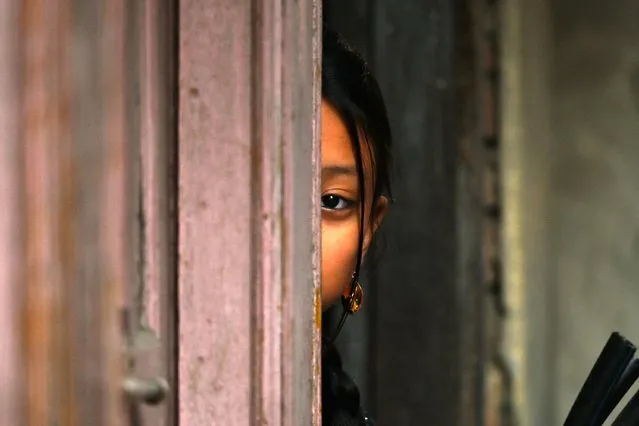
A girl watches the members of Nepali ethnic Newar community participating in “Jyapu Day” celebrations that marks the end of the harvest season, in Kathmandu on December 26, 2023. (Photo by Prakash Mathema/AFP Photo)

A girl watches the members of Nepali ethnic Newar community participating in “Jyapu Day” celebrations that marks the end of the harvest season, in Kathmandu on December 26, 2023. (Photo by Prakash Mathema/AFP Photo)
Details
16 Jan 2024 17:09:00
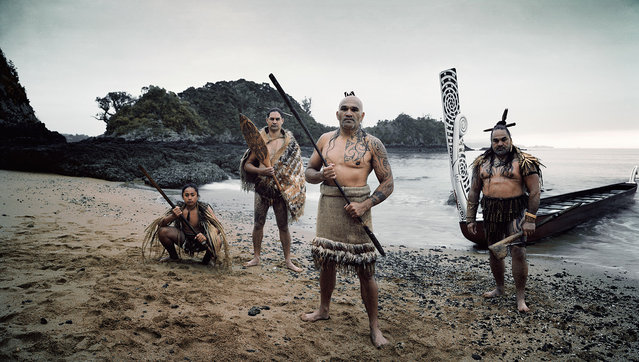
Maori  People New Zealand

The long and intriguing story of the origine of the indigenous Maori people can be traced back to the 13th century, the mythical homeland Hawaiki, Eastern Polynesia. Due to centuries of isolation, the Maori established a distinct society with characteristic art, a separate language and unique mythology. Defining aspects of Maori traditional culture include art, dance, legends, tattoos and community. While the arrival of European colonists in the 18th centure had a profound impact on the Maori way of life, many aspects of traditional society have survived into the 21th century.
Details
11 Mar 2014 14:40:00
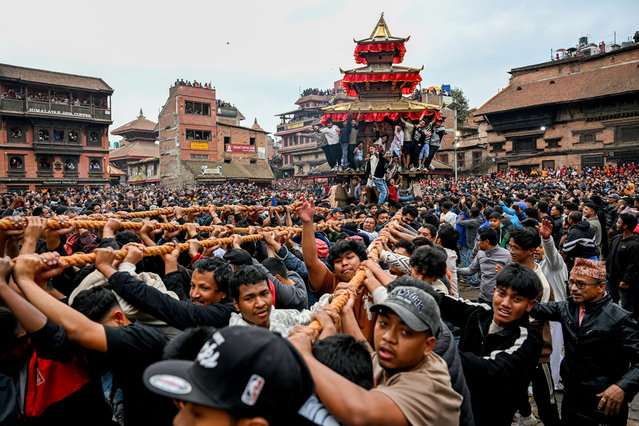
Devotees pull a wooden chariot carrying an idol of the Hindu deity Bhairav during 'Bisket Jatra' festival to mark the Nepali New Year, in Bhaktapur, on the outskirts of Kathmandu, on April 10, 2025. (Photo by Prakash Mathema/AFP Photo)

Devotees pull a wooden chariot carrying an idol of the Hindu deity Bhairav during 'Bisket Jatra' festival to mark the Nepali New Year, in Bhaktapur, on the outskirts of Kathmandu, on April 10, 2025. (Photo by Prakash Mathema/AFP Photo)
Details
26 Apr 2025 02:12:00
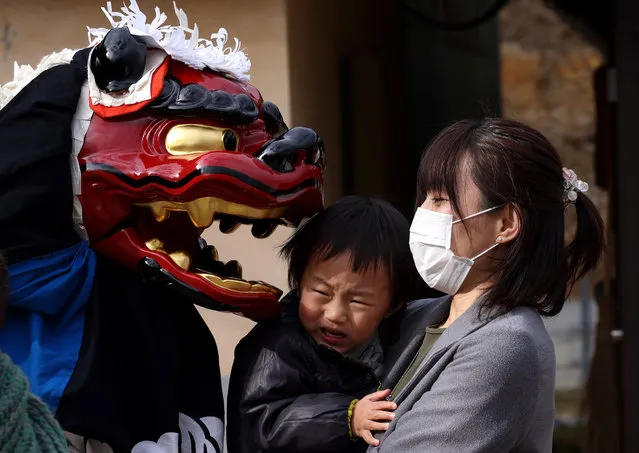
A performer wearing a lion mask performs the Ise Daikagura lion dance at the remote village of Yamanawa on February 08, 2021 in Ryuo, Japan. Ise Daikagura is a group of traditional Lion Dance performers who pray in front of farmers houses and businesses for good grain harvests and disease-free lives. Performers play sacred music using drums and flutes with two lion mask dancers. A lion mask is considered a symbol of God, who enters the house and performs in front of the Shinto God, a statue placed inside the house, mostly in the kitchen. These prayers are called “Kamodo Barai”. After the prayers, they are gifted with money, rice, sake and Japanese sweets from the householders. A group can travel for more than one hundred days to thousands of households and businesses throughout rural-villages in western Japan, and pray to those who are unable to visit the country’s most sacred shrine, the Grand Ise Shrine in Mie Prefecture. The group started its performance in the Edo era between 1603 to 1868 according to Japanese history. The Japanese government designated it as an important folk cultural national property in 1981. (Photo by Buddhika Weerasinghe/Getty Images)

A performer wearing a lion mask performs the Ise Daikagura lion dance at the remote village of Yamanawa on February 08, 2021 in Ryuo, Japan. Ise Daikagura is a group of traditional Lion Dance performers who pray in front of farmers houses and businesses for good grain harvests and disease-free lives. (Photo by Buddhika Weerasinghe/Getty Images)
Details
18 Feb 2021 09:27:00
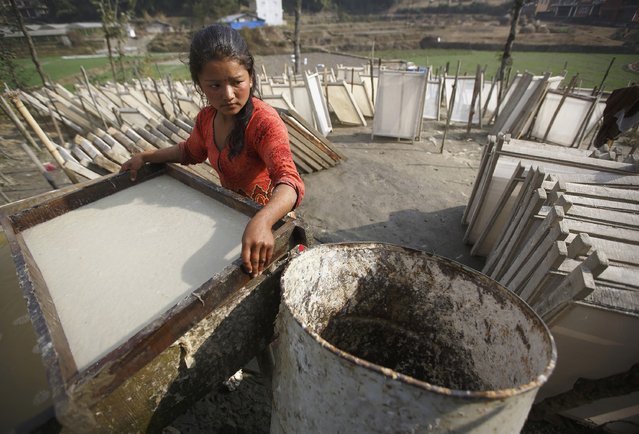
A woman works to create handmade Nepali Lokta paper in Kathmandu January 7, 2015. Lokta papers are made from the fibrous inner bark of Lokta bushes that are found over 5,000 metres above sea level. (Photo by Navesh Chitrakar/Reuters)

A woman works to create handmade Nepali Lokta paper in Kathmandu January 7, 2015. Lokta papers are made from the fibrous inner bark of Lokta bushes that are found over 5,000 metres above sea level. (Photo by Navesh Chitrakar/Reuters)
Details
15 Jan 2015 14:09:00
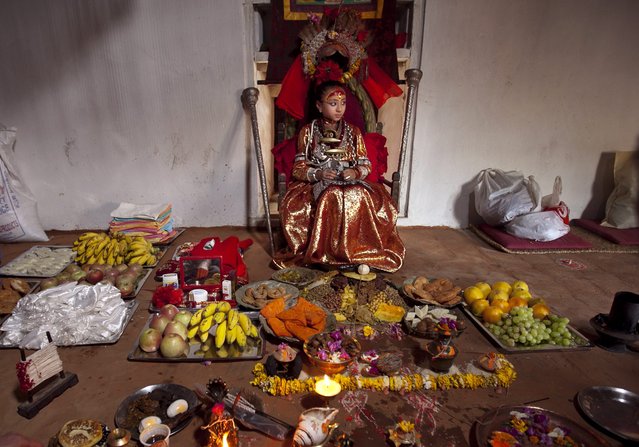
Kumari Samita Bajracharya sits in front of devotees offers during a special puja at Kumari Ghar in Patan, Nepal, 09 April 2011. It is believed that worshipping Kumari and receiving tika from her reduces illness and avoid problems. Kumari, or Kumari Devi, is a “living goddess”. The word literally means virgin in Nepali. The Living Goddesses are young pre-pubescent girls that are considered to be incarnations of the Hindu Goddess of Power, Kali. The Kumari retires when she reaches puberty. (Photo by Narendra Shrestha/EPA)

Kumari Samita Bajracharya sits in front of devotees offers during a special puja at Kumari Ghar in Patan, Nepal, 09 April 2011. It is believed that worshipping Kumari and receiving tika from her reduces illness and avoid problems. Kumari, or Kumari Devi, is a “living goddess”. The word literally means virgin in Nepali. The Living Goddesses are young pre-pubescent girls that are considered to be incarnations of the Hindu Goddess of Power, Kali. The Kumari retires when she reaches puberty. (Photo by Narendra Shrestha/EPA)
Details
18 Jun 2014 12:31:00
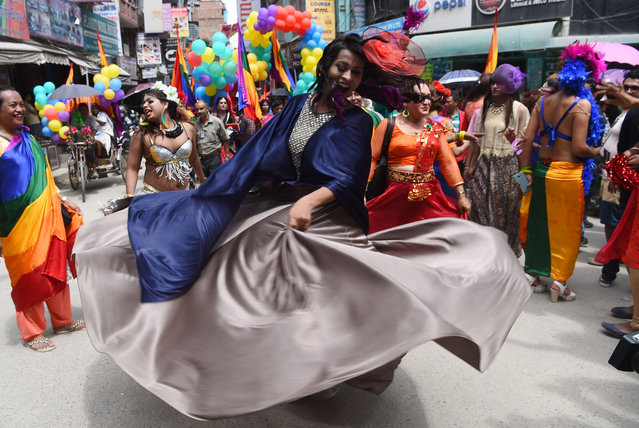
Nepali members of the LGBT community take part in a Gay Pride parade in Kathmandu on August 8, 2017. Scores of gays, lesbians, transvestites and transsexuals from across the country took part in the rally to spread their campaign for sexual rights in the country. In 2013 Nepal introduced citizenships with a third gender option and began issuing passports reflecting the same in 2015. (Photo by Prakash Mathema/AFP Photo)

Nepali members of the LGBT community take part in a Gay Pride parade in Kathmandu on August 8, 2017. Scores of gays, lesbians, transvestites and transsexuals from across the country took part in the rally to spread their campaign for sexual rights in the country. In 2013 Nepal introduced citizenships with a third gender option and began issuing passports reflecting the same in 2015. (Photo by Prakash Mathema/AFP Photo)
Details
09 Aug 2017 07:43:00
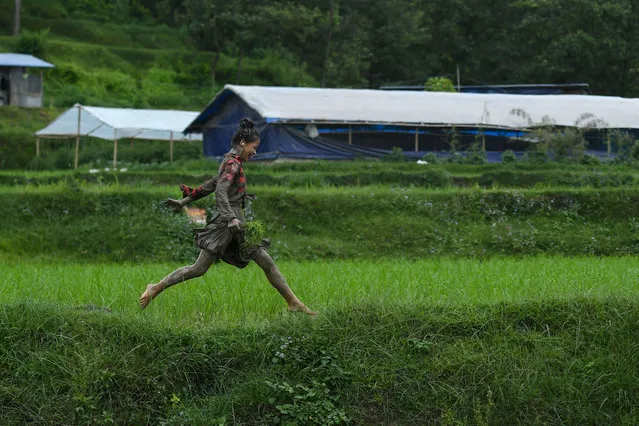
A girl walks along rice paddy fields during “National Paddy Day”, which marks the start of the annual rice planting season, in Tokha village on the outskirts of Kathmandu on June 29, 2020. Splashing mud and drinking local rice beer, Nepali farmers this week celebrated National Paddy Day to mark the beginning of the rice-planting season, despite some coronavirus lockdown measures still in place. Traditional farming songs and laughter echoed in the air as farmers waded into waterlogged fields to sow green paddy. (Photo by Prakash Mathema/AFP Photo)

A girl walks along rice paddy fields during “National Paddy Day”, which marks the start of the annual rice planting season, in Tokha village on the outskirts of Kathmandu on June 29, 2020. Splashing mud and drinking local rice beer, Nepali farmers this week celebrated National Paddy Day to mark the beginning of the rice-planting season, despite some coronavirus lockdown measures still in place. Traditional farming songs and laughter echoed in the air as farmers waded into waterlogged fields to sow green paddy. (Photo by Prakash Mathema/AFP Photo)
Details
02 Aug 2020 00:01:00