Loading...
Done
A reveler attends the “Volta, Alice” celebrations before Rio Carnival, in Rio de Janeiro, Brazil, 17 February 2019. The Carnival in Rio de Janeiro runs from 02 to 09 March 2019. (Photo by António Lacerda/EPA/EFE)

A reveler attends the “Volta, Alice” celebrations before Rio Carnival, in Rio de Janeiro, Brazil, 17 February 2019. The Carnival in Rio de Janeiro runs from 02 to 09 March 2019. (Photo by António Lacerda/EPA/EFE)
Details
19 Feb 2019 10:49:00
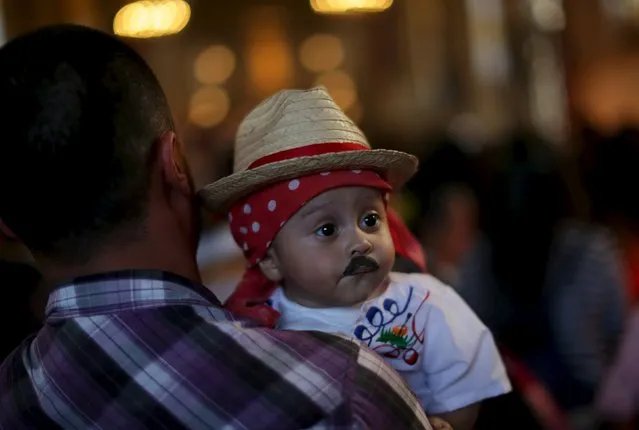
A man hugs a child at the Santuario de Nuestra Senora de Guadalupe during a celebration on the Virgin of Guadalupe Day in Guatemala City, December 12, 2015. According to Catholic believers, December 12 marks the anniversary of the apparition of the Virgin of Guadalupe at the Cerro del Tepeyac in Mexico. (Photo by Jorge Dan Lopez/Reuters)

A man hugs a child at the Santuario de Nuestra Senora de Guadalupe during a celebration on the Virgin of Guadalupe Day in Guatemala City, December 12, 2015. According to Catholic believers, December 12 marks the anniversary of the apparition of the Virgin of Guadalupe at the Cerro del Tepeyac in Mexico. (Photo by Jorge Dan Lopez/Reuters)
Details
14 Dec 2015 10:39:00
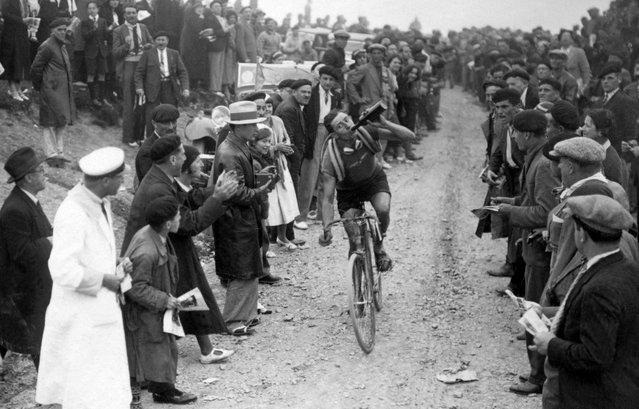
Frenchman Georges Speicher drinks as he starts riding down the Col de l'Aubisque during the 18th stage of the Tour de France between Tarbes and Pau. on July 17, 1933. Speicher finished second beaten by Spanish winner Learco Guerra to retain his overall leader's yellox jersey on his way to winning the Tour de France. (Photo by France Presse Voir/AFP Photo)

Frenchman Georges Speicher drinks as he starts riding down the Col de l'Aubisque during the 18th stage of the Tour de France between Tarbes and Pau. on July 17, 1933. Speicher finished second beaten by Spanish winner Learco Guerra to retain his overall leader's yellox jersey on his way to winning the Tour de France. (Photo by France Presse Voir/AFP Photo)
Details
18 Apr 2021 09:12:00
Cornish students (R) Nina Brooke, 21 and (L) Bonnie Mably, 20, laugh as they pose for a photograph as they try a Cornish pasty that has been baked as part of the World Cornish Pasty Championships at The Eden Project

“A Cornish pasty, sometimes known as a pastie or British pasty in the United States, is a filled pastry case, associated in particular with Cornwall in Great Britain. It is made by placing the uncooked filling on a flat pastry circle, and folding it to wrap the filling, crimping the edge at the side or top to form a seal. The result is a raised semicircular package”. – Wikipedia

Photo: Cornish students (R) Nina Brooke, 21 and (L) Bonnie Mably, 20, laugh as they pose for a photograph as they try a Cornish pasty that has been baked as part of the World Cornish Pasty Championships at The Eden Project on March 3, 2012 in St Austell, England. (Photo by Matt Cardy/Getty Images)

Details
04 Mar 2012 11:49:00
Performers take part in a parade during the annual Cervantes market (Mercado Cervantino) in the hometown of famous Spanish writer Miguel de Cervantes, Alcala de Henares, Spain, October 9, 2015. (Photo by Susana Vera/Reuters)

Performers take part in a parade during the annual Cervantes market (Mercado Cervantino) in the hometown of famous Spanish writer Miguel de Cervantes, Alcala de Henares, Spain, October 9, 2015. The Mercado Cervantino, which represents a market and fair from the 16th and 17th centuries, takes place in the city's historic centre and commemorates Miguel de Cervantes' baptism, which took place on October 9, 1547. (Photo by Susana Vera/Reuters)
Details
13 Oct 2015 08:06:00
Devotees of International Society for Krishna Consciousness (ISKCON) celebrate Holi, the Hindu spring festival of colours, at a temple on the outskirts of Amritsar on March 13, 2025. (Photo by Narinder Nanu/AFP Photo)

Devotees of International Society for Krishna Consciousness (ISKCON) celebrate Holi, the Hindu spring festival of colours, at a temple on the outskirts of Amritsar on March 13, 2025. (Photo by Narinder Nanu/AFP Photo)
Details
17 Mar 2025 03:49:00
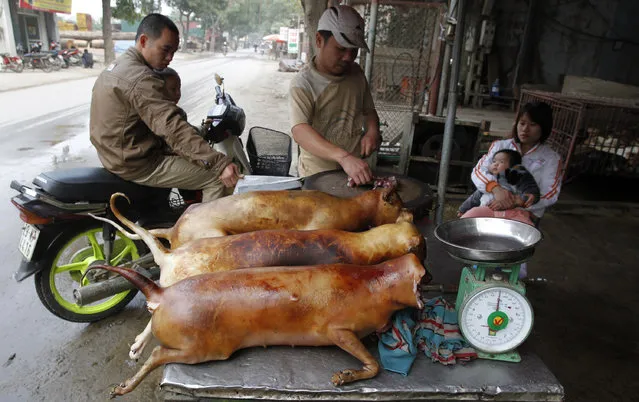
A vendor (C) cuts slaughtered dogs for sale at his roadside stall in Duong Noi village, outside Hanoi December 16, 2011. While animal rights activists have condemned eating dog meat as cruel treatment of the animals, it is still an accepted popular delicacy for some Vietnamese, as well in some other Asian countries. (Photo by Reuters/Kham)

A vendor (C) cuts slaughtered dogs for sale at his roadside stall in Duong Noi village, outside Hanoi December 16, 2011. While animal rights activists have condemned eating dog meat as cruel treatment of the animals, it is still an accepted popular delicacy for some Vietnamese, as well in some other Asian countries. Duong Noi is well-known as a dog-meat village, where hundreds of dogs are killed each day for sale as popular traditional food. Dog-eating as a custom is rooted in Vietnam and was developed as a result of poverty. One kilogram of dog meat costs about 130,000 dongs ($6.2). (Photo by Reuters/Kham)
Details
16 Jul 2013 11:40:00
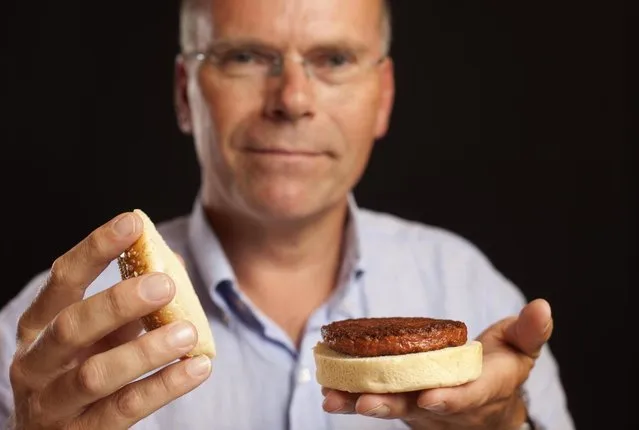
In this handout image provided by Ogilvy, a burger made from cultured beef, which has been developed by Professor Mark Post of Maastricht University in the Netherlands (pictured) is shown to the media during a press conference on August 5, 2013 in London, England. Cultured Beef could help solve the coming food crisis and combat climate change with commercial production of Cultured Beef beginning within ten to twenty years. (Photo by David Parry via Getty Images)

In this handout image provided by Ogilvy, a burger made from cultured beef, which has been developed by Professor Mark Post of Maastricht University in the Netherlands (pictured) is shown to the media during a press conference on August 5, 2013 in London, England. The in-vitro burger, cultured from cattle stem cells, the first example of what its creator says could provide an answer to global food shortages and help combat climate change, was fried in a pan and tasted by two volunteers. The burger is the result of years of research by Dutch scientist Mark Post, a vascular biologist at the University of Maastricht, who is working to show how meat grown in petri dishes might one day be a true alternative to meat from livestock.The meat in the burger has been made by knitting together around 20,000 strands of protein that has been cultured from cattle stem cells in Post's lab. (Photo by David Parry)
Details
06 Aug 2013 08:48:00