Loading...
Done
The opening of sculptor Carole Feuerman solo outdoor public art show, Sea Idylls, on Park Avenue in NYC on April 27, 2023. The hyperrealistic sculptures in conjunction with Les Galeries Bartoux and Patrons of Park Avenue line the median. (Photo by Milo Hess/ZUMA Press Wire/Rex Features/Shutterstock)

The opening of sculptor Carole Feuerman solo outdoor public art show, Sea Idylls, on Park Avenue in NYC on April 27, 2023. The hyperrealistic sculptures in conjunction with Les Galeries Bartoux and Patrons of Park Avenue line the median. (Photo by Milo Hess/ZUMA Press Wire/Rex Features/Shutterstock)
Details
06 Jun 2023 04:52:00
Handmade Candies Store

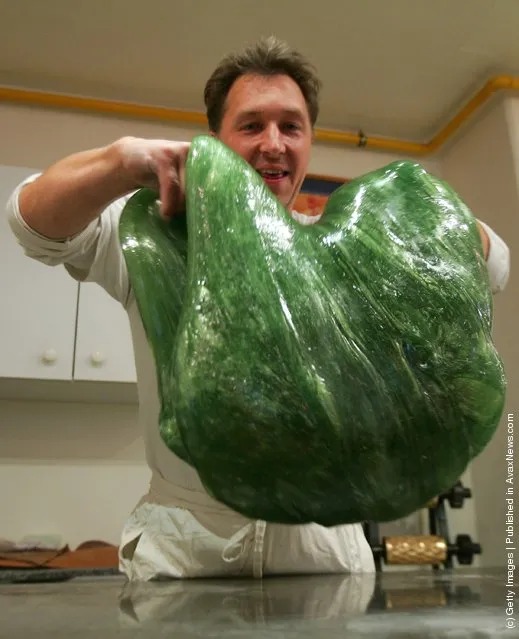
Hjalmar kneads the raw candy paste on a table on October 12, 2007 in Berlin, Germany. The Berlin based candy store produces 30 different kinds of handmade candies according traditional recipes. (Photo by Andreas Rentz/Getty Images)
Details
16 Oct 2011 10:31:00
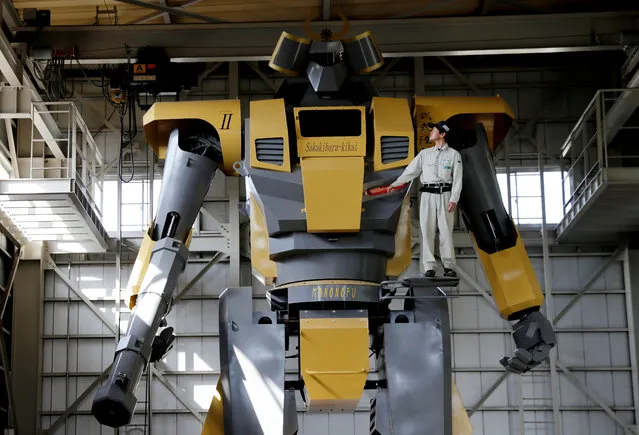
Sakakibara Kikai's engineer Go Sakakibara poses with the bipedal robot Mononofu during its demonstration at its factory in Shinto Village, Gunma Prefecture, Japan on April 12, 2018. Developed at Sakakibara Kikai, a maker of farming machinery, LW-Mononofu is a 28-feet tall, two-legged robot weighing in at more than 7 tonnes. It contains a cockpit with monitors and levers for the pilot to control the robot's arms and legs. (Photo by Kim Kyung-Hoon/Reuters)

Sakakibara Kikai's engineer Go Sakakibara poses with the bipedal robot Mononofu during its demonstration at its factory in Shinto Village, Gunma Prefecture, Japan on April 12, 2018. Developed at Sakakibara Kikai, a maker of farming machinery, LW-Mononofu is a 28-feet tall, two-legged robot weighing in at more than 7 tonnes. It contains a cockpit with monitors and levers for the pilot to control the robot's arms and legs. (Photo by Kim Kyung-Hoon/Reuters)
Details
17 Apr 2018 00:01:00


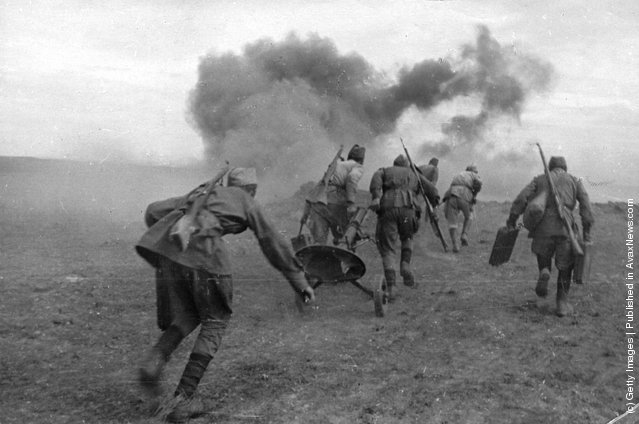
A Russian trenchmortar crew run to take up a new firing position in the Stalingrad area during the Great Patriotic War. (Photo by Keystone/Getty Images). October 1942
Details
25 May 2011 09:25:00
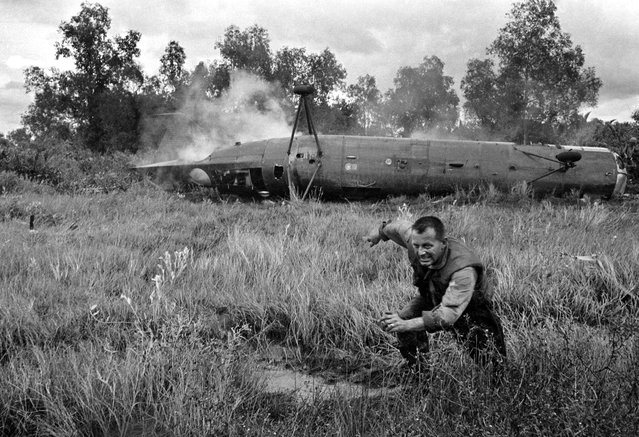
A U.S. crewman runs from a crashed CH-21 Shawnee troop helicopter near the village of Ca Mau in the southern tip of South Vietnam, Dec. 11, 1962

“Horst Faas (28 April 1933 – 10 May 2012) was a German photo-journalist and two-time Pulitzer Prize winner. He is best-known for his images of the Vietnam War”. – Wikipedia

Photo: A U.S. crewman runs from a crashed CH-21 Shawnee troop helicopter near the village of Ca Mau in the southern tip of South Vietnam, December 11, 1962. Two helicopters crashed without serious injuries during a government raid on the Viet Cong-infiltrated area. Both helicopters were destroyed to keep them out of enemy hands. (Photo by AP Photo/Horst Faas)
Details
24 May 2012 09:43:00
Second World War Fighter Plane Found Preserved In The Sahara

The number of soldiers on both sides of WWII that were killed or went missing is just staggering. Now, the mystery surrounding one RAF pilot and what happened to him and his plane has been solved after 70 years. RAF flight Sergeant Dennis Copping climbed into his Kittyhawk P-40 aircraft in June 1942 to fly the plane to another airbase for repairs. He was never seen or heard from again.
Details
02 Oct 2014 18:42:00
Extraordinary images of the cruise ship by Jonathan Danko Kielkowski from his book Concordia, published by White Press. The German photographer swam out to where the ship – which ran aground off Tuscany in 2012 with the loss of 32 lives – is moored. Francesco Schettino, the ship’s captain, was jailed for 16 years over the accident. (Photo by Jonathan Danko Kielkowski)

Extraordinary images of the cruise ship by Jonathan Danko Kielkowski from his book Concordia, published by White Press. The German photographer swam out to where the ship – which ran aground off Tuscany in 2012 with the loss of 32 lives – is moored. Francesco Schettino, the ship’s captain, was jailed for 16 years over the accident. (Photo by Jonathan Danko Kielkowski)
Details
23 Jan 2016 13:34:00
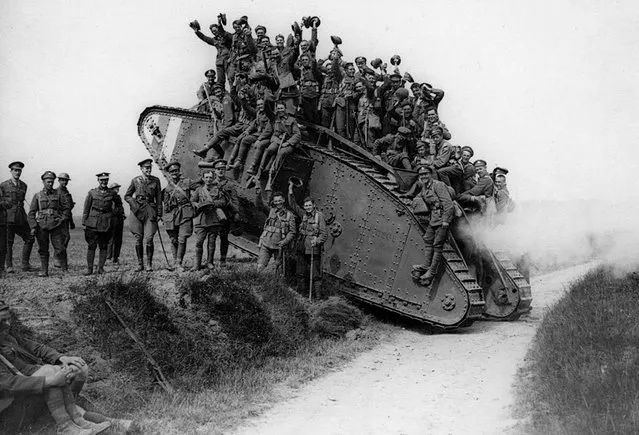
These black-and-white photos are taken from the new book “Armoured Warfare in the First World War 1916 – 1918” by Anthony Tucker-Jones and published by Pen & Sword Military. “Interestingly the British, French and Germans took completely different approaches with varying results”. The British military produced “Little Willie” in Autumn 1915 weighing 18 tonnes, which had a crew of two plus four gunners. “Inspired by a tracked artillery tractor “Little Willie” was referred to as a water tank – hence the name tank – to ensure secrecy”, said Anthony. “This led to the strange looking Mark I with its peculiar rhomboid shape, designed to cross trenches with guns in sponsons on either side. The Germans saw the tank as unchivalrous and were slow to grasp its utility. They favoured the Stormtrooper (specialist soldiers used to infiltrate enemy trenches) and artillery, not the tank”, said Anthony. “However, they didn’t hesitate to make use of captured British tanks. Although the tank helped secure victory and German soldiers dubbed it “Germany’s Downfall” the country was ultimately brought to its knees by the Allies blockade”. Here: British troops hitch a ride on a Mark IV after the massed tank fleet spearheading attack at Cambrai on November 20, 1917. (Photo by Anthony Tucker-Jones/Mediadrumworld.com)

These black-and-white photos are taken from the new book “Armoured Warfare in the First World War 1916 – 1918” by Anthony Tucker-Jones and published by Pen & Sword Military. Here: British troops hitch a ride on a Mark IV after the massed tank fleet spearheading attack at Cambrai on November 20, 1917. (Photo by Anthony Tucker-Jones/Mediadrumworld.com)
Details
23 Feb 2017 00:02:00