Loading...
Done


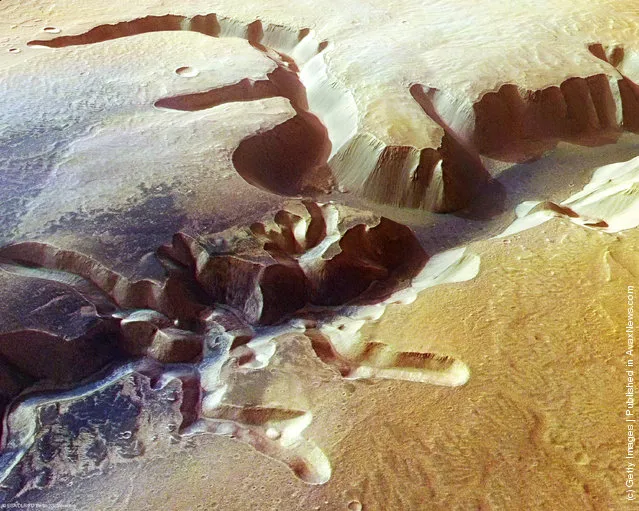
“Echus Chasma is a chasma in the Lunae Planum high plateau north of the Valles Marineris canyon system of Mars. Clay has been found in Echus Chasma that means that water once sat there for a time. Echus Chasma is approximately 100 km long and 10 km wide, with valleys ranging in depth from around 1 km to 4 km”. – Wikipedia

Photo: In this handout image supplied by the European Space Agency (ESA) on July 16, 2008, The Echus Chasma, one of the largest water source regions on Mars, is pictured from ESA's Mars Express. The data was acquired on September 25, 2005. The dark material shows a network of light-coloured, incised valleys that look similar to drainage networks known on Earth. It is still debated whether the valleys originate from precipitation, groundwater springs or liquid or magma flows on the surface. (Photo by ESA via Getty Images)
Details
18 Jul 2011 11:47:00
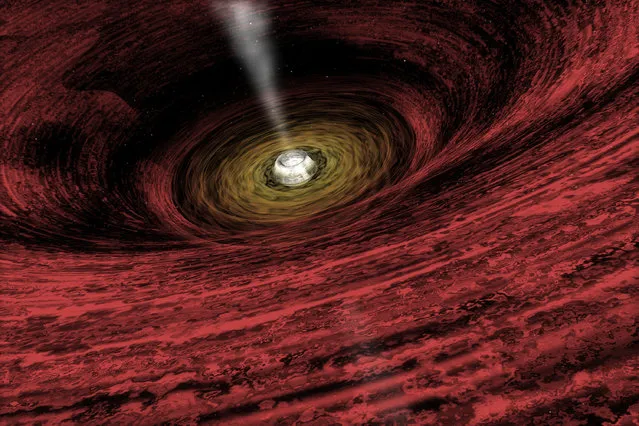
An artist's impression of a growing supermassive black hole located in the early Universe is seen in this NASA handout illustration released on June 15, 2011. Using the deepest X-ray image ever taken, astronomers found the first direct evidence that massive black holes were common in the early universe. This discovery from NASA's Chandra X-Ray Observatory shows that very young black holes grew more aggressively than previously thought, in tandem with the growth of their host galaxies. (Photo by Reuters/NASA/Chandra X-Ray Observatory/A.Hobart)

An artist's impression of a growing supermassive black hole located in the early Universe is seen in this NASA handout illustration released on June 15, 2011. Using the deepest X-ray image ever taken, astronomers found the first direct evidence that massive black holes were common in the early universe. This discovery from NASA's Chandra X-Ray Observatory shows that very young black holes grew more aggressively than previously thought, in tandem with the growth of their host galaxies. (Photo by Reuters/NASA/Chandra X-Ray Observatory/A.Hobart)
Details
11 Feb 2016 12:57:00
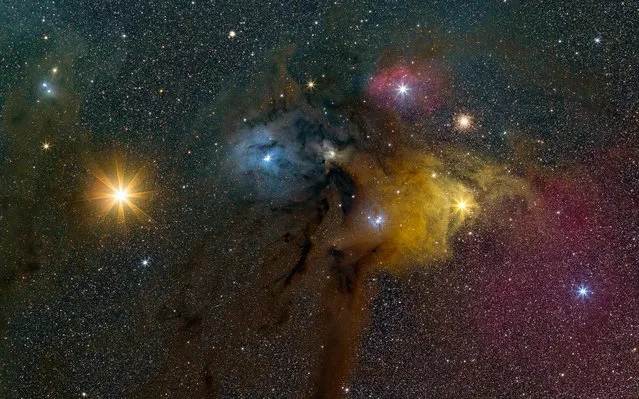
Mars and its Rival Antares and the Rho Ophiuchi cloud complex. (Photo by Phil Hart/CWAS/The Guardian)

These spectacular images of the universe are the finalists in the 2016 CWAS “David Malin” awards. The annual competition, which celebrates the best astronomy images taken by Australian photographers, is part of AstroFest 2016. The winners will be announced on 16 July. An associated exhibition opens the following day at the CSIRO Parkes Observatory visitors centre, and a second exhibition will also travel to selected venues around Australia. Here: Mars and its Rival Antares and the Rho Ophiuchi cloud complex. (Photo by Phil Hart/CWAS/The Guardian)
Details
12 Jul 2016 12:08:00
Colombia's Tatiana Renteria Renteria (red) wrestles Japan's Yuka Kagami (blue) in their women's freestyle 76kg wrestling semi-final match at the Champ-de-Mars Arena during the Paris 2024 Olympic Games, in Paris on August 10, 2024. (Photo by Punit Paranjpe/AFP Photo)

Colombia's Tatiana Renteria Renteria (red) wrestles Japan's Yuka Kagami (blue) in their women's freestyle 76kg wrestling semi-final match at the Champ-de-Mars Arena during the Paris 2024 Olympic Games, in Paris on August 10, 2024. (Photo by Punit Paranjpe/AFP Photo)
Details
04 Dec 2025 03:07:00
Dream Chaser

“The Dream Chaser is a planned crewed suborbital and orbital vertical-takeoff, horizontal-landing (VTHL) lifting-body spaceplane being developed by SpaceDev, a wholly owned subsidiary of Sierra Nevada Corporation (SNC). The Dream Chaser design is planned to carry seven people to and from low earth orbit. The vehicle would launch vertically on an Atlas V and land horizontally on conventional runways”. – Wikipedia

Photo: NASA Deputy Administrator Lori Garver talks during a press conference with Sierra Nevada's Dream Chaser spacecraft in the background at the University of Colorado at Boulder on February 5, 2011 in Boulder, Colorado. Sierra Nevada's Dream Chaser spacecraft is under development with support from NASA's Commercial Crew Development Program to provide crew transportation to and from low Earth orbit. NASA is helping private companies develop innovative technologies to ensure that the U.S. remains competitive in future space endeavors. (Photo by Bill Ingalls/NASA via Getty Images)
Details
12 Aug 2011 14:16:00
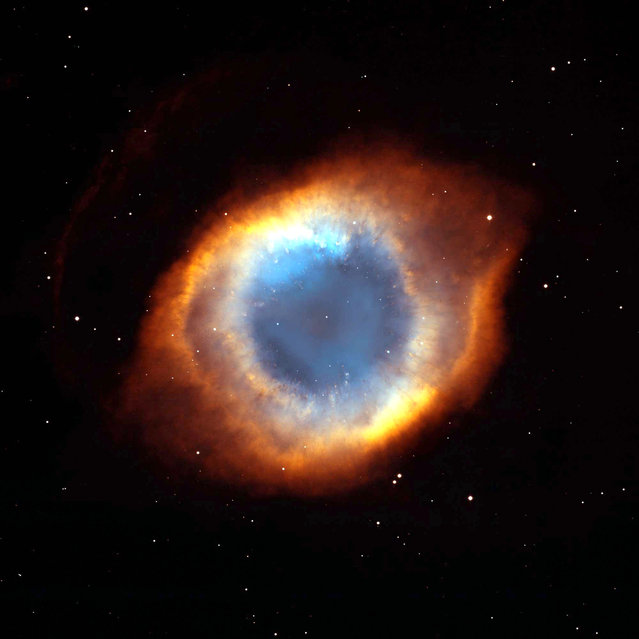
A coil-shaped Helix Nebula showing a fine web of filamentary “bicycle-spoke” features embedded in the colorful red and blue ring of gas. At 650 light-years away, the Helix is one of the nearest planetary nebulae to Earth. A planetary nebula is the glowing gas around a dying, Sun-like star. (Photo by Reuters/NASA)

A coil-shaped Helix Nebula showing a fine web of filamentary “bicycle-spoke” features embedded in the colorful red and blue ring of gas. At 650 light-years away, the Helix is one of the nearest planetary nebulae to Earth. A planetary nebula is the glowing gas around a dying, Sun-like star. (Photo by Reuters/NASA)
Details
22 Oct 2014 14:01:00
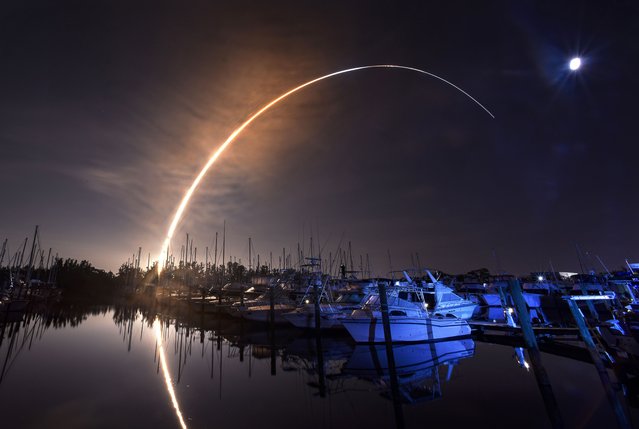
NASA's new moon rocket lifts off from the Kennedy Space Center in Cape Canaveral, Wednesday morning, November 16, 2022, as seen from Harbor town Marina on Merritt Island, Fla. The moon is visible in the sky. (Photo by Malcolm Denemark/Florida Today via AP Photo)

NASA's new moon rocket lifts off from the Kennedy Space Center in Cape Canaveral, Wednesday morning, November 16, 2022, as seen from Harbor town Marina on Merritt Island, Fla. The moon is visible in the sky. (Photo by Malcolm Denemark/Florida Today via AP Photo)
Details
23 Nov 2022 04:21:00
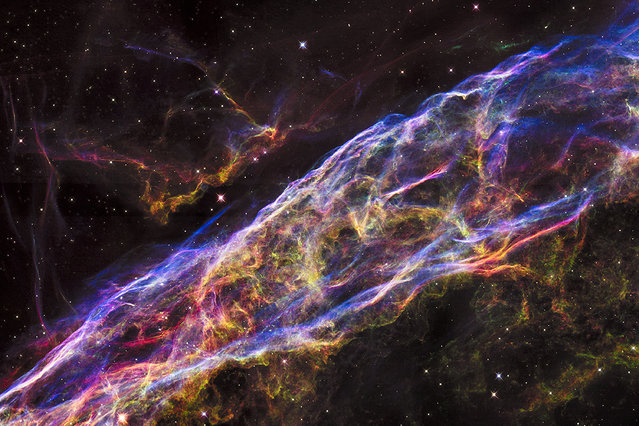
A small section of the expanding remains of the Veil Nebula, a massive star that exploded about 8,000 years ago. The entire nebula is 110 light-years across, covering six full moons on the sky as seen from Earth, and resides about 2,100 light-years away in the constellation Cygnus, the Swan. Image taken by NASA's Hubble Space Telescope. Released September 24, 2015. (Photo by Reuters/NASA/ESA/Hubble Heritage Team)

A small section of the expanding remains of the Veil Nebula, a massive star that exploded about 8,000 years ago. The entire nebula is 110 light-years across, covering six full moons on the sky as seen from Earth, and resides about 2,100 light-years away in the constellation Cygnus, the Swan. Image taken by NASA's Hubble Space Telescope. Released September 24, 2015. (Photo by Reuters/NASA/ESA/Hubble Heritage Team)
Details
10 Dec 2015 08:01:00