Loading...
Done
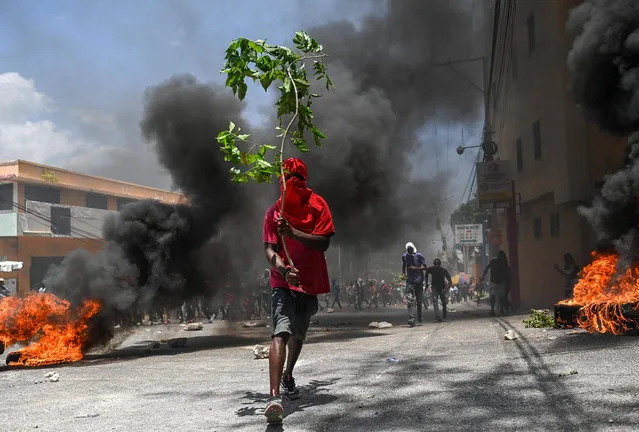
A man holds a tree branch and marches by burning tires during a protest against insecurity, on August 7, 2023, near the Prime Minister's official house in Port-au-Prince, Haiti. Some 300 women and minors were kidnapped in Haiti by criminal gangs in the first half of this year, UNICEF said Monday, warning of a disturbing rise in abductions that leave “deep physical and psychological scars”. The surge in abductions threatens “both the people of Haiti and those who have come to help”. (Photo by Richard Pierrin/AFP Photo)

A man holds a tree branch and marches by burning tires during a protest against insecurity, on August 7, 2023, near the Prime Minister's official house in Port-au-Prince, Haiti. Some 300 women and minors were kidnapped in Haiti by criminal gangs in the first half of this year, UNICEF said Monday, warning of a disturbing rise in abductions that leave “deep physical and psychological scars”. The surge in abductions threatens “both the people of Haiti and those who have come to help”. (Photo by Richard Pierrin/AFP Photo)
Details
19 Aug 2023 04:04:00
A moto-taxi driver takes two passengers past a burning barricade set up by people protesting fuel shortages in Port-au-Prince, Haiti, Monday, September 16, 2019. Haiti was at a standstill Monday with no public transportation available and closed banks, government offices, and schools amid street protests due to a fuel crisis. (Photo by Dieu Nalio Chery/AP Photo)

A moto-taxi driver takes two passengers past a burning barricade set up by people protesting fuel shortages in Port-au-Prince, Haiti, Monday, September 16, 2019. Haiti was at a standstill Monday with no public transportation available and closed banks, government offices, and schools amid street protests due to a fuel crisis. (Photo by Dieu Nalio Chery/AP Photo)
Details
27 Sep 2019 00:03:00
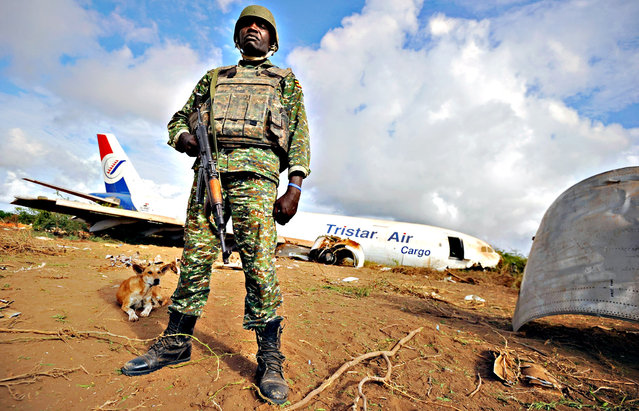
A soldier from the African Union (AU) peacekeeping force stands guard at the site where a cargo plane carrying supplies for AU troops crash-landed outside Somalia's capital, on October 13, 2015 at Abirska, some 18 kilometres outside Somalian capital, Mogadishu. The officials said the Egyptian-owned transport plane went down after making several unsuccessful passes over the seafront airport. (Photo by Mohamed Abdiwahab/AFP Photo)

A soldier from the African Union (AU) peacekeeping force stands guard at the site where a cargo plane carrying supplies for AU troops crash-landed outside Somalia's capital, on October 13, 2015 at Abirska, some 18 kilometres outside Somalian capital, Mogadishu. The officials said the Egyptian-owned transport plane went down after making several unsuccessful passes over the seafront airport. Two of the six crew members suffered light injuries in the crash, the officials said, but added that the plane and those on board were safe having landed in an area controlled by the Somali government and the African Union's AMISOM force. (Photo by Mohamed Abdiwahab/AFP Photo)
Details
16 Oct 2015 08:02:00
Villagers from Jiexi Jiantan village perform a ritual of “Zha Laoye”, or “Cracking local spirits”, in Chaoshan, Guangdong Province, China, 10 February 2019. Jiexi Jiantan Village celebrates the annual custom of “Zha Laoye” where Laoye are local spirits. Every third day of the lunar New Year, statues of local spirits known as the “Thousand-mile Eye” Laoye and “Ear Following the Wind” Laoye are brought out to the village committee to receive incensed tea offered by believers. By the sixth day of the year, the “Zha Laoye” activities begin with each man holding one of the statues on a chair above his head while run around a bonfire. Two other men light firecrackers strung up on a long bamboo poles and chase the spirit around the bonfire, signifying a bountiful new year. (Photo by EPA/EFE/ZNSEN)

Villagers from Jiexi Jiantan village perform a ritual of “Zha Laoye”, or “Cracking local spirits”, in Chaoshan, Guangdong Province, China, 10 February 2019. Jiexi Jiantan Village celebrates the annual custom of “Zha Laoye” where Laoye are local spirits. Every third day of the lunar New Year, statues of local spirits known as the “Thousand-mile Eye” Laoye and “Ear Following the Wind” Laoye are brought out to the village committee to receive incensed tea offered by believers. (Photo by EPA/EFE/ZNSEN)
Details
23 Feb 2019 00:07:00
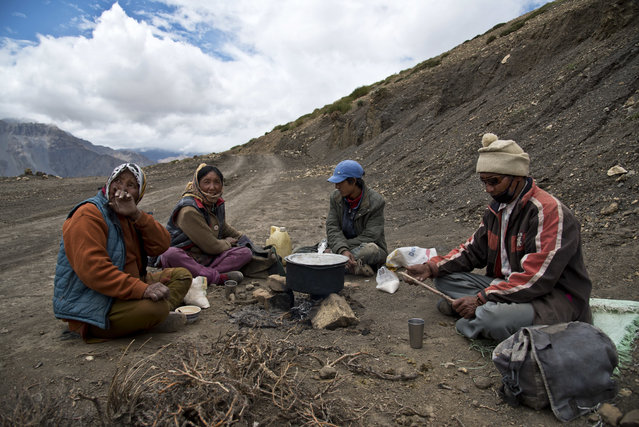
In this August 17, 2016, photo, from left to right, Chhering Chodom, 60, Tashi Yangzom, 50, Lobsang Chhering, 27, and Dorje Tandup, 58, drink milk tea on the side of the road. For centuries, the sleepy valley nestled in the Indian Himalayas remained a hidden Buddhist enclave forbidden to outsiders. Enduring the harsh year-round conditions of the high mountain desert, the people of Spiti Valley lived by a simple communal code – share the Earth's bounty, be hospitable to neighbors, and eschew greed and temptation at all turns. That's all starting to change, for better or worse. Since India began allowing its own citizens as well as outsiders to visit the valley in the early 1990s, tourism and trade have boomed. And the marks of modernization, such as solar panels, asphalt roads and concrete buildings, have begun to appear around some of the villages that dot the remote landscape at altitudes above 4,000 meters (13,000 feet). (Photo by Thomas Cytrynowicz/AP Photo)

In this August 17, 2016, photo, from left to right, Chhering Chodom, 60, Tashi Yangzom, 50, Lobsang Chhering, 27, and Dorje Tandup, 58, drink milk tea on the side of the road. For centuries, the sleepy valley nestled in the Indian Himalayas remained a hidden Buddhist enclave forbidden to outsiders. Enduring the harsh year-round conditions of the high mountain desert, the people of Spiti Valley lived by a simple communal code – share the Earth's bounty, be hospitable to neighbors, and eschew greed and temptation at all turns. That's all starting to change, for better or worse. (Photo by Thomas Cytrynowicz/AP Photo)
Details
15 Sep 2016 09:22:00
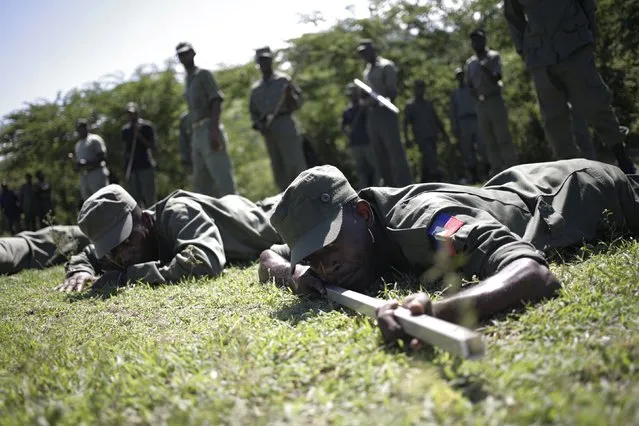
A man holds a metal bar as a weapon during a training day for former soldiers and volunteers train in a makeshift camp in the outskirts of Port-au-Prince, Haiti, October 28, 2015. Haiti disbanded its abusive armed forces two decades ago but uniformed veterans and young recruits are resurfacing to add another destabilising factor to the volatile Caribbean nation already dealing with a political vacuum. (Photo by Andres Martinez Casares/Reuters)

A man holds a metal bar as a weapon during a training day for former soldiers and volunteers train in a makeshift camp in the outskirts of Port-au-Prince, Haiti, October 28, 2015. Haiti disbanded its abusive armed forces two decades ago but uniformed veterans and young recruits are resurfacing to add another destabilising factor to the volatile Caribbean nation already dealing with a political vacuum. (Photo by Andres Martinez Casares/Reuters)
Details
15 Feb 2016 10:05:00
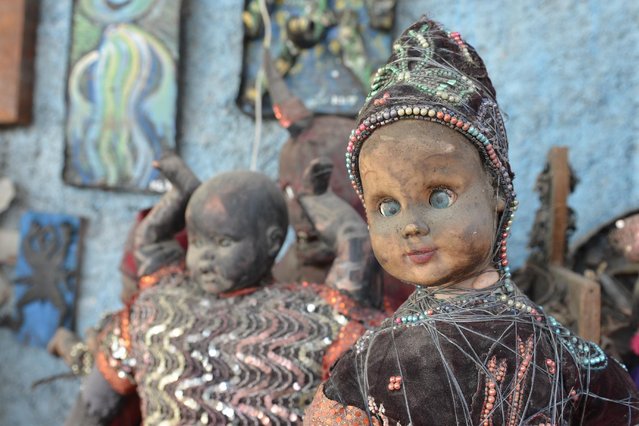
In this April 2, 2016 photo, dusty sculptures made of cast-off baby dolls sit in an open-air museum and art workshop off a trash-strewn street cutting through some of the poorest neighborhoods in Port-au-Prince, Haiti. They were created by Haitian artists called Atis Rezistans who have become celebrated in the international art world by creating sculptures out of scrapped car parts, old wood, discarded toys and even human skulls found scattered outside crumbling mausoleums. (Photo by David McFadden/AP Photo)

In this April 2, 2016 photo, dusty sculptures made of cast-off baby dolls sit in an open-air museum and art workshop off a trash-strewn street cutting through some of the poorest neighborhoods in Port-au-Prince, Haiti. They were created by Haitian artists called Atis Rezistans who have become celebrated in the international art world by creating sculptures out of scrapped car parts, old wood, discarded toys and even human skulls found scattered outside crumbling mausoleums. (Photo by David McFadden/AP Photo)
Details
12 Apr 2016 11:10:00
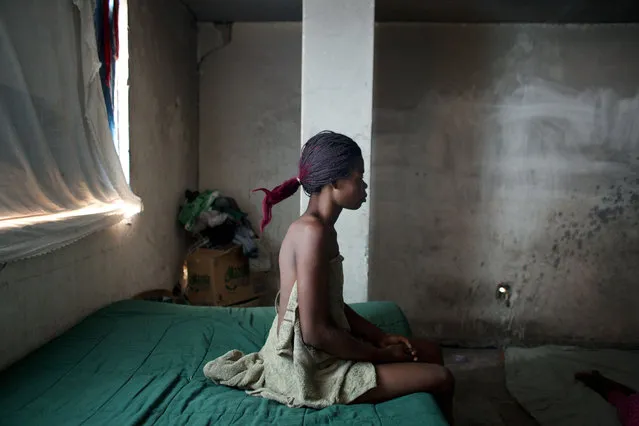
In this June 29, 2015 photo, hairdresser Loavia Bienaime, 30, sits on her bed as she prepares to begin her day in the room her family occupies in an government office building that was damaged in the 2010 earthquake in Port-au-Prince, Haiti. Bienaime's husband, Jimmy Bellefleur, used his skill as an electrician to connect the abandoned building to the power grid, and has repaired broken televisions, fans, and a blender for the family to use. (Photo by Rebecca Blackwell/AP Photo)

In this June 29, 2015 photo, hairdresser Loavia Bienaime, 30, sits on her bed as she prepares to begin her day in the room her family occupies in an government office building that was damaged in the 2010 earthquake in Port-au-Prince, Haiti. Bienaime's husband, Jimmy Bellefleur, used his skill as an electrician to connect the abandoned building to the power grid, and has repaired broken televisions, fans, and a blender for the family to use. (Photo by Rebecca Blackwell/AP Photo)
Details
05 Aug 2015 13:21:00