Loading...
Done
The Three Peaks Of Lavaredo

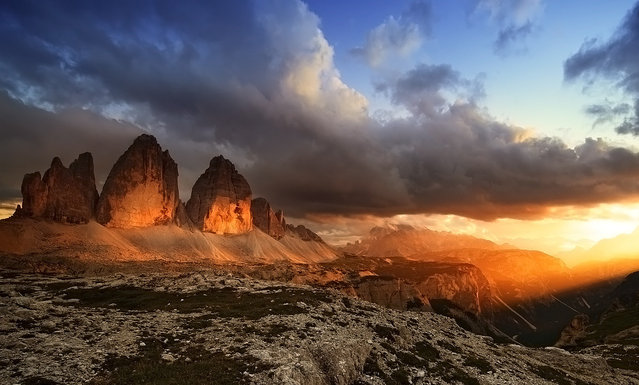
The three peaks of Lavaredo, or the “Tre Cime di Lavaredo” in Italian, are three distinctive battlement-like peaks, in the Sexten Dolomites of northeastern Italy. They are probably one of the best-known mountain groups in the Alps, and one of the most photographed in Italy. The three peaks are named, from east to west, "little peak" (Cima Piccola), "big peak" (Cima Grande) and "western peak" (Cima Ovest). The Cima Grande has an elevation of 2,999 metres (9,839 ft). It stands between the Cima Piccola, at 2,857 metres (9,373 ft), and the Cima Ovest, at 2,973 metres (9,754 ft).
Details
21 Oct 2013 10:27:00
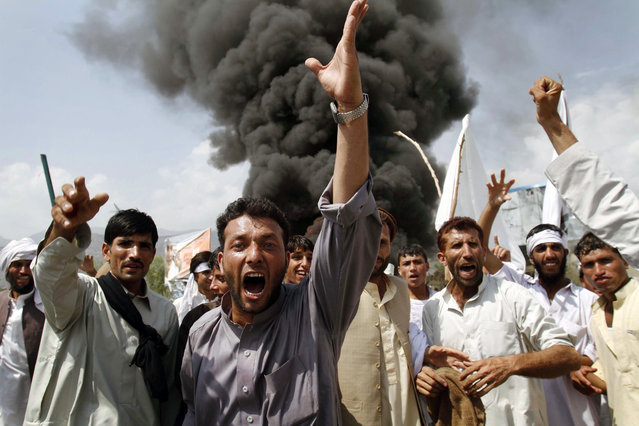
Afghans shout anti-U.S. slogans as they burn tires and block a highway during a protest in reaction to a small American church's plan to burn copies of the Quran, at Jalalabad, east of Kabul, Afghanistan, Friday, September 10, 2010. Religious and political leaders across the Muslim world welcomed a decision by the church to suspend its plans to torch copies of their holy book but some said Friday the damage has already been done. (Photo by Rahmat Gul/AP Photo)

Afghans shout anti-U.S. slogans as they burn tires and block a highway during a protest in reaction to a small American church's plan to burn copies of the Quran, at Jalalabad, east of Kabul, Afghanistan, Friday, September 10, 2010. Religious and political leaders across the Muslim world welcomed a decision by the church to suspend its plans to torch copies of their holy book but some said Friday the damage has already been done. (Photo by Rahmat Gul/AP Photo)
Details
07 Apr 2016 14:52:00
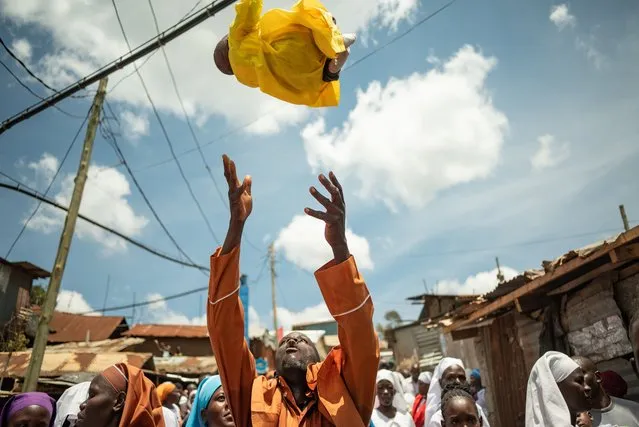
A member of the Africa Roho Msalaba church throws a 2 month old baby into the air during the “Throwing babies into the air” ritual in Kibera Slum of Nairobi, Kenya on March 10, 2024. The babies of the members of the Africa Roho Msalaba church, who are not taken out of the house until they are 2 months old and are not allowed to be seen by strangers, are introduced to the community by being paraded through the streets with the 'throwing babies in the air' ritual. (Photo by Edwin Ndeke/Anadolu via Getty Images)

A member of the Africa Roho Msalaba church throws a 2 month old baby into the air during the “Throwing babies into the air” ritual in Kibera Slum of Nairobi, Kenya on March 10, 2024. The babies of the members of the Africa Roho Msalaba church, who are not taken out of the house until they are 2 months old and are not allowed to be seen by strangers, are introduced to the community by being paraded through the streets with the 'throwing babies in the air' ritual. (Photo by Edwin Ndeke/Anadolu via Getty Images)
Details
02 Apr 2024 03:57:00
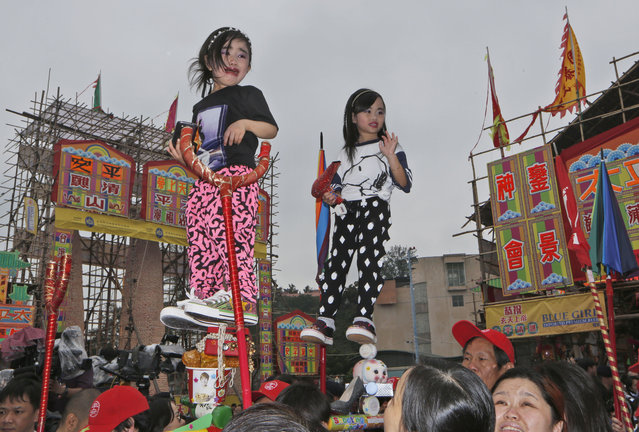
A young performer cries as she parades during the Bun Festival on Cheung Chau island in Hong Kong Tuesday, May 6, 2014. Bun Festival, the Taoist God of the Sea, is worshipped and evil spirits are believed to be scared away by loud gongs and drums during the procession. The celebration includes bun scrambling, parades, opera performances, and children dressed in colorful costumes. (Photo by Kin Cheung/AP Photo)

A young performer cries as she parades during the Bun Festival on Cheung Chau island in Hong Kong Tuesday, May 6, 2014. Bun Festival, the Taoist God of the Sea, is worshipped and evil spirits are believed to be scared away by loud gongs and drums during the procession. The celebration includes bun scrambling, parades, opera performances, and children dressed in colorful costumes. (Photo by Kin Cheung/AP Photo)
Details
08 May 2014 07:31:00
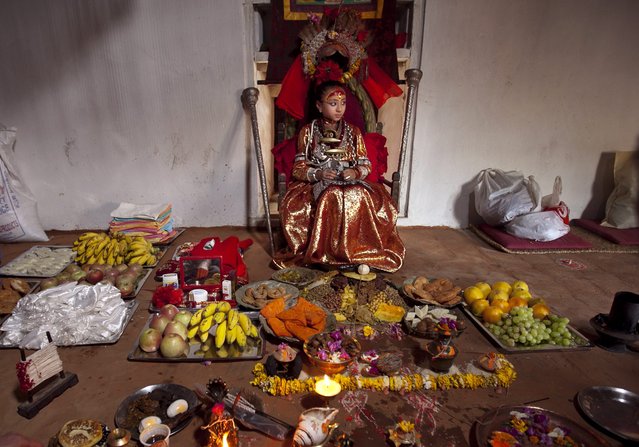
Kumari Samita Bajracharya sits in front of devotees offers during a special puja at Kumari Ghar in Patan, Nepal, 09 April 2011. It is believed that worshipping Kumari and receiving tika from her reduces illness and avoid problems. Kumari, or Kumari Devi, is a “living goddess”. The word literally means virgin in Nepali. The Living Goddesses are young pre-pubescent girls that are considered to be incarnations of the Hindu Goddess of Power, Kali. The Kumari retires when she reaches puberty. (Photo by Narendra Shrestha/EPA)

Kumari Samita Bajracharya sits in front of devotees offers during a special puja at Kumari Ghar in Patan, Nepal, 09 April 2011. It is believed that worshipping Kumari and receiving tika from her reduces illness and avoid problems. Kumari, or Kumari Devi, is a “living goddess”. The word literally means virgin in Nepali. The Living Goddesses are young pre-pubescent girls that are considered to be incarnations of the Hindu Goddess of Power, Kali. The Kumari retires when she reaches puberty. (Photo by Narendra Shrestha/EPA)
Details
18 Jun 2014 12:31:00
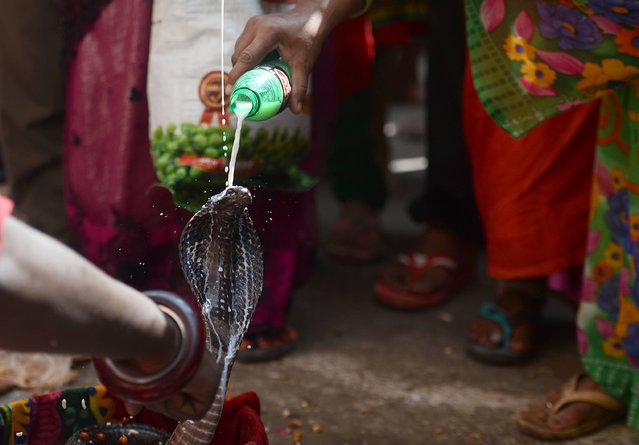
An Indian Hindu devotee pours milk on a snake as an offering during the annual Nag Panchami festival, dedicated to the worship of snakes outside the Nagvasuki temple, in Allahabad, on July 28, 2017. (Photo by Sanjay Kanojia/AFP Photo)

An Indian Hindu devotee pours milk on a snake as an offering during the annual Nag Panchami festival, dedicated to the worship of snakes outside the Nagvasuki temple, in Allahabad, on July 28, 2017. Officially the snake charmers' profession is banned in India, but many in the country offered prayers and milk blessings to cobras and other deadly serpents on July 28 in an annual tribute. The 800,000 charmers and their young apprentices come to the fore for the Nag Panchami festival which dates back several centuries. (Photo by Sanjay Kanojia/AFP Photo)
Details
31 Jul 2017 09:17:00
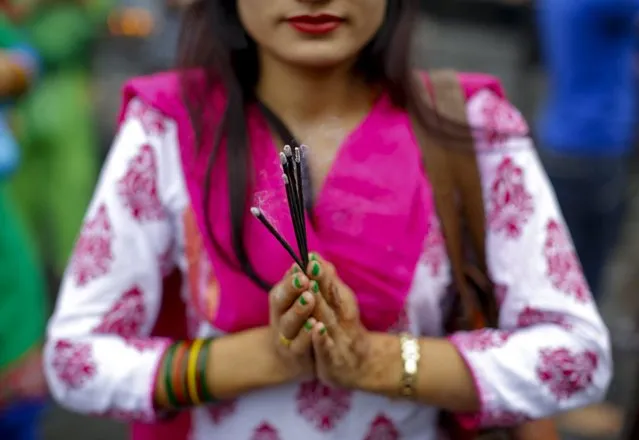
Nepalese Hindu women pray to worship Lord Shiva during the first day of the Sarwan Brata festival, the month of fasting, at the premises of Pashupati Temple in Kathmandu, Nepal, 18 July 2016. Thousands of married and single Nepalese Hindu women will gather in temples for each Monday of the Sawan month (spanning from 16 July to 16 August) to pray for a long and prosperous life of their husbands or for a chance to find a good one. (Photo by Narendra Shrestha/EPA)

Nepalese Hindu women pray to worship Lord Shiva during the first day of the Sarwan Brata festival, the month of fasting, at the premises of Pashupati Temple in Kathmandu, Nepal, 18 July 2016. Thousands of married and single Nepalese Hindu women will gather in temples for each Monday of the Sawan month (spanning from 16 July to 16 August) to pray for a long and prosperous life of their husbands or for a chance to find a good one. (Photo by Narendra Shrestha/EPA)
Details
19 Jul 2016 12:59:00
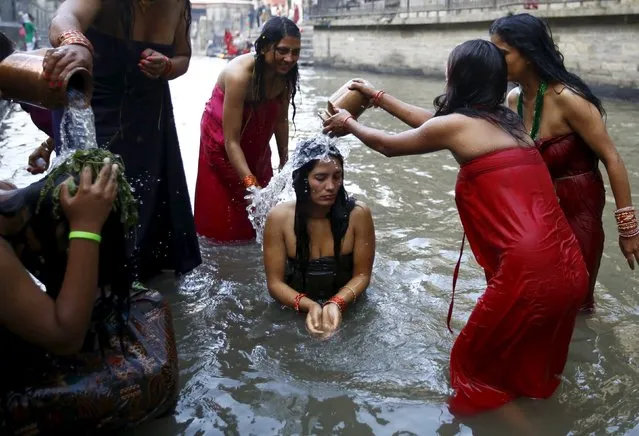
Nepalese women performs ritual as they take a holy bath in the Bagmati River, during the Rishi Panchami festival, in Kathmandu, Nepal September 18, 2015. Rishi Panchami is observed on the last day of Teej when women worship Sapta Rishi (Seven Saints) to ask for forgiveness for sins committed during their menstrual periods throughout the year. (Photo by Navesh Chitrakar/Reuters)

Nepalese women performs ritual as they take a holy bath in the Bagmati River, during the Rishi Panchami festival, in Kathmandu, Nepal September 18, 2015. Rishi Panchami is observed on the last day of Teej when women worship Sapta Rishi (Seven Saints) to ask for forgiveness for sins committed during their menstrual periods throughout the year. The Hindu religion considers menstruation as a representation of impurity and women are prohibited from taking part in religious practices during their monthly menstruations. (Photo by Navesh Chitrakar/Reuters)
Details
21 Sep 2015 12:23:00