Loading...
Done
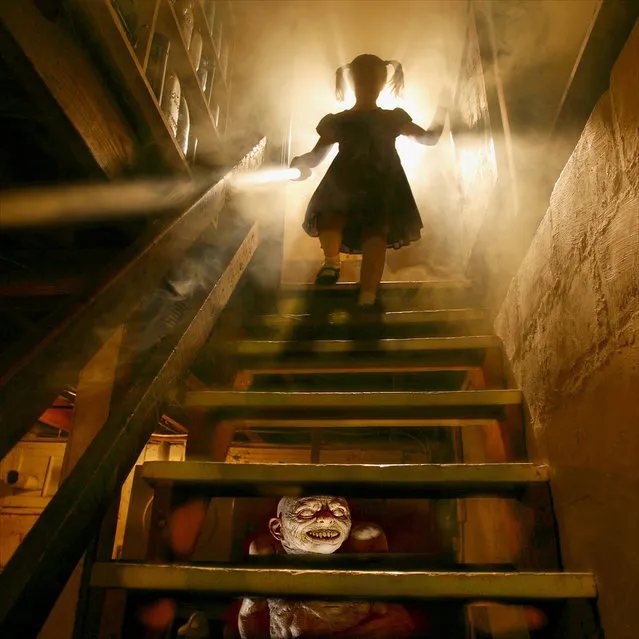
“Basement”. (Photo by Joshua Hoffine/The Washington Post)

Joshua Hoffine, based in Kansas City, Mo., and a self-proclaimed “Horror Photographer”, is interested in the psychology of fear. In his project “After Dark, My Sweet”, Hoffine’s surreal and staged images render these fears visible with the “visual grammar of a child”. Through elaborate sets, costumes, makeup and fog machines, Hoffine’s children act out these terrifying scenes in front of his camera. Here: “Basement”. (Photo by Joshua Hoffine/The Washington Post)
Details
29 Oct 2016 11:47:00
Hamlet the micro pig may already be a hit on Instagram, but its not stopped her from hogging the limelight on her birthday. Known for her adorable costume play, the miniature pig, from Pasadena, California, celebrated her first birthday in style, inviting all her furry Instagram friends to join her party. Pictured wearing a bright pink tutu and a tiara fit for a princess, Hamlet, who is named after Lady Hamlet from the Shakespeare play, shows that shes no boar when it comes to partying. Here: Hamlet enjoying his birthday party. (Photo by Caters News)

Hamlet the micro pig may already be a hit on Instagram, but its not stopped her from hogging the limelight on her birthday. Known for her adorable costume play, the miniature pig, from Pasadena, California, celebrated her first birthday in style, inviting all her furry Instagram friends to join her party. Pictured wearing a bright pink tutu and a tiara fit for a princess, Hamlet, who is named after Lady Hamlet from the Shakespeare play, shows that shes no boar when it comes to partying. Here: Hamlet enjoying his birthday party. (Photo by Caters News)
Details
31 Mar 2015 12:53:00
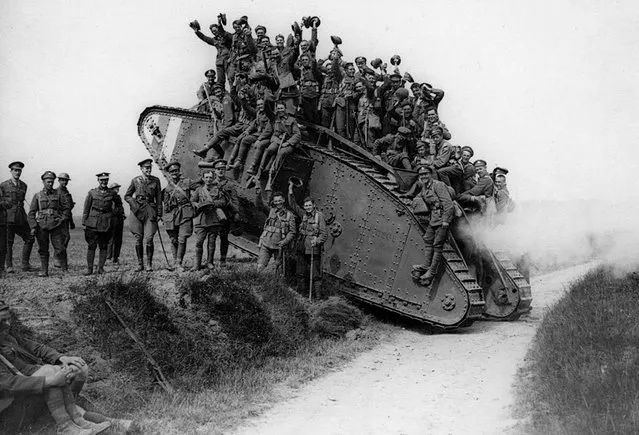
These black-and-white photos are taken from the new book “Armoured Warfare in the First World War 1916 – 1918” by Anthony Tucker-Jones and published by Pen & Sword Military. “Interestingly the British, French and Germans took completely different approaches with varying results”. The British military produced “Little Willie” in Autumn 1915 weighing 18 tonnes, which had a crew of two plus four gunners. “Inspired by a tracked artillery tractor “Little Willie” was referred to as a water tank – hence the name tank – to ensure secrecy”, said Anthony. “This led to the strange looking Mark I with its peculiar rhomboid shape, designed to cross trenches with guns in sponsons on either side. The Germans saw the tank as unchivalrous and were slow to grasp its utility. They favoured the Stormtrooper (specialist soldiers used to infiltrate enemy trenches) and artillery, not the tank”, said Anthony. “However, they didn’t hesitate to make use of captured British tanks. Although the tank helped secure victory and German soldiers dubbed it “Germany’s Downfall” the country was ultimately brought to its knees by the Allies blockade”. Here: British troops hitch a ride on a Mark IV after the massed tank fleet spearheading attack at Cambrai on November 20, 1917. (Photo by Anthony Tucker-Jones/Mediadrumworld.com)

These black-and-white photos are taken from the new book “Armoured Warfare in the First World War 1916 – 1918” by Anthony Tucker-Jones and published by Pen & Sword Military. Here: British troops hitch a ride on a Mark IV after the massed tank fleet spearheading attack at Cambrai on November 20, 1917. (Photo by Anthony Tucker-Jones/Mediadrumworld.com)
Details
23 Feb 2017 00:02:00
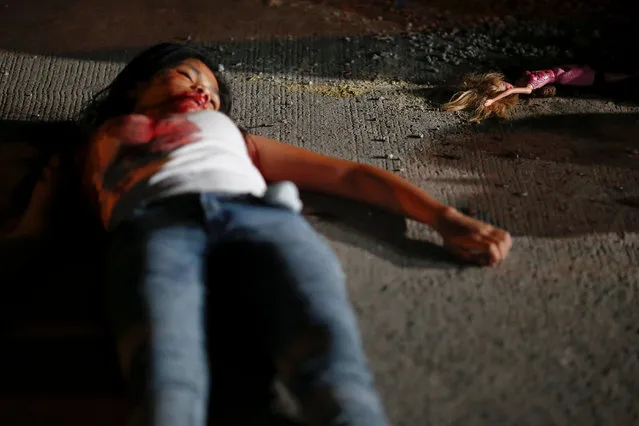
A 17 year old girl lays dead next to her doll after she and her friend were killed by unknown motorcycle-riding gunmen, in an alley in Manila, Philippines early October 26, 2016. According to the police, a sign on a cardboard reading “Tulak ka, hayop ka”, which translates to “You are a (drug) pusher, you are an animal” was found with the body of girl's friend. (Photo by Damir Sagolj/Reuters)

Damir Sagolj has won Reuters photojournalist of the year for his 2016 work, which included documenting the deadly Philippine drug war and the North Korea congress. Here: A 17 year old girl lays dead next to her doll after she and her friend were killed by unknown motorcycle-riding gunmen, in an alley in Manila, Philippines early October 26, 2016. According to the police, a sign on a cardboard reading “Tulak ka, hayop ka”, which translates to “You are a (drug) pusher, you are an animal” was found with the body of girl's friend. (Photo by Damir Sagolj/Reuters)
Details
06 Mar 2017 00:03:00
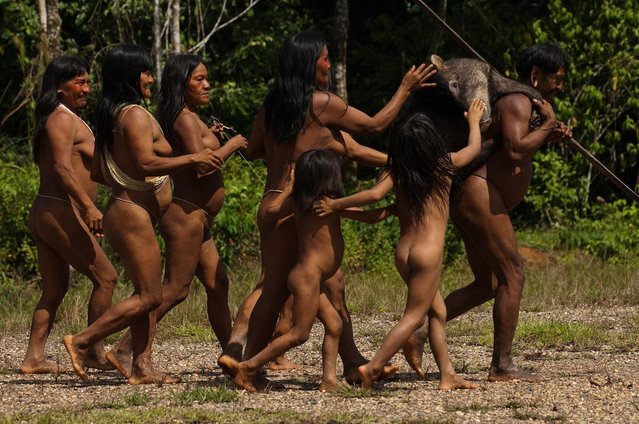
Spectacular images offering insight into the lives of the Huaorani people in the Ecuadorian Amazon have been revealed showing how they use traditional methods to hunt monkeys for food. The stunning pictures were taken by conservation photographer Pete Oxford from Torquay, Devon in the Ecuadorian Amazon. “The Huaorani Indians are a forest people highly in tune with their environment. Many are now totally acculturated since the 1950s by missionaries”, said Pete. “Today they face radical change to their culture to the proximity of oil exploration within their territory and the Yasuni National Park and Biosphere Reserve, they are vastly changed. Some still live very traditionally and for this shoot, through my Huaorani friend, a direct relative of those photographed he wanted to depict them as close to their original culture as possible. They still largely hunt with blow pipes and spears eating a lot of monkeys and peccaries”. The Huaorani are also known as the Waorani, Waodani or the Waos and are native Amerindians. Their lands are located between the Curaray and Napo rivers and speak the Huaorani language. Pete says that during his visit he was welcomed into the group and hopes that ancient cultures can be saved. Here: The tribe were seen celebrating after a hunter returned to camp with a wild pig. (Photo by Pete Oxford/Mediadrumworld.com)

Spectacular images offering insight into the lives of the Huaorani people in the Ecuadorian Amazon have been revealed showing how they use traditional methods to hunt monkeys for food. The stunning pictures were taken by conservation photographer Pete Oxford from Torquay, Devon in the Ecuadorian Amazon. Here: The tribe were seen celebrating after a hunter returned to camp with a wild pig. (Photo by Pete Oxford/Mediadrumworld.com)
Details
20 Jan 2017 07:58:00
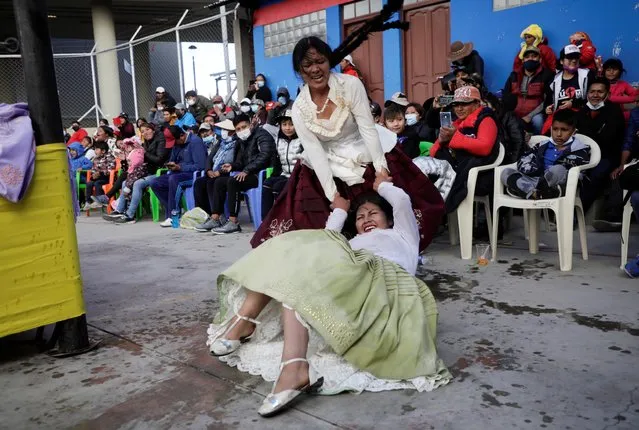
Barbara Quisbert and Susana La Bonita, cholitas wrestlers, fight during their return to the ring after the coronavirus disease (COVID-19) restrictions, in El Alto outskirts of La Paz, November 29, 2020. (Photo by David Mercado/Reuters)

The Fighting Cholitas are a group of female wrestlers who perform in El Alto, Bolivia. Tickets to the exhibitions cost $1. Like the general population of El Alto, which consists almost entirely of Aymara and Quechua residents, the Cholitas are indigenous. They wear braided hair, bowler hats and multilayered skirts in the ring. Here: Barbara Quisbert and Susana La Bonita, cholitas wrestlers, fight during their return to the ring after the coronavirus disease (COVID-19) restrictions, in El Alto outskirts of La Paz, November 29, 2020. (Photo by David Mercado/Reuters)
Details
12 Dec 2020 00:03:00
A man assists two young hostages who managed to escape from the school building after special forces entered the school in Beslan, North Ossetia, Friday 03 September 2004. Streams of hostages fled the besieged school in Beslan in southern Russia Friday amid intensive shooting and a series of powerful explosions that signalled a bloody end to the three-day stand-off with terrorists. (Photo by Yuri Kochetkov/EPA)

On September 1, 2004, Chechen militants stormed an elementary school in the town of Beslan in the Russian republic of North Ossetia. They took 1,100 teachers, children, and their relatives hostage, demanding the withdrawal of federal forces from Chechnya as a condition for their release. On September 3, 2004, Russian security forces stormed the building, resulting in a battle in which more than 330 hostages died, including 186 children. Here: A man assists two young hostages who managed to escape from the school building after special forces entered the school in Beslan, North Ossetia, Friday 03 September 2004. (Photo by Yuri Kochetkov/EPA)
Details
25 Sep 2017 06:41:00
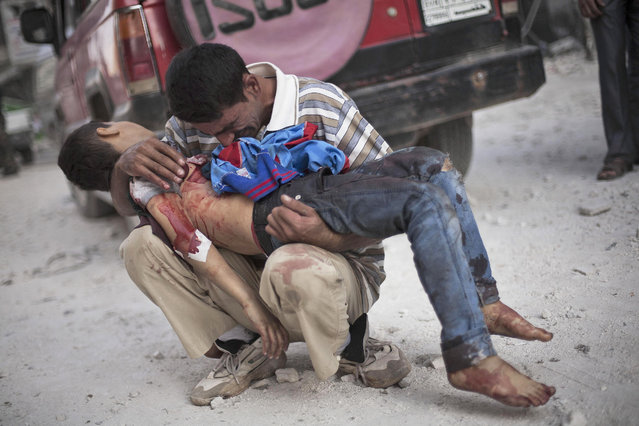
A Syrian man cries while holding the body of his son, killed by the Syrian Army, near Dar El Shifa hospital in Aleppo, Syria, Wednesday, October 3, 2012. (Photo by Manu Brabo/AP Photo)

Manu Brabo was born in Spain in 1981. After studying Photography in The School of Arts and Crafts in Oviedo, he moved to Madrid where he started Journalism in Carlos III University while he was working as a photographer for several humble newspapers and agencies. In 2011, Manu was held captive and then released by by Libyan forces. Brabo, along with fellow AP photographers were awarded the 2013 Pulitzer Prize for Breaking News Photography. Here: a Syrian man cries while holding the body of his son, killed by the Syrian Army, near Dar El Shifa hospital in Aleppo, Syria, Wednesday, October 3, 2012. (Photo by Manu Brabo/AP Photo)
Details
27 Oct 2015 08:04:00