Loading...
Done


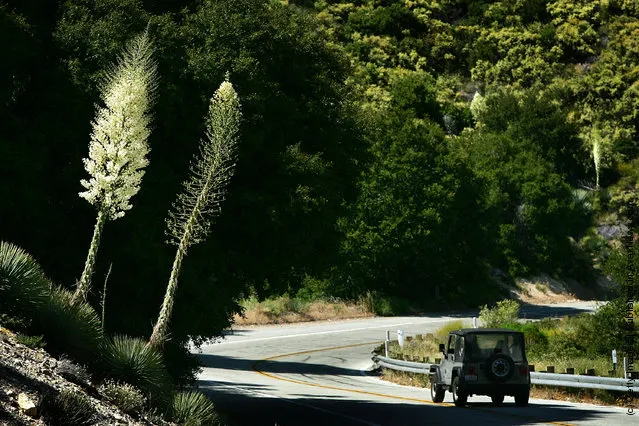
“Yucca is a genus of perennial shrubs and trees in the agave family, Agavaceae. Its 40-50 species are notable for their rosettes of evergreen, tough, sword-shaped leaves and large terminal panicles of white or whitish flowers. They are native to the hot and dry (arid) parts of North America, Central America, South America, and the Caribbean. Early reports of the species were confused with the cassava (Manihot esculenta). Consequently, Linnaeus mistakenly derived the generic name from the Carib word for the latter, yuca. It is also colloquially known in the midwest United States as “Ghosts in the graveyard”, as it is commonly found growing in rural graveyards and when in bloom the flowers appear as an apparition floating.” – Wikipedia

Photo: A yucca standing among flowers bursts forth a very large stalk of flowers as a heavy wildflower bloom on June 21, 2005 in the Angeles National Forest northwest of La Canada, California. (Photo by David McNew/Getty Images)
Details
29 Mar 2011 07:31:00
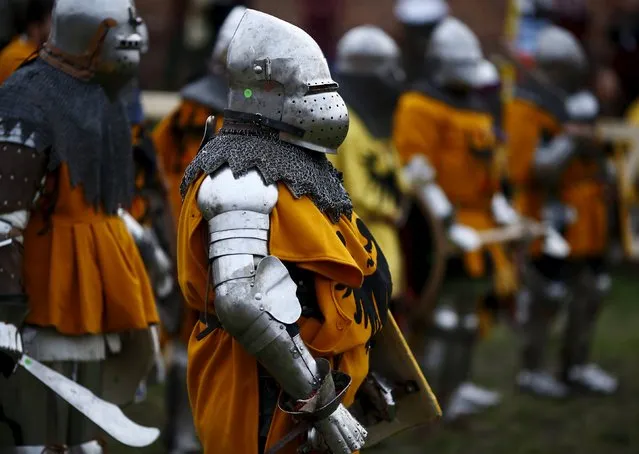
Fighters from Germany take up position before competing in the Medieval Combat World Championship at Malbork Castle, northern Poland, April 30, 2015. (Photo by Kacper Pempel/Reuters)

Fighters from Germany take up position before competing in the Medieval Combat World Championship at Malbork Castle, northern Poland, April 30, 2015. Medieval combat is a full contact sport that revives the foot based tournament fighting of medieval Europe. Countries fight in refereed matches where the objective is to get the opposing team to the floor. There are also duels with polearms, swords and shields where the number of hits landed are scored. The fighters, both male and female, wear heavy armours and weapons, mostly replicas of authentic pieces, and fight following the knights code of conduct. According to organizers, 25 nations from 6 continents are taking part in the Championships, which started on April 30 and will go on until May 3. (Photo by Kacper Pempel/Reuters)
Details
03 May 2015 12:02:00
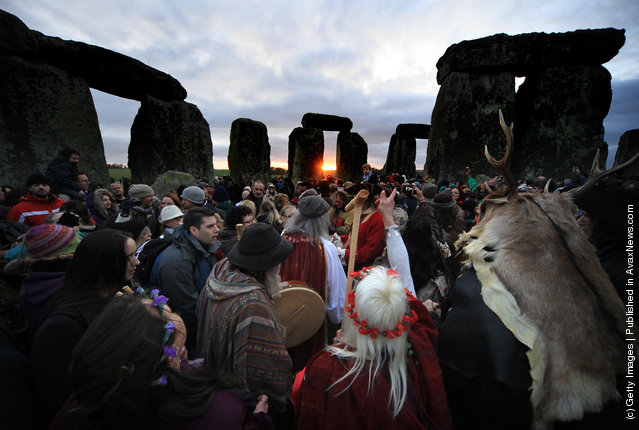
Druids Celebrate Winter Solstice At Stonehenge

Druids, pagans and revellers cheer as the sun rises at Stonehenge on December 22, 2011 in Wiltshire, England. The unseasonable warm weather encouraged a larger than normal crowd to gather at the famous historic stone circle to celebrate the sunrise closest to the Winter Solstice, the shortest day of the year. (Photo by Matt Cardy/Getty Images)
Details
23 Dec 2011 12:17:00
A mob attacks a female police officer accused of shooting a protester in the Buterere neighborhood of Bujumbura, Burundi, May 12, 2015. (Photo by Goran Tomasevic/Reuters)

A mob attacks a female police officer accused of shooting a protester in the Buterere neighborhood of Bujumbura, Burundi, May 12, 2015. Protesters opposed to the president's decision to run for a third term chased, beat and stoned the woman, who was later handed back to the police. (Photo by Goran Tomasevic/Reuters)
Details
13 May 2015 12:12:00


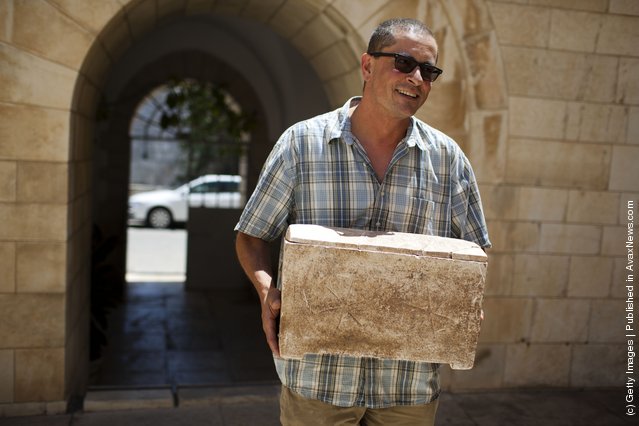
Doctor Boaz Zissu of the Bar Ilan University shows the inscription on a 2,000-year-old ossuary at the Rockefeller Museum on June 30, 2011 in Jerusalem, Israel. The Israel Antiquities Authority have confirmed the credibility of the ancient ossuary, otherwise known as a stone chest in which to store bones, as bearing the name of a relative of the high priest Caiaphas from the New Testament. Laboratory tests have come back saying that the inscription with the name of “Miriam daughter of Yeshua son of Caiaphas, priest of Maaziah from Beth Imri” is both “genuine and ancient”. (Photo by Uriel Sinai/Getty Images)
Details
01 Jul 2011 11:35:00
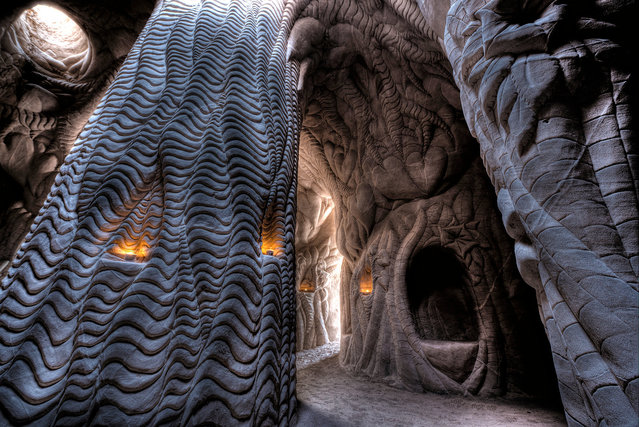
Cave Art By Ra Paulette

Ra Paulette is an American cave sculptor based in New Mexico who digs into hillsides to sculpt elaborate artistic spaces inside mountains. Reviewer Martha Mendoza in the Los Angeles Times described the caves he created as shrines, as hallowed places, a “sanctuary for prayer and meditation” while others describe the caves as works of art. The caves are finished with “scallops, molded curves, smooth ledges, inlaid stones, narrow pods and crusty ledges”. His caves attract visitors worldwide.
Details
24 Nov 2016 08:05:00
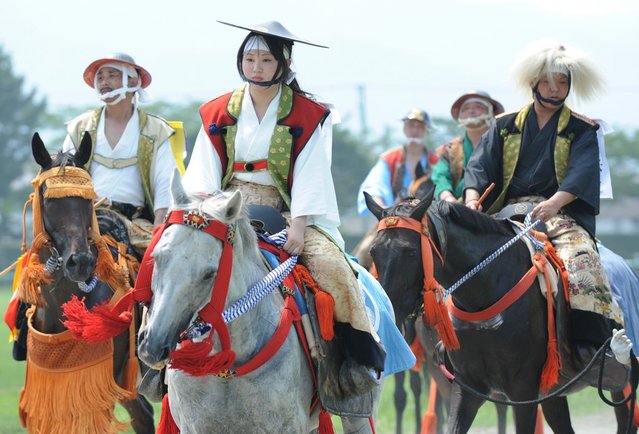
A young woman (C) clad in samurai costume leads other local poeple as she rides her horse during a parade at the annual Soma Nomaoi festival in Minamisoma, Fukushima Prefecture, on July 28, 2012.  The traditional full-scale festival kicked off for the first time after the accident of the Fukushima Dai-ichi Nuclear Power Plant following the massive earthquake and the tsunami on March 11, 2011. (Photo by Toru Yamanaka/AFP Photo)

Soma-Nomaoi is a festival that recreates a battle scene from more than 1,000 years ago. It is annually held for 4 days from July 22 to 25 in Haramachi City, Fukushima Prefecture, in the eastern part of Japan. In this historical event, 600 mounted samurai in traditional Japanese armor, with long swords at their side and ancestral flagstaffs streaming from their backs, ride across open fields. Soma-Nomaoi has been designated an Important Intangible Folk Cultural Property.

Photo: A young woman (C) clad in samurai costume leads other local poeple as she rides her horse during a parade at the annual Soma Nomaoi festival in Minamisoma, Fukushima Prefecture, on July 28, 2012. The traditional full-scale festival kicked off for the first time after the accident of the Fukushima Dai-ichi Nuclear Power Plant following the massive earthquake and the tsunami on March 11, 2011. (Photo by Toru Yamanaka/AFP Photo)
Details
02 Aug 2012 12:59:00
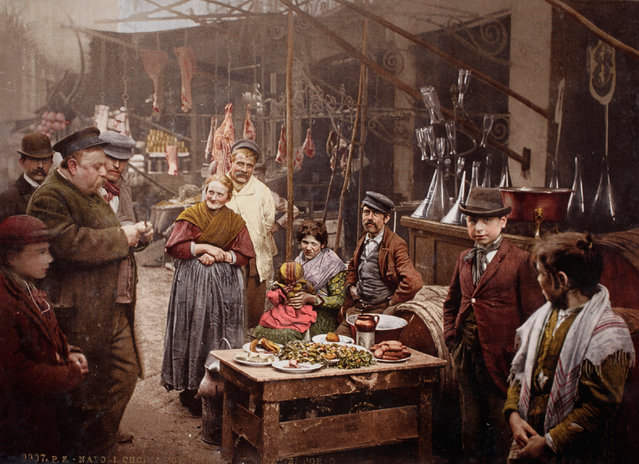
The finished photochromes were produced using at least six different tint stones, although many more were often used. Here: Street food in the Strada del Porto in Naples, Italy, 1899. (Photo by Swiss Camera Museum/The Guardian)

Photochromes are vibrant and nuanced prints hand-coloured from black-and-white negatives. Created using a process pioneered in the 1880s, these images offer a fascinating insight into the world when colour photography was still in its infancy. A Tour of the World in Photochromes is at the Swiss Camera Museum, Vevey, until 21 August. Here: Street food in the Strada del Porto in Naples, Italy, 1899. (Photo by Swiss Camera Museum/The Guardian)
Details
07 Jul 2016 10:56:00