Loading...
Done
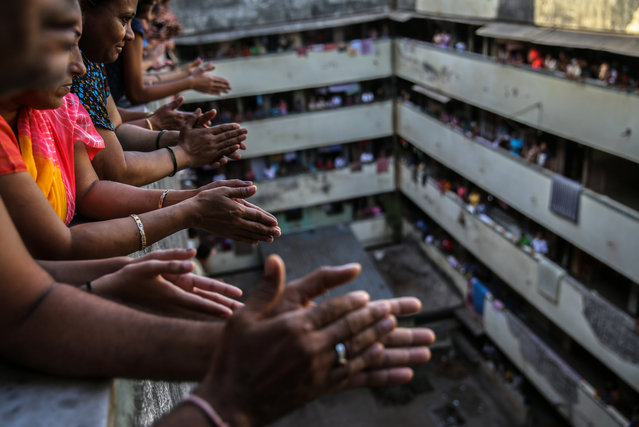
Indian people bang utensils and clap from the balconies of a residential building in Mumbai, India, 22 March 2020. Prime Minister Narendra Modi asks citizens to impose self-curfew to fight Coronavirus COVID-19 and also ask them to clap, bang the bells and utensils at 5pm Indian time to mark of respect and to thank the medical staff and others working 24 hours, during Covid-19 outbreak to keeping the Indians safe. (Photo by Divyakant Solanki/EPA/EFE)

Indian people bang utensils and clap from the balconies of a residential building in Mumbai, India, 22 March 2020. Prime Minister Narendra Modi asks citizens to impose self-curfew to fight Coronavirus COVID-19 and also ask them to clap, bang the bells and utensils at 5pm Indian time to mark of respect and to thank the medical staff and others working 24 hours, during Covid-19 outbreak to keeping the Indians safe. (Photo by Divyakant Solanki/EPA/EFE)
Details
29 Mar 2020 00:05:00
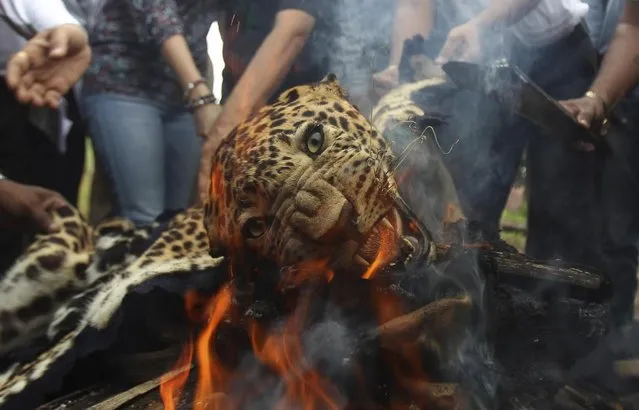
A leopard skin burns as Indian officials and activists burn wildlife contraband including tiger and leopard skins, and bones as part of a campaign to save the tiger in Mumbai, India, Tuesday, July 30, 2013. Despite conservation efforts, tiger numbers in India have declined due to rampant poaching of the cats for their valuable pelts and body parts that are highly prized in traditional Chinese medicine. (Photo by Rafiq Maqbool/AP Photo)

A leopard skin burns as Indian officials and activists burn wildlife contraband including tiger and leopard skins, and bones as part of a campaign to save the tiger in Mumbai, India, Tuesday, July 30, 2013. Despite conservation efforts, tiger numbers in India have declined due to rampant poaching of the cats for their valuable pelts and body parts that are highly prized in traditional Chinese medicine. (Photo by Rafiq Maqbool/AP Photo)
Details
01 Aug 2013 10:50:00
Syrian Tulin Hashemi waits for a job interview at a hotel in Vidigal slum in Rio de Janeiro, Brazil, September 22, 2015. Tulin, whose mother arrived two days ago, has been living in Brazil for two months. As she does not speak Portuguese, Tulin says it is difficult for her to find a job and therefore she is staying at the slum as it is one of the cheaper neighbourhoods to live in. (Photo by Pilar Olivares/Reuters)

Syrian Tulin Hashemi waits for a job interview at a hotel in Vidigal slum in Rio de Janeiro, Brazil, September 22, 2015. Tulin, whose mother arrived two days ago, has been living in Brazil for two months. As she does not speak Portuguese, Tulin says it is difficult for her to find a job and therefore she is staying at the slum as it is one of the cheaper neighbourhoods to live in. According to the National Committee for Refugees (CONARE), 2,077 people fleeing the Syrian civil war have settled in Brazil, whilst a quarter of the 8,400 refugees in the Latin American country come from Syria. (Photo by Pilar Olivares/Reuters)
Details
25 Sep 2015 08:05:00
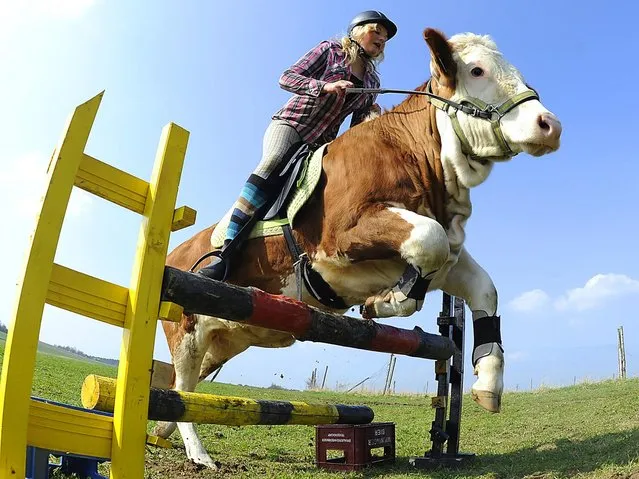
Luna The Leaping Cow

A 15-year-old girl denied a horse from her parents has turned to a cow to fulfil her riding dreams. Teenager Regina Mayer, from southern Germany, is able to ride her cow, Luna. She has even trained her bovine pet to soar over a beer-crate hurdle like a regular show jumper. Why, you may well ask, when most cow-owners are surely content to let the creatures chew and lactate and sit down to indicate the imminent arrival of rain? Well, Regina's parents wouldn't let her have a horse.

Details
05 Jun 2014 10:38:00
Reading the Metro, enjoying some Swedish meatballs. (Photo by Svetlana Valyiskaya/Mercury)

It's often said that pets and their owners can start to look alike, but these adorable photographs take the old mantra to a new extreme. They are the work of Svetlana Valyiskaya (27), from St Petersburg, who snaps pets in everyday poses in her spare time from her job as a commercial photographer. The vibrant costumes and scenes, which Svetlana designs herself, have made the photos a hit in her native Russia – and it's not hard to see why. She said: “I really love animals, they are loyal, faithful and true and always interesting to work with – plus they never criticise the photographs afterwards”. (Photo by Svetlana Valyiskaya/Mercury)
Details
03 Sep 2014 10:44:00
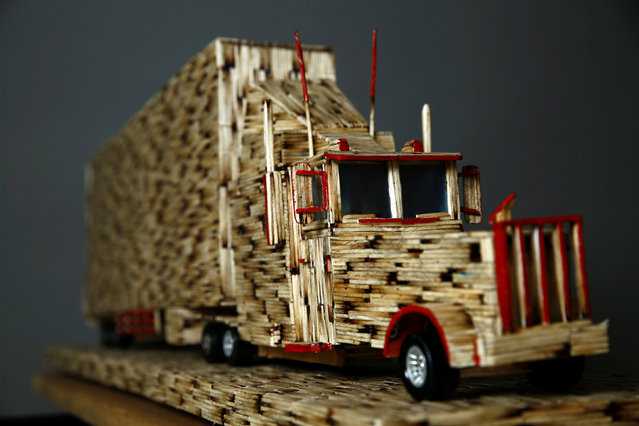
A replica of the truck made from matchsticks by Janusz Urbanski is pictured at his flat in Ruda Slaska, Poland May 4, 2016. (Photo by Kacper Pempel/Reuters)

A replica of the truck made from matchsticks by Janusz Urbanski is pictured at his flat in Ruda Slaska, Poland May 4, 2016. Janusz Urbanski has a one of a kind chessboard he never plays, a personalised guitar he does not strum and a boat he cannot sail. Why? They are all made from tens of thousands of matches. For the last 40 years, the former Polish miner and ironworker has harboured a passion to build replicas of objects, buildings and famous sites with just matchsticks and glue. (Photo by Kacper Pempel/Reuters)
Details
07 May 2016 12:54:00
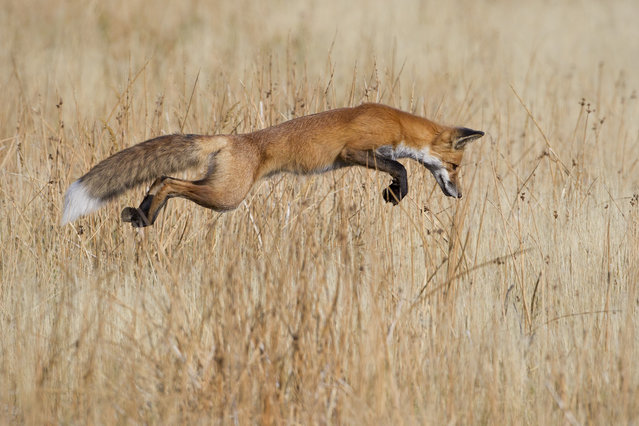
Canada: “Lucky pounce”. (Photo by Connor Stefanison/Wildlife Photographer of the Year 2013)

The winners of The London’s Natural History Museum's prestigious Wildlife Photographer of the Year for 2013 have finally been unveiled. Selected from almost 43,000 entries from 96 countries, the winners offer a glimpse of the stunning array of natural beauty on our planet. Photo: Canada: “Lucky pounce”. “Anticipating the pounce – that was the hardest part”, says Connor, who had come to Yellowstone National Park, Wyoming, USA, in search of wildlife as much as the spectacular landscape. He had found this fox, his first ever, on his last day in the park. It was so absorbed in hunting that Connor had plenty of time to get out of the car and settle behind a rock. It quartered the grassland, back and forth, and then started staring intently at a patch of ground, giving Connor just enough warning of the action to come. When it sprung up, Connor got his shot. And when it landed, the fox got his mouse. (Photo by Connor Stefanison/Wildlife Photographer of the Year 2013)
Details
17 Oct 2013 08:12:00
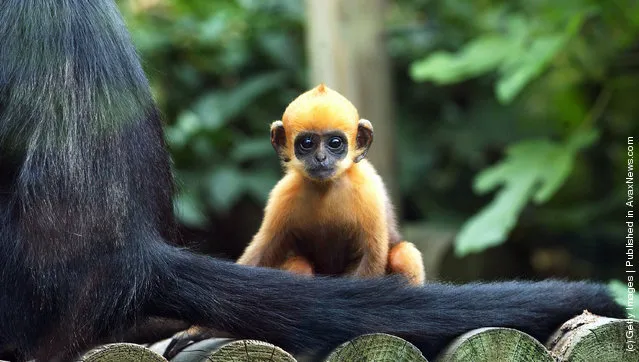
Baby Francois' Langur

“Francois' langur is one of several species of leaf monkeys. Over 50% of its diet is made up of young leaves. It will also consume fruits (17.2%), seeds, flowers, stems, roots, bark and occasionally minerals and insects off of rock surfaces and cliffs. This langur consumes its favorite food, young leaves, at the highest rate during the dry season, April through September, also known as the young leaf-lean period”. – Wikipedia

Photo: An endangered baby Francois' Langur monkey called Laa Laa settles in following her July 6 birth at London Zoo, Regent's Park on August 5, 2004 in London. The bright ginger youngster was born to glossy black parents Max and Shaneka and has the typical orange baby coat which is in stark contrast against the black of her parent's and older brother Grub's fur. (Photo by Steve Finn/Getty Images)
Details
22 Sep 2011 11:28:00