Loading...
Done
Mayu adjusts Koiku’s kimono, as Koiku wears a protective face mask while posing for a photograph, before they work at a party where they will entertain with other geisha at Japanese luxury restaurant Asada in Tokyo, Japan, June 23, 2020. The coronavirus pandemic has made Tokyo's geisha fear for their centuries-old profession as never before. Though the number of geisha - famed for their witty conversation, beauty and skill at traditional arts - has been falling for years, they were without work for months due to Japan's state of emergency and now operate under awkward social distancing rules. Engagements are down 95 percent, and come with new rules: no pouring drinks for customers or touching them even to shake hands, and sitting 2 meters apart. Masks are hard to wear with their elaborate wigs, so they mostly don't. “I was just full of anxiety”, said Mayu, 47. “I went through my photos, sorted my kimonos ... The thought of a second wave is terrifying”. (Photo by Kim Kyung-Hoon/Reuters)

Mayu adjusts Koiku’s kimono, as Koiku wears a protective face mask while posing for a photograph, before they work at a party where they will entertain with other geisha at Japanese luxury restaurant Asada in Tokyo, Japan, June 23, 2020. (Photo by Kim Kyung-Hoon/Reuters)
Details
23 Jul 2020 00:03:00
A woman wears a plastic water bottle with a cutout to cover her face, as she walks on a footbridge in Hong Kong on January 31, 2020, as a preventative measure following a virus outbreak which began in the Chinese city of Wuhan. The World Health Organization, which initially downplayed the severity of a disease that has now killed 170 nationwide, warned all governments to be “on alert” as it weighed whether to declare a global health emergency. (Photo by Anthony Wallace/AFP Photo)

A local wears a plastic water bottle with a cutout to cover her face, as she walks on a footbridge in Hong Kong on January 31, 2020, as a preventative measure following a virus outbreak which began in the Chinese city of Wuhan. The World Health Organization, which initially downplayed the severity of a disease that has now killed 170 nationwide, warned all governments to be “on alert” as it weighed whether to declare a global health emergency. (Photo by Anthony Wallace/AFP Photo)
Details
03 Feb 2020 00:03:00
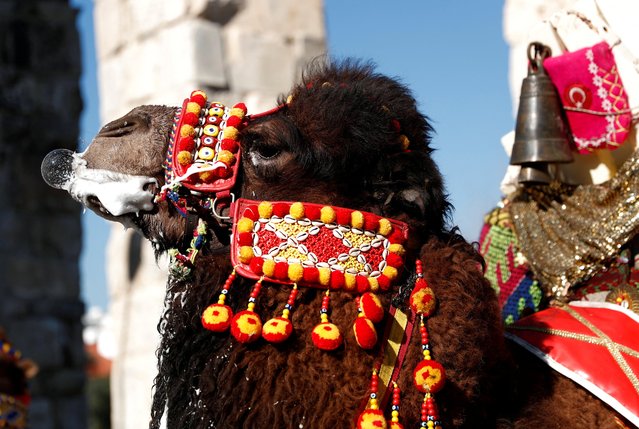
A wrestling camel adorned with colourful ornaments takes part in the Camel Beauty Contest ahead of the annual 40th Efes Selcuk Camel Wrestling Festival, in the Aegean town of Selcuk, near Izmir, Turkey on January 15, 2022. (Photo by Murad Sezer/Reuters)

A wrestling camel adorned with colourful ornaments takes part in the Camel Beauty Contest ahead of the annual 40th Efes Selcuk Camel Wrestling Festival, in the Aegean town of Selcuk, near Izmir, Turkey on January 15, 2022. (Photo by Murad Sezer/Reuters)
Details
25 Jan 2022 06:23:00
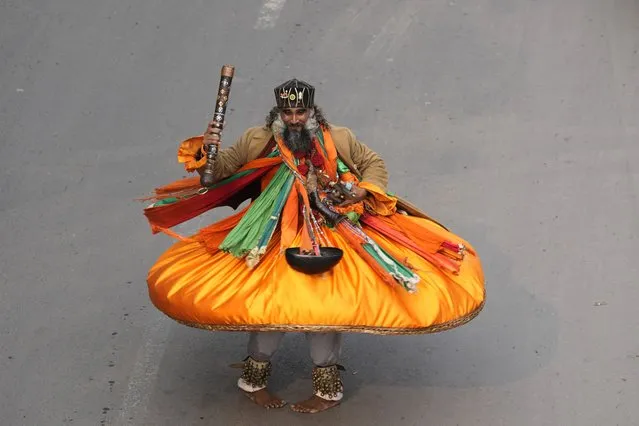
A Muslim dervish whirls during celebrations for Mawlid al-Nabi that marks the birthday of the Muslim Prophet Muhammad, in Peshawar, Pakistan, Sunday, October 9, 2022. Thousands of Muslims take part in religious processions, ceremonies and distribute free meals among the poor to mark the holiday. (Photo by Muhammad Sajjad/AP Photo)

A Muslim dervish whirls during celebrations for Mawlid al-Nabi that marks the birthday of the Muslim Prophet Muhammad, in Peshawar, Pakistan, Sunday, October 9, 2022. Thousands of Muslims take part in religious processions, ceremonies and distribute free meals among the poor to mark the holiday. (Photo by Muhammad Sajjad/AP Photo)
Details
24 Oct 2022 04:38:00
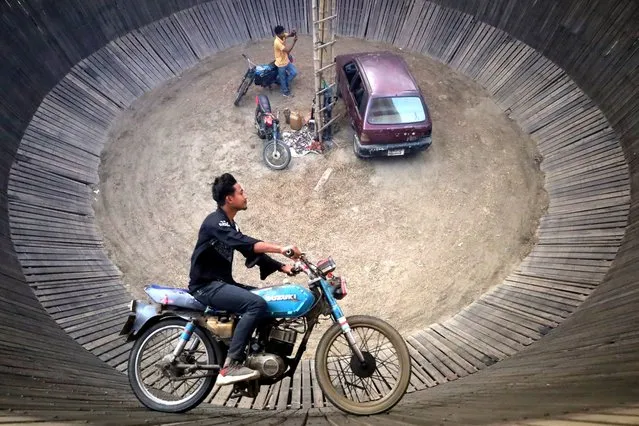
Daring motorists entertain spectators by dangerously driving cars and motorcycles on a vertical “wall of death” in Manikgonj, Bangladesh on January 17, 2023. Performers travel without any protective gear at speeds of up to 80 km/h so that their vehicles can balance on the 25 feet high wooden plank. (Photo by Syed Mahabubul Kader/ZUMA Press Wire/Rex Features/Shutterstock)

Daring motorists entertain spectators by dangerously driving cars and motorcycles on a vertical “wall of death” in Manikgonj, Bangladesh on January 17, 2023. Performers travel without any protective gear at speeds of up to 80 km/h so that their vehicles can balance on the 25 feet high wooden plank. (Photo by Syed Mahabubul Kader/ZUMA Press Wire/Rex Features/Shutterstock)
Details
10 Feb 2023 04:46:00
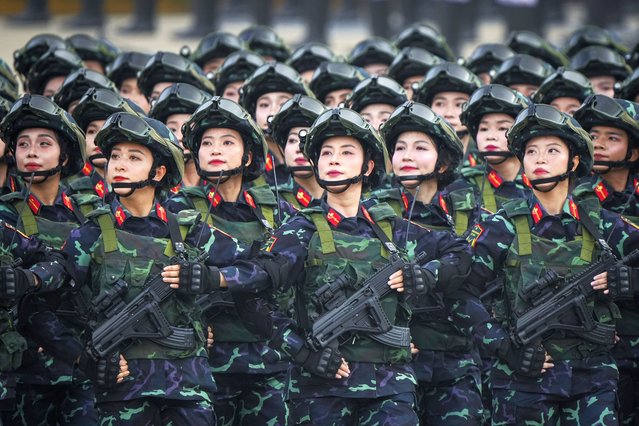
Vietnamese troops march during a parade celebrating the 80th anniversary of independence in Hanoi, Vietnam Tuesday, September 2, 2025. (Photo by Vincent Thian/AP Photo)

Vietnamese troops march during a parade celebrating the 80th anniversary of independence in Hanoi, Vietnam Tuesday, September 2, 2025. (Photo by Vincent Thian/AP Photo)
Details
10 Oct 2025 02:45:00
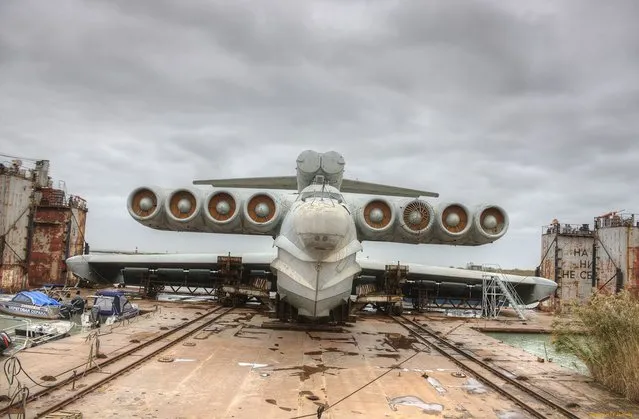
The Lun-class Ekranoplane was used by the Soviet Navy starting in 1987, and wasn't retired until the late 1990s, after the Soviet Union's fall. (Igor113)

“The Lun-class ekranoplan (NATO reporting name Duck) was a ground effect vehicle (GEV) designed by Rostislav Evgenievich Alexeev and used by the Soviet and Russian navies from 1987 until sometime in the late 1990s. It “flew” using the lift generated by the ground effect of its large wings when close to the surface of the water – about four metres or less. Although they might look similar and/or have related technical characteristics, ekranoplans like the Lun are not aircraft, seaplanes, hovercraft, or hydrofoils – ground effect is a separate technology altogether. The International Maritime Organization classifies these vehicles as maritime ships. The name Lun comes from the Russian for harrier”. – Wikipedia (Photo by Igor113)
Details
08 Aug 2014 10:51:00
Girls play in the water during the Balaton Sound music festival held on the shore of lake Balaton in Zamardi, west Hungary, on July 9, 2017. (Photo by Sandor Csudai/Rockstar Photographers)

Girls play in the water during the Balaton Sound music festival held on the shore of lake Balaton in Zamardi, west Hungary, on July 9, 2017. (Photo by Sandor Csudai/Rockstar Photographers)
Details
11 Jul 2017 06:25:00