Loading...
Done
Double tornadoes, lightning storms and rotating supercells – this is what it's like to chase storms for a year. These dramatic images show apocalyptic weather throughout 2014 from a lightning storm to a pair of rainbows. Roger Hill, 57, has been chasing storms in the United States for thirty years and runs a tour operation with his wife Caryn. (Photo by Roger Hill/Barcroft Media)

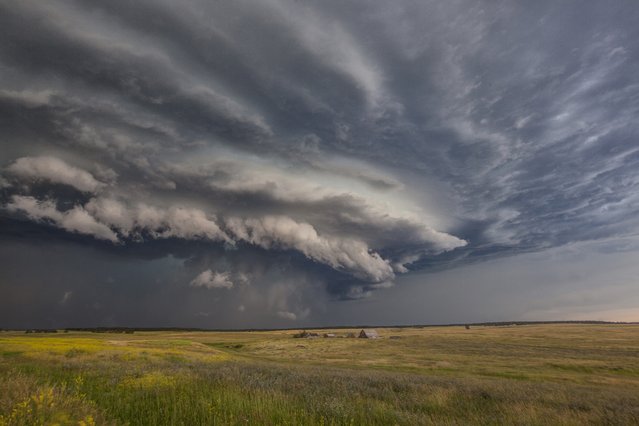
Double tornadoes, lightning storms and rotating supercells – this is what it's like to chase storms for a year. These dramatic images show apocalyptic weather throughout 2014 from a lightning storm to a pair of rainbows. Roger Hill, 57, has been chasing storms in the United States for thirty years and runs a tour operation with his wife Caryn. Here: a hailstorm rolls over fields, on July 22, 2014, in South Dakota. (Photo by Roger Hill/Barcroft Media)
Details
04 Jan 2015 13:08:00
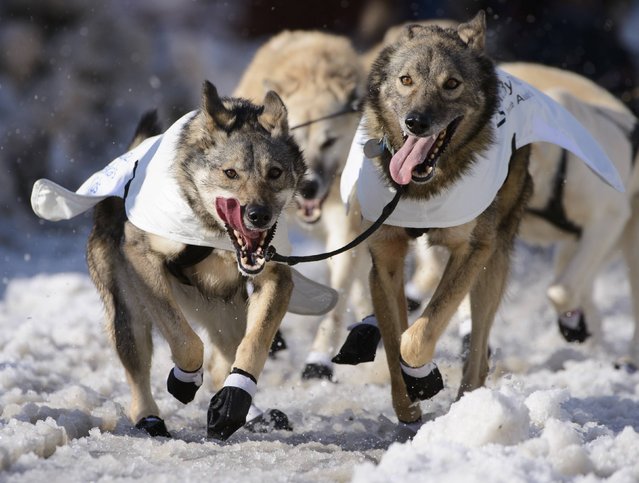
Richie Diehl team charges out of the chute over trucked-in snow at the 2015 ceremonial start of the Iditarod Trail Sled Dog race in downtown Anchorage, Alaska March 7, 2015. The timed portion of the race, which typically lasts nine days or longer, begins on Monday in Fairbanks, about 300 miles (482 km) away. Traditionally held in Willow, the timed start was moved to Fairbanks this year to accommodate an alternate trail selected after race officials deemed sections of the traditional path unsafe.    REUTERS/Mark Meyer  (UNITED STATES - Tags: SPORT ANIMALS SOCIETY)

Richie Diehl team charges out of the chute over trucked-in snow at the 2015 ceremonial start of the Iditarod Trail Sled Dog race in downtown Anchorage, Alaska March 7, 2015. The timed portion of the race, which typically lasts nine days or longer, begins on Monday in Fairbanks, about 300 miles (482 km) away. Traditionally held in Willow, the timed start was moved to Fairbanks this year to accommodate an alternate trail selected after race officials deemed sections of the traditional path unsafe. REUTERS/Mark Meyer (UNITED STATES - Tags: SPORT ANIMALS SOCIETY)
Details
09 Mar 2015 13:22:00
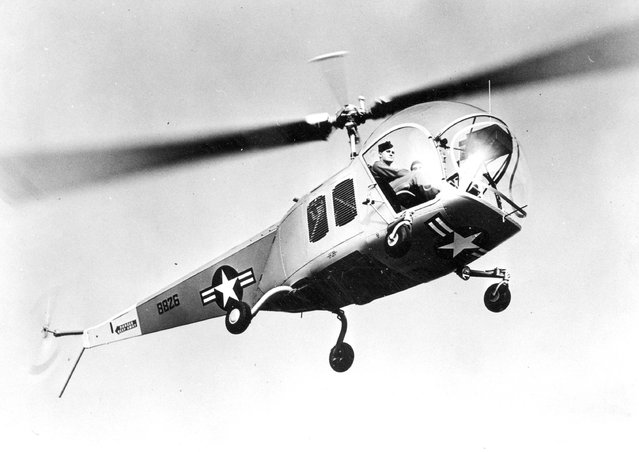
Number 10. BELL H-13 SIOUX was a two-bladed, single engine, light helicopter built by Bell Helicopter. Westland Aircraft manufactured the Sioux under license for the British military as the Sioux AH.1 and HT. (Photo by AP Photo)

Number 10. BELL H-13 SIOUX was a two-bladed, single engine, light helicopter built by Bell Helicopter. Westland Aircraft manufactured the Sioux under license for the British military as the Sioux AH.1 and HT. In 1947, the United States Air Force ordered the improved Bell Model 47A. Most were designated YR-13 and three winterized versions were designated YR-13A. The United States Army first ordered Bell 47s in 1948 under the designation H-13. These would later receive the name Sioux. The Bell-built H-13 B is seen airborne in this April 29, 1951 photo. The helicopter is equipped with a 173 horsepower engine, cruises at 85 miles per hour, climbs 900 feet in a minute and has a service ceiling of 11,500 feet. (Photo by AP Photo)
Details
08 Aug 2014 11:59:00
Rolando Pujol Rodriguez photographed the Cuban raft exodus in 1994, and twenty years later Enrique de la Osa took portraits of some of the people who made it to the United States, in this story which combines archive and present day images. Here: People put the finishing touches to a makeshift boat on a rooftop before lowering it onto a truck and launching it into the Straits of Florida towards the U.S., on the last day of the 1994 Cuban raft exodus in Havana, in this September 13, 1994 file photo. (Photo by Rolando Pujol Rodriguez/Reuters)

Rolando Pujol Rodriguez photographed the Cuban raft exodus in 1994, and twenty years later Enrique de la Osa took portraits of some of the people who made it to the United States, in this story which combines archive and present day images. Here: People put the finishing touches to a makeshift boat on a rooftop before lowering it onto a truck and launching it into the Straits of Florida towards the U.S., on the last day of the 1994 Cuban raft exodus in Havana, in this September 13, 1994 file photo. (Photo by Rolando Pujol Rodriguez/Reuters)
Details
13 Nov 2014 14:07:00
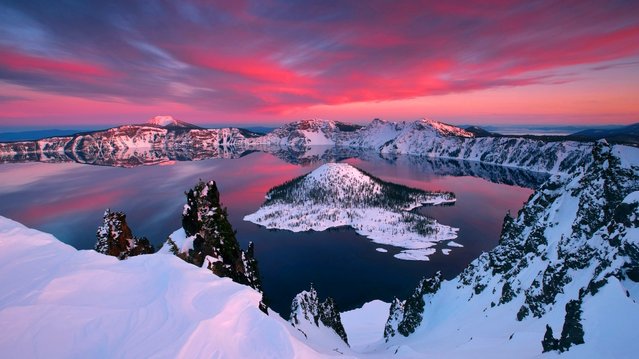
Crater Lake In Oregon

As you look at the majestic Crater Lake, located in south-central Oregon, United States, it is hard to imagine that thousands of years ago this place was one giant crater with scorching hot lava spilling over the sides. Those were the times of turmoil. Now, however, this place is the essence of tranquility. The lake that was formed, after the volcano died down, is amazingly clear due to the fact that the water isn’t moving at all. No rivers go in or out of the Crater Lake, and the water lost through evaporation is compensated by the rain and snowfall. This lake is also frighteningly deep – 1,943 feet (592 m) at its deepest point – making it the deepest lake in the United States. If you love nature and if you ever come to Oregon, this is truly a sight to behold.
Details
19 Nov 2014 14:14:00
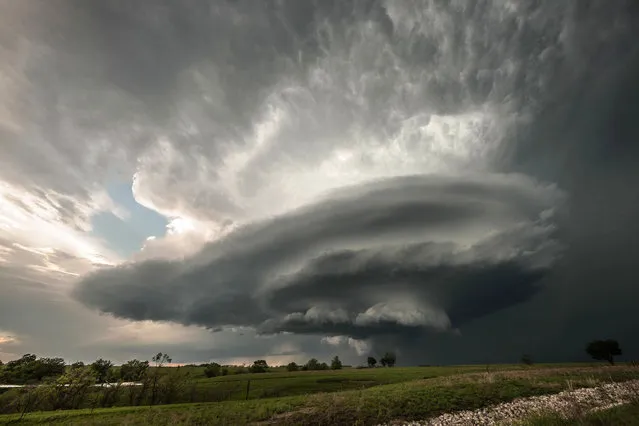
The rotating updraft base of a supercell thunderstorm, and a rear flank downdraft containing rain and hail, backlit by the setting sun, on May 10, 2014, in Climax, Kansas, United States. To most of us, dark clouds on the horizon usually means rain – but here in Kansas, they can also signal the start of a supercell. The huge formations, also known as rotating thunderstorms, are among the most powerful weather phenomenon found over land. (Photo by Stephen Locke/Barcroft Media)

The rotating updraft base of a supercell thunderstorm, and a rear flank downdraft containing rain and hail, backlit by the setting sun, on May 10, 2014, in Climax, Kansas, United States. To most of us, dark clouds on the horizon usually means rain – but here in Kansas, they can also signal the start of a supercell. The huge formations, also known as rotating thunderstorms, are among the most powerful weather phenomenon found over land. They can occur anywhere where the conditions are right, but are normally found in more arid climates. These awe-inspiring supercells were captured south of Climax city by storm chaser Stephen Locke. (Photo by Stephen Locke/Barcroft Media)
Details
18 Jul 2014 12:01:00
A displaced Yemeni woman from Hodeida fills water containers at a make-shift camp in a village in the northern district of Abs in the country's Hajjah province, on May 9, 2019. The Yemeni conflict has triggered what the United Nations describes as the world's worst humanitarian crisis, with 3.3 million people still displaced and 24.1 million in need of aid. (Photo by Essa Ahmed/AFP Photo)

A displaced Yemeni woman from Hodeida fills water containers at a make-shift camp in a village in the northern district of Abs in the country's Hajjah province, on May 9, 2019. The Yemeni conflict has triggered what the United Nations describes as the world's worst humanitarian crisis, with 3.3 million people still displaced and 24.1 million in need of aid. (Photo by Essa Ahmed/AFP Photo)
Details
13 May 2019 00:03:00
In this April 20, 2018, file aerial photo released by China's Xinhua News Agency, advection fog drifts across skyscrapers on the waterfront in Qingdao in eastern China's Shandong Province. Chinese leaders have long been sensitive about their communist country’s international image. Now, they are battling back, investing in diplomacy and a courtship of hearts and minds, just as the United States digs in on the Trump administration’s “America First” mindset. (Photo by Lu Hui/Xinhua via AP Photo/File)

In this April 20, 2018, file aerial photo released by China's Xinhua News Agency, advection fog drifts across skyscrapers on the waterfront in Qingdao in eastern China's Shandong Province. Chinese leaders have long been sensitive about their communist country’s international image. Now, they are battling back, investing in diplomacy and a courtship of hearts and minds, just as the United States digs in on the Trump administration’s “America First” mindset. (Photo by Lu Hui/Xinhua via AP Photo/File)
Details
15 Feb 2020 00:03:00