Boxer Tommy Fury is pictured during a weight measurement, a day ahead of a match against Jake Paul (not pictured) in Riyadh, on February 25, 2023. (Photo by Fayez Nureldine/AFP Photo)
New York Islanders' Matt Martin (17) and Pittsburgh Penguins' Zach Aston-Reese (12) fight during the second period in Game 2 of an NHL hockey Stanley Cup first-round playoff series in Pittsburgh, Tuesday, May 18, 2021. Both players received a two-minute minor penalty. (Photo by Gene J. Puskar/AP Photo)
Kyla Drumm, 5, waits after receiving the Pfizer-BioNTech coronavirus disease (COVID-19) vaccine in Skippack, Pennsylvania, U.S., November 3, 2021. (Photo by Hannah Beier/Reuters)
Peter Carberry riding Gabbys Cross falls off during the Randox Grand National Chase during day three of the Randox Grand National Festival at Aintree Racecourse on April 15, 2023 in Liverpool, England. (Photo by Michael Steele/Getty Images)
Cybermen patrol the National Museum of Scotland before the opening of the Doctor Who Worlds of Wonder exhibition in Edinburgh, Scotland on Wednesday, December 7, 2022. (Photo by Murdo MacLeod/The Guardian)
Riders perform during a freestyle motocross show at the EICMA exhibition motorcycle fair in Rho, outskirt of Milan, Italy, Thursday, November 7, 2024. (Photo by Luca Bruno/AP Photo)
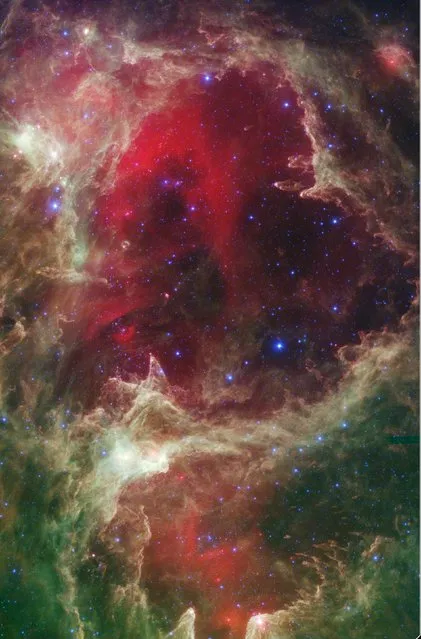
An infrared portrait from NASA's Spitzer Space Telescope which shows generations of stars is seen in this undated NASA handout image released February 14, 2013. In this wispy star-forming region, called W5, the oldest stars can be seen as blue dots in the centers of the two hollow cavities (other blue dots are background and foreground stars not associated with the region). Red shows heated dust that pervades the region's cavities, while green highlights dense clouds. (Photo by NASA/Reuters/JPL-Caltech/Harvard-Smithsonian/Handout)
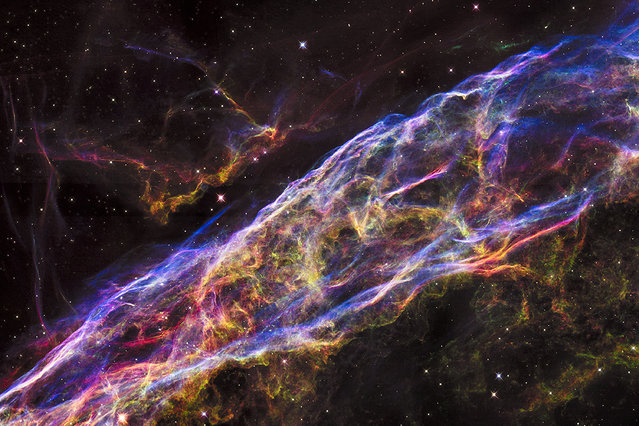
A small section of the expanding remains of the Veil Nebula, a massive star that exploded about 8,000 years ago. The entire nebula is 110 light-years across, covering six full moons on the sky as seen from Earth, and resides about 2,100 light-years away in the constellation Cygnus, the Swan. Image taken by NASA's Hubble Space Telescope. Released September 24, 2015. (Photo by Reuters/NASA/ESA/Hubble Heritage Team)