On the festival of Krishna Janmashtami, a girl costumed as Lord Krishna poses for a photo in Dhaka, Bangladesh on August 19, 2022. (Photo by Nayem Shaan/ZUMA Press Wire/Rex Features/Shutterstock)
Members of Myanmar's vovinam team warm up before competing in the vovinam event at the 32nd Southeast Asian Games (SEA Games) in Phnom Penh on May 6, 2023. (Photo by Mohd Rasfan/AFP Photo)
A CatCon attendee poses at CatCon LA 2023 at Pasadena Convention Center on August 06, 2023 in Pasadena, California. (Photo by Sarah Morris/Getty Images)
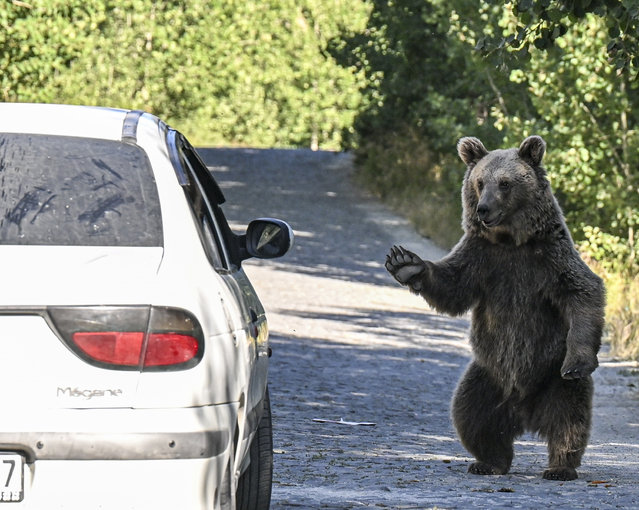
A grizzly bear waves its paw at a vehicle on the road to Nemrut Crater Lake in Tatvan district of Bitlis, Turkiye on August 24, 2023. (Photo by Muhammed Selim Korkutata/Anadolu Agency via Getty Images)
Visitors take photos of Fu Bao, a giant panda, at Everland amusement park in Yongin, south of Seoul, South Korea, 25 February 2024. The panda will be displayed to the public until 03 March, before returning to China in early April. The female panda, which was born to giant panda Ai Bao and her partner, Le Bao, at the Everland amusement park in Yongin, south of Seoul, in 2020, will be returned to China under an international agreement. (Photo by Yonhap/EPA)
Traditional dancers with their masks look on before their performance during “Nawa Durga Nach” Hindu dance festival in Bhaktapur on the outskirts of Kathmandu on March 28, 2024. (Photo by Prakash Mathema/AFP Photo)
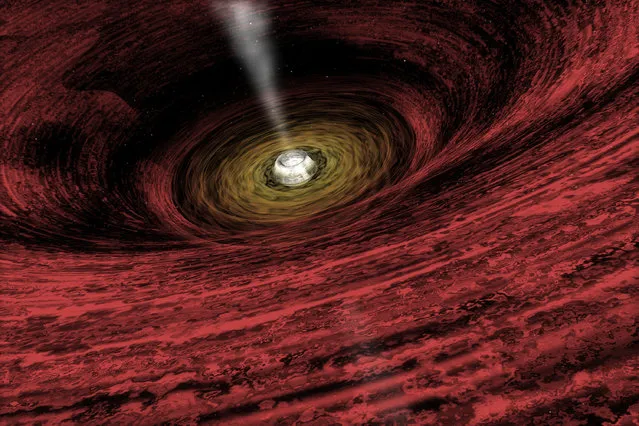
An artist's impression of a growing supermassive black hole located in the early Universe is seen in this NASA handout illustration released on June 15, 2011. Using the deepest X-ray image ever taken, astronomers found the first direct evidence that massive black holes were common in the early universe. This discovery from NASA's Chandra X-Ray Observatory shows that very young black holes grew more aggressively than previously thought, in tandem with the growth of their host galaxies. (Photo by Reuters/NASA/Chandra X-Ray Observatory/A.Hobart)
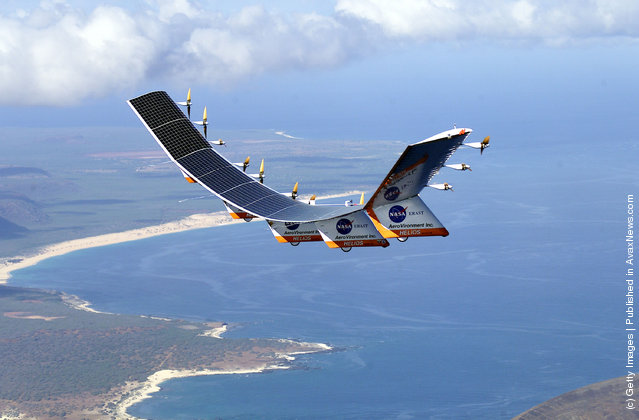
“NASA's Pathfinder, Pathfinder Plus, Centurion and Helios Prototype were an evolutionary series of solar- and fuel-cell-system-powered unmanned aerial vehicles. AeroVironment, Inc. developed the vehicles under NASA's Environmental Research Aircraft and Sensor Technology (ERAST) program. They were built to develop the technologies that would allow long-term, high-altitude aircraft to serve as “atmospheric satellites”, to perform atmospheric research tasks as well as serve as communications platforms”. – Wikipedia
Photo: The solar-electric Helios Prototype flying wing is flies over the Hawaiian islands of Niihau and Lehua during the first solar-powered test flight July 14, 2001 from the U.S. Navy's Pacific Missile Range Facility on Kauai, HI. The 18-hour flight was a functional checkout of the aircraft's systems and performance in preparation for an attempt to reach sustained flight at 100,000 feet altitude later in the summer. (Photo Courtesy of NASA/Getty Images)