Loading...
Done
Bikini-clad women ski as they are led by a car during a performance on the frozen Yenisei River outside Krasnoyarsk, Siberia, Russia, March 20, 2016. The performance, entitled “Siberian Spring's Strings” and created with the participation of artist Vasily Slonov, marked the day of spring equinox (vernal equinox), according to organizers. (Photo by Ilya Naymushin/Reuters)

Bikini-clad women ski as they are led by a car during a performance on the frozen Yenisei River outside Krasnoyarsk, Siberia, Russia, March 20, 2016. The performance, entitled “Siberian Spring's Strings” and created with the participation of artist Vasily Slonov, marked the day of spring equinox (vernal equinox), according to organizers. (Photo by Ilya Naymushin/Reuters)
Details
21 Mar 2016 13:07:00
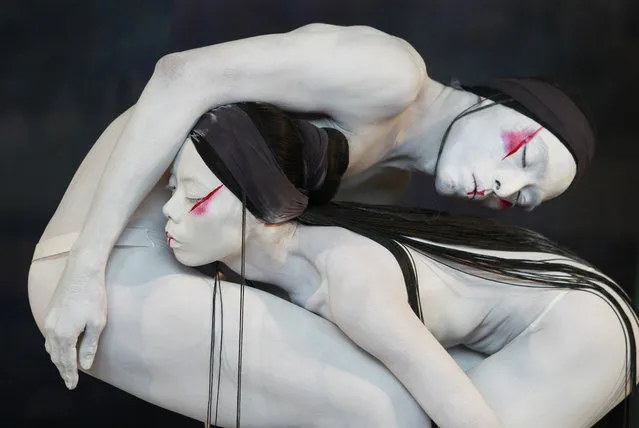
Dancers from the “Legend Lin Dance Theatre” perform the artistic director and choreographer Li-chen Lin's classic works “Hymne aux Fleurs qui Passent, Anthem to the Fading Flowers” during a rehearsal at the National Theater Concert Hall in Taipei, Taiwan, Tuesday, August 18, 2015. “Hymne aux Fleurs Qui Passent” pays tribute to the cycle of the year and the complementary principles of Yin and Yang whose eternal struggle provides the driving force behind the changing of the seasons. (Photo by Chiang Ying-ying/AP Photo)

Dancers from the “Legend Lin Dance Theatre” perform the artistic director and choreographer Li-chen Lin's classic works “Hymne aux Fleurs qui Passent, Anthem to the Fading Flowers” during a rehearsal at the National Theater Concert Hall in Taipei, Taiwan, Tuesday, August 18, 2015. “Hymne aux Fleurs Qui Passent” pays tribute to the cycle of the year and the complementary principles of Yin and Yang whose eternal struggle provides the driving force behind the changing of the seasons. (Photo by Chiang Ying-ying/AP Photo)
Details
19 Aug 2015 12:59:00
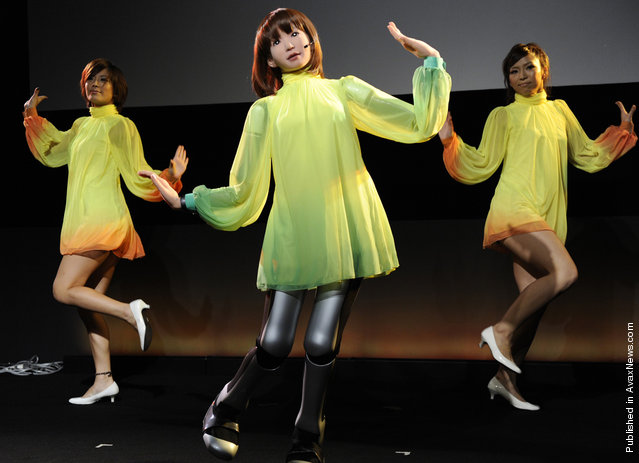
HRP-4C, a five-foot humanoid robot developed at Japan's National Institute of Advanced Industrial Science and Technology, sings and dances with performers at the Digital Contents Expo in Tokyo on October 17, 2010. The robot runs entertainment software called Choreonoid, a name formed from the words “choreograph” and “humanoid”

HRP-4C, a five-foot humanoid robot developed at Japan's National Institute of Advanced Industrial Science and Technology, sings and dances with performers at the Digital Contents Expo in Tokyo on October 17, 2010. The robot runs entertainment software called Choreonoid, a name formed from the words “choreograph” and “humanoid”. (Yoshikazu Tsuno/AFP)
Details
15 Apr 2012 11:44:00
Alee Harrison, 13, wears the tv series “Doctor Who” on her legs as she works on a painting for Operation Blue Pride. (Photo by Greg Lovett/The Palm Beach Post)

Alee Harrison, 13, wears the tv series “Doctor Who” on her legs as she works on a painting for Operation Blue Pride. (Photo by Greg Lovett/The Palm Beach Post)
Details
26 Feb 2014 10:00:00
Makeup artists Kamila Wysocka and Alexis Jackson from Florida, point at another costumed person as they eat dinner in their zombie makeup at ComicCon in New York, on Oktober 10, 2013. (Photo by Carlo Allegri/Reuters)

Makeup artists Kamila Wysocka and Alexis Jackson from Florida, point at another costumed person as they eat dinner in their zombie makeup at ComicCon in New York, on Oktober 10, 2013. (Photo by Carlo Allegri/Reuters)

P.S. All pictures are presented in high resolution. To see Hi-Res images – just TWICE click on any picture. In other words, click small picture – opens the BIG picture. Click BIG picture – opens VERY BIG picture (if available; this principle works anywhere on the site AvaxNews)
Details
12 Oct 2013 11:03:00
NASA's New Space Launch System

“The Space Launch System, or SLS, is a Shuttle-Derived heavy launch vehicle being designed by NASA, following the cancellation of the Constellation Program, to replace the Space Shuttle after its retirement. The NASA Authorization Act of 2010 envisions the transformation of the Ares I and Ares V vehicle designs into a single launch vehicle usable for both crew and cargo. It is to be upgraded over time with more powerful versions. The proposed SLS is visually similar to the legacy Saturn V booster and in particular the proposed, two-stage, Saturn INT-20”. – Wikipedia

Photo: In this illustration provided by NASA, the design for a new space rocket system, the Space Launch System, is seen. NASA's new rocket design will reportedly cost about $35 billion and be ready to for test launch in 2017. According to NASA, the rocket will be used to carry Orion Multi-Purpose Crew Vehicle as well as cargo and science experiments to earth's orbit, as a backup for the space station and possibly destinations beyond that. (Illustration by NASA via Getty Images)

Details
15 Sep 2011 10:50:00
“Tic Tac and Tootsie (twin sisters Carrol and Shelly McKean)”. Taylor Wessing photographic portrait prize 2010. (Photo by Jeffrey Stockbridge)

“The National Portrait Gallery, London's annual photographic portrait prize was established in 2003 as the Schweppes Photographic Portrait Prize. In the years 2006 and 2007 it was referred to simply as the Photographic Portrait Prize, while from 2008 new sponsors have resulted in the name, Taylor Wessing Photographic Portait Prize”. – Wikipedia. Photo: “Tic Tac and Tootsie (twin sisters Carrol and Shelly McKean)”. Taylor Wessing photographic portrait prize 2010. (Photo by Jeffrey Stockbridge)
Details
21 Feb 2013 11:53:00
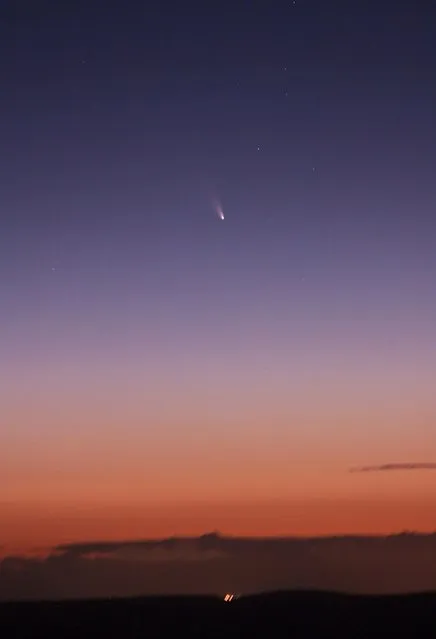
This image provided by NASA shoaws the comet PANSTARRS as seen from Mount Dale, Western Australia on March 5, 2013. According to NASA on March 10, it will make its closest approach to the sun about 28 million miles (45 million kilometers) away. As it continues its nightly trek across the sky, the comet may get lost in the sun's glare but should return and be visible to the naked eye by March 12. (Photo by AP Photo/NASA)

It’s time to start watching for Comet PANSTARRS, one of two comets to get excited about in 2013. Photo: This image provided by NASA shoaws the comet PANSTARRS as seen from Mount Dale, Western Australia on March 5, 2013. According to NASA on March 10, it will make its closest approach to the sun about 28 million miles (45 million kilometers) away. As it continues its nightly trek across the sky, the comet may get lost in the sun's glare but should return and be visible to the naked eye by March 12. (Photo by AP Photo/NASA)
Details
13 Mar 2013 08:03:00