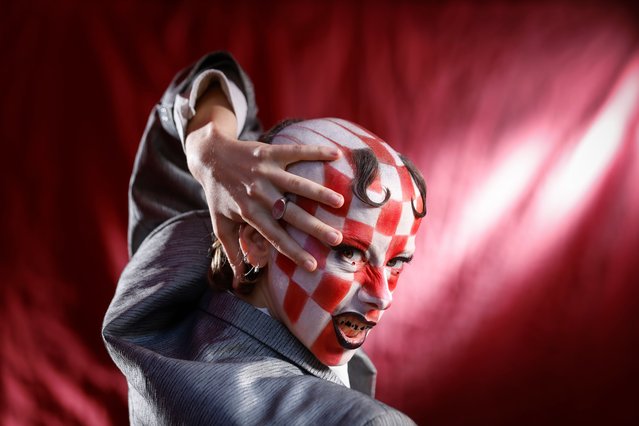
The drag artist Wet Mess performs Testo – a show about testosterone – at the Here & Now Showcase, Edinburgh international festival fringe in 2024. (Photo by Murdo MacLeod/The Guardian)
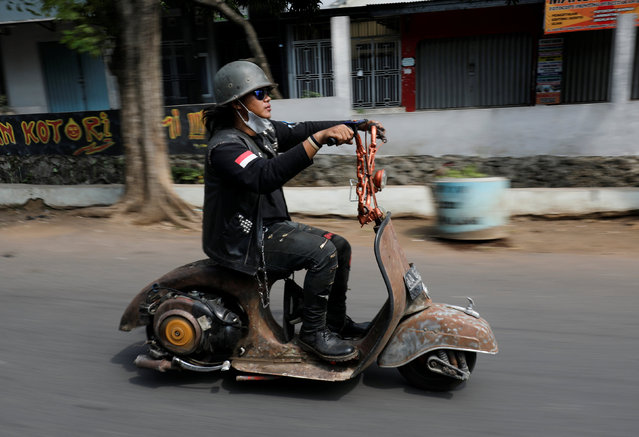
An extreme Vespa enthusiast rides his bike after attending weekend festival for extreme Vespas in Semarang, Central Java, Indonesia, July 22, 2018. Every year, Indonesians from teens and granddads, to mechanics and students, gather in eastern Java to celebrate their love of the iconic Italian Vespa scooter. (Photo by Darren Whiteside/Reuters)
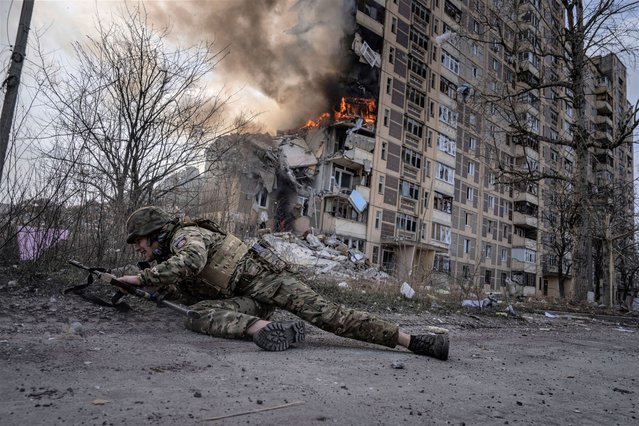
A Ukrainian police officer takes cover in front of a burning building that was hit in a Russian airstrike in Avdiivka, Ukraine, Friday, March 17, 2023. (Photo by Evgeniy Maloletka/AP Photo)
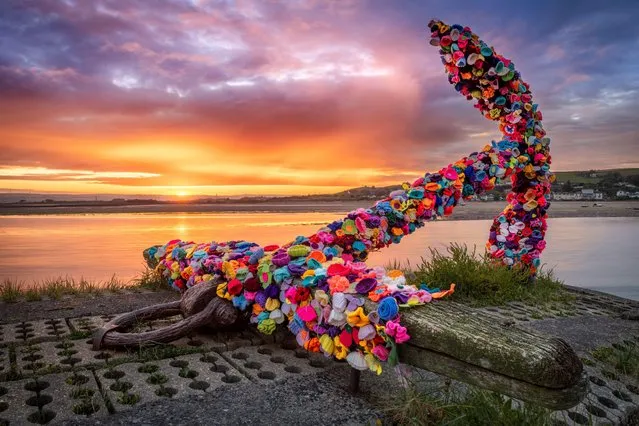
The sun rises behind the landmark Anchor on the quay in Appledore, North Devon, United Kingdom on June 7, 2022. The anchor has been decorated with hundreds of colourful crocheted flowers by the residents of the North Devon coastal village. (Photo by Terry Mathews/Alamy Live News)
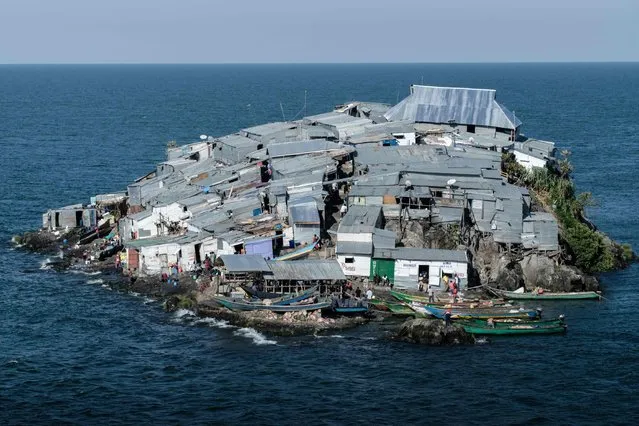
A picture taken on October 5, 2018, shows a general view of Migingo island which is densely populated by residents fishing mainly for Nile perch in Lake Victoria, the continent's largest lake, on the border of Uganda and Kenya. More than 500 people live on the island, which is barely 2,000-square-metres. (Photo by Yasuyoshi Chiba/AFP Photo)
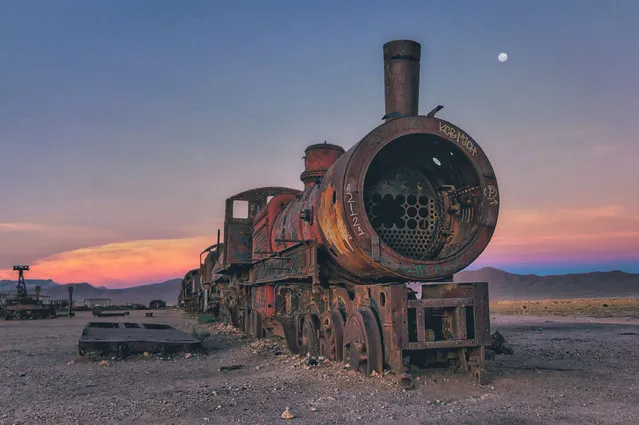
Chris Staring photographs a mysterious train graveyard in the heart of southern Bolivia, where the skeletons of British steam locomotives and rail cars rust away on the edge of the world’s largest salt flats. More than 100 rail cars and locomotives can be found in different states of decay in the train graveyard. (Photo by Chris Staring/Rex Features/Shutterstock)
Sparks are thrown as an employee grinds the edges of a ski at the plant of Swiss ski manufacturer Stoeckli in Malters, Switzerland November 25, 2015. Stoeckli plans to produce some 1,000 pair of skis per year of a special edition for Swiss watch manufacturer TAG Heuer, a brand of LVMH Group. (Photo by Arnd Wiegmann/Reuters)
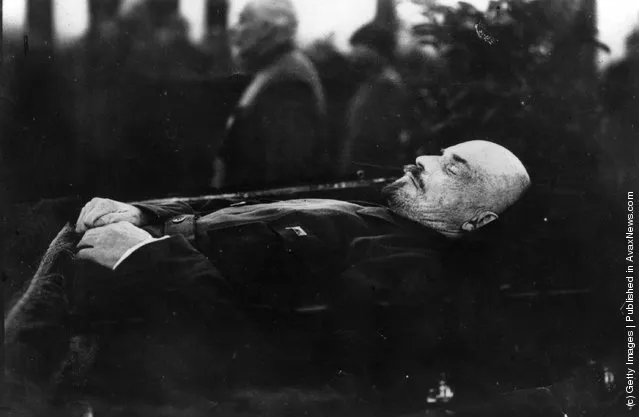
Photo: Vladimir Ilyich Lenin (1870 – 1924) lying in state in the Kremlin. (Photo by Hulton Archive/Getty Images). 1924
Important! For the same article in Russian language click here.
Something quite intriguing is happening within Russian-speaking internet during the last few – should you type a fully academic inquiry (at least, according to Russian academic requirements) in national search engines for "Lenin's mausoleum" – the first thing you get (even in top 10 searches) is website pages talking about black magic and occult. Website authors view this construction differently, but unconditionally agree on one thing: the mausoleum of the "leader of the world proletariat” – the essence of a magical artifact, a sort of “energy vampire”. It was built with a certain purpose: to drain the energy out of miserable Soviet citizens on one hand; and to poison the anthroposphere of one-sixth part of the earth with its vibes (the exact territory that was occupied by the former Soviet Union), depriving the Russian people of will to resist on the other hand. Complete nonsense? No doubt. Nevertheless, an intriguing one. Well, probably because some oddities do exist in mausoleum's history. These oddities are the thing we are going to discuss this time. First, let me refresh you memory on the subject.