Loading...
Done
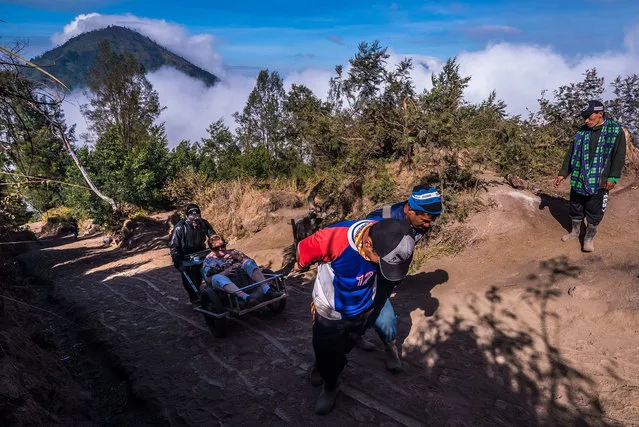
Miners pulling up lazy tourists to the rim of Kawah Ijen (Ijen Volcano), East Java, Indonesia on September 21, 2017. They will earn as much as they would bring down a load of sulfur. Nomadic Explorer, Cultural Lifestyle Photographer Claudio Sieber captured striking images of miners working at Ijen volcanic range in East Java, Indonesia. The sulphur miners risk their lives daily as they climb the active volcano carrying heavy loads, which they sell to sugar refineries. Shortly after midnight curious tourists are flocking in hundreds through the gate of Ijen's foothills to be right on time, driven by the images others took before them. Kawah Ijen is the one of the world's largest acidic volcanic crater lake; famous for its turquoise color as well as the unreal atmosphere it offers during darkness. A dusty path zigzags 3 kilometers up to the crater rim. This doesn't mean anything challenging; in particular, special sights have to be deserved anyway. The irritating smell of sulfur announces the near of the crater's existence. Arriving on the crater's rim the reward for the torture becomes visible. Blue fire darts its tongues through the fumes of sulfur dioxide. Somehow, the spectacle isn't as romantic as expected, since it is also the rough working space of approx. 150 sulfur miners who start their shift at 1 am. Lately, harvesting the abundance of devil's gold received international attention. This did obviously not really improve a miner's lifestyle; neither did it contribute to a better wage. (Photo by Claudio Sieber/Barcroft Images)

Miners pulling up lazy tourists to the rim of Kawah Ijen (Ijen Volcano), East Java, Indonesia on September 21, 2017. They will earn as much as they would bring down a load of sulfur. Nomadic Explorer, Cultural Lifestyle Photographer Claudio Sieber captured striking images of miners working at Ijen volcanic range in East Java, Indonesia. The sulphur miners risk their lives daily as they climb the active volcano carrying heavy loads, which they sell to sugar refineries. (Photo by Claudio Sieber/Barcroft Images)
Details
02 Oct 2017 08:31:00
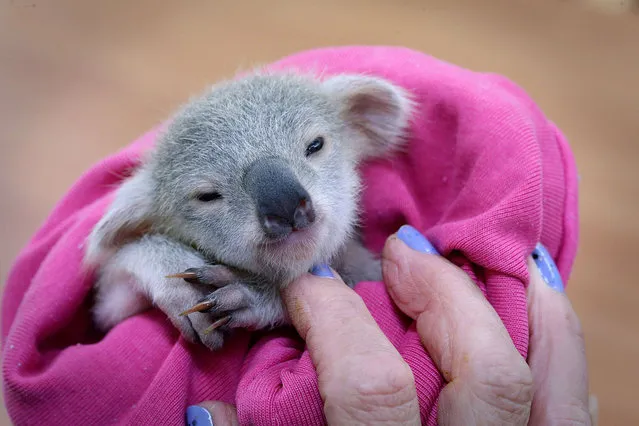
An adorable baby koala is seen enjoying a snooze after a traumatic start to life. The baby koala, nicknamed “Blondie Bumstead”, is being cared for by a volunteer from the Ipswich Koala protection society in Queensland after her mother was killed by a dog. (Photo by Jamie Hanson/Newspix/REX Features)

An adorable baby koala is seen enjoying a snooze after a traumatic start to life. The baby koala, nicknamed “Blondie Bumstead”, is being cared for by a volunteer from the Ipswich Koala protection society in Queensland after her mother was killed by a dog. Blondie, who was named for her light fur, was given just a 50-50 chance of pulling through after the attack. But after a course of antibiotics and some tender loving car from volunteer Marilyn Spletter she has now been given a clean bill of health. According to Marilyn she has hand-reared around 40 baby koalas but says that Blondie, who will be released back into the wild after 15 months, is one of her favourites. She said: “She's got a little character all of her own and she knows what she wants and what she doesn't. When she's stressed I kiss her on the nose or I rub my nose on hers and it relaxes her”. (Photo by Jamie Hanson/Newspix/REX Features)
Details
07 Aug 2014 10:26:00
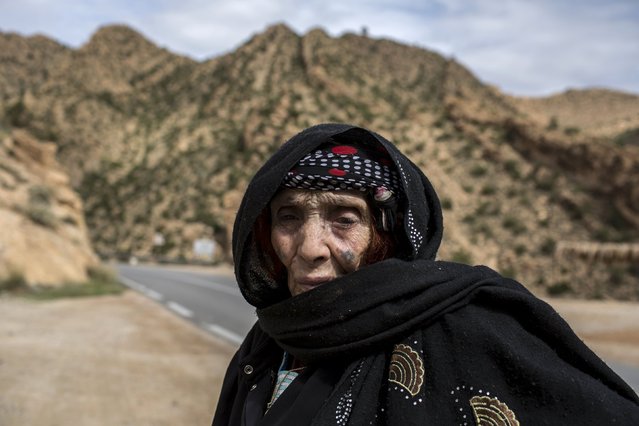
Mazouza Bouglada, 86, a berber woman from the Chaouia region, who has facial tattoos, poses for a photograph in Taghit in the Aures Mountain, Algeria October 8, 2015. Bouglada was tattooed aged 7 by a nomadic man from the Sahara region. She was advised by her mother to get tattooed. The more she got tattooed the more she showed off. Even if she still remembers the pain, she felt beautiful once it was done, Bouglada said. (Photo by Zohra Bensemra/Reuters)

Mazouza Bouglada, 86, a berber woman from the Chaouia region, who has facial tattoos, poses for a photograph in Taghit in the Aures Mountain, Algeria October 8, 2015. Bouglada was tattooed aged 7 by a nomadic man from the Sahara region. She was advised by her mother to get tattooed. The more she got tattooed the more she showed off. Even if she still remembers the pain, she felt beautiful once it was done, Bouglada said. She was very proud of her stars on her cheeks. Her eldest sister had been tattooed before her and she wanted to imitate her. Bouglada said she has now given away all her silver jewellery to atone for the sin that believers told her she had committed by being tattooed. (Photo by Zohra Bensemra/Reuters)
Details
01 Nov 2015 08:02:00


“The ONE Campaign is a international, nonpartisan, non-profit organization which aims to increase government funding for and effectiveness of international aid programs. ONE was originally founded by a coalition of 11 non-profit humanitarian and advocacy organizations — including DATA, World Vision, Oxfam America, and Bread for the World — with funding from the Bill & Melinda Gates Foundation. In 2007, ONE announced that it would be merging with DATA. Currently, ONE is campaigning for resources to help developing countries adapt to climate change. During the 2008 U.S. presidential election the organization launched a campaign, called ONE Vote '08, which was co-chaired by former U.S. Senate majority leaders Tom Daschle (D-SD) and Bill Frist (R-TN). The campaign is named after the U2 song “One” which was a top ten hit single on the critically acclaimed 1991 Achtung Baby album”. – Wikipedia

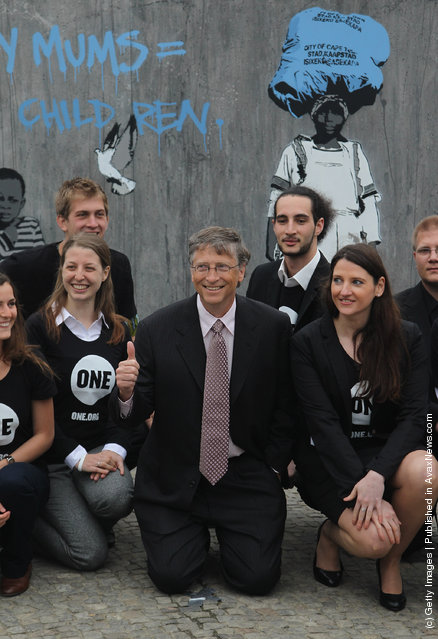
Photo: Bill Gates, founder of Microsoft and now philanthropist, poses with One.org charity volunteers at Pariser Platz square during a brief stop at Brandenburg Gate on April 6, 2011 in Berlin, Germany. Gates is in Berlin to meet with German government officials, including Chancellor Angela Merkel and Development Minister Dirk Niebel, to discuss aid for developing countries and promote his One.org charity initiative, which is part of the Bill and Melinda Gates Foundation. (Photo by Sean Gallup/Getty Images)

Details
07 Apr 2011 08:31:00
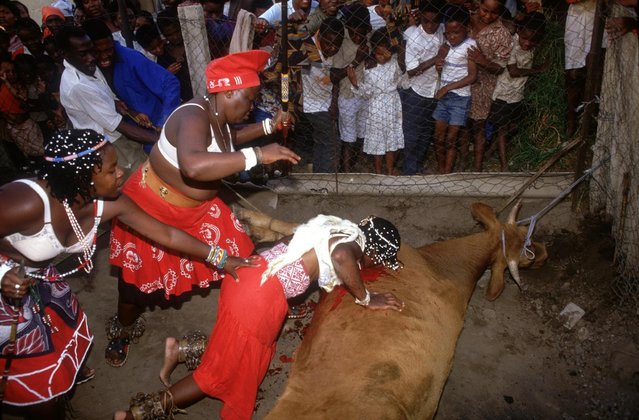
South African Sangomas are wizards and witches who are supposedly chosen by their ancestors to follow a traditional training and go through a rite of passage after which they become Sangomas and can cure and help people. They are so respected and trusted that western medical authorities have actually advised the government of South Africa to develop its cooperation with Sangomas in order to improve hygiene and health among the population. Today is graduation day for Trissa, 25, a Sangoma student in Tembisa, near Pretoria. Thanks to the help of the spirits of her ancestors, she has found a cow that had been hidden. The cow has then been killed by Sangoma Thelma and Trissa is now drinking its blood, thus becoming a Sangoma and changing her name to Nomadlozi. Location: Tembisa, near Pretoria, South Africa. (Photo by Patrick Durand/Sygma via Getty Images)

South African Sangomas are wizards and witches who are supposedly chosen by their ancestors to follow a traditional training and go through a rite of passage after which they become Sangomas and can cure and help people. They are so respected and trusted that western medical authorities have actually advised the government of South Africa to develop its cooperation with Sangomas in order to improve hygiene and health among the population. (Photo by Patrick Durand/Sygma via Getty Images)
Details
24 Feb 2017 00:05:00
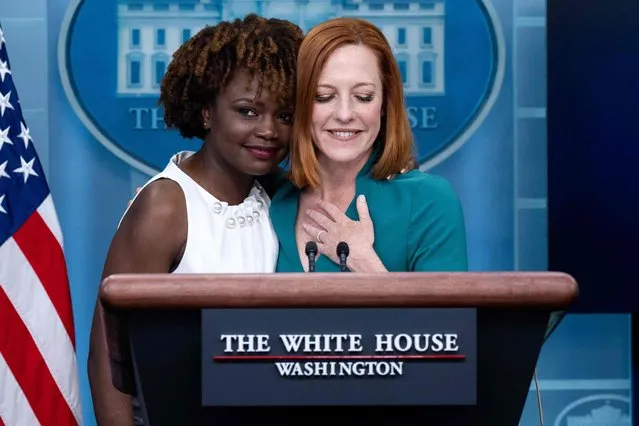
White House Press Secretary Jen Psaki (R) is hugged by current Principal Deputy Press Secretary Karine Jean-Pierre during a press briefing in the Brady Press Briefing Room of the White House in Washington, DC, May 5, 2022, after it was announced Psaki would step down from her role next week and be replaced by Jean-Pierre. US President Joe Biden on May 5, 2022 named Karine Jean-Pierre as the next White House press secretary, the first Black woman to hold the high-profile post. Jean-Pierre, who will also be the first openly LGBTQ+ person in the role, will replace Jen Psaki, under whom she served as deputy, from May 13, according to a White House statement. (Photo by Saul Loeb/AFP Photo)

White House Press Secretary Jen Psaki (R) is hugged by current Principal Deputy Press Secretary Karine Jean-Pierre during a press briefing in the Brady Press Briefing Room of the White House in Washington, DC, May 5, 2022, after it was announced Psaki would step down from her role next week and be replaced by Jean-Pierre. (Photo by Saul Loeb/AFP Photo)
Details
09 May 2022 05:45:00
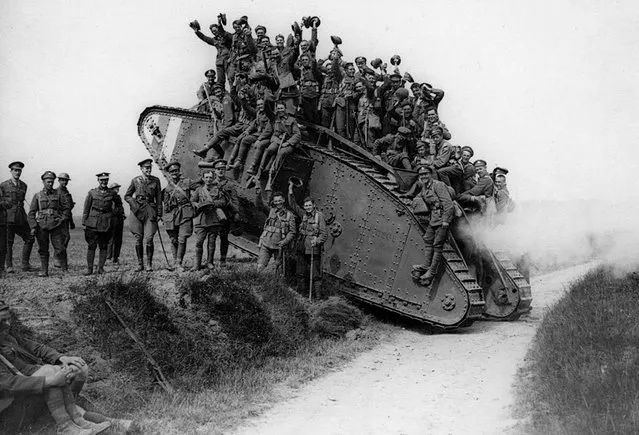
These black-and-white photos are taken from the new book “Armoured Warfare in the First World War 1916 – 1918” by Anthony Tucker-Jones and published by Pen & Sword Military. “Interestingly the British, French and Germans took completely different approaches with varying results”. The British military produced “Little Willie” in Autumn 1915 weighing 18 tonnes, which had a crew of two plus four gunners. “Inspired by a tracked artillery tractor “Little Willie” was referred to as a water tank – hence the name tank – to ensure secrecy”, said Anthony. “This led to the strange looking Mark I with its peculiar rhomboid shape, designed to cross trenches with guns in sponsons on either side. The Germans saw the tank as unchivalrous and were slow to grasp its utility. They favoured the Stormtrooper (specialist soldiers used to infiltrate enemy trenches) and artillery, not the tank”, said Anthony. “However, they didn’t hesitate to make use of captured British tanks. Although the tank helped secure victory and German soldiers dubbed it “Germany’s Downfall” the country was ultimately brought to its knees by the Allies blockade”. Here: British troops hitch a ride on a Mark IV after the massed tank fleet spearheading attack at Cambrai on November 20, 1917. (Photo by Anthony Tucker-Jones/Mediadrumworld.com)

These black-and-white photos are taken from the new book “Armoured Warfare in the First World War 1916 – 1918” by Anthony Tucker-Jones and published by Pen & Sword Military. Here: British troops hitch a ride on a Mark IV after the massed tank fleet spearheading attack at Cambrai on November 20, 1917. (Photo by Anthony Tucker-Jones/Mediadrumworld.com)
Details
23 Feb 2017 00:02:00
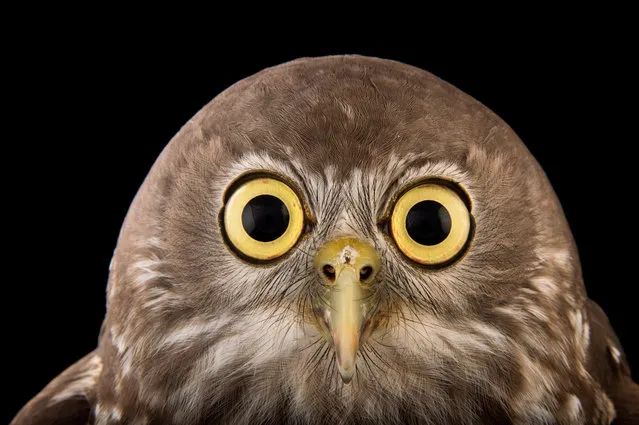
The National Geographic Photo Ark is a travelling exhibition of photographer Joel Sartore’s quest to create a photo archive of biodiversity around the world. So far, Sartore has captured studio portraits of more than 6,000 species – a number that he hopes to double. On 1 July, the ark will open at Melbourne zoo – the first time it has been exhibited in the southern hemisphere. More than 50 portraits will be on display, including many of Australian endangered animals being protected by programs at the zoo itself. These captions have been edited from text supplied by Melbourne zoo. Here: Barking owl. So-named because its call sounds like a barking dog, these birds are native to Australia, Indonesia and Papua New Guinea. In Victoria they are listed as an endangered species, and in 2003 there were estimated to be fewer than 50 breeding pairs. The main threat to the species in Victoria is loss of habitat, especially large trees with hollows in which they can nest and on which many of their prey depend. Apart from a bark, they may utter a chilling scream when they feel threatened. (Photo by Joel Sartore/National Geographic Photo Ark/The Guardian)

The National Geographic Photo Ark is a travelling exhibition of photographer Joel Sartore’s quest to create a photo archive of biodiversity around the world. So far, Sartore has captured studio portraits of more than 6,000 species – a number that he hopes to double. On 1 July, the ark will open at Melbourne zoo – the first time it has been exhibited in the southern hemisphere. More than 50 portraits will be on display, including many of Australian endangered animals being protected by programs at the zoo itself. These captions have been edited from text supplied by Melbourne zoo. Here: Barking owl. (Photo by Joel Sartore/National Geographic Photo Ark/The Guardian)
Details
01 Jul 2017 07:45:00