Kids play in water to cool off during the scorching weather of a heatwave at a River Landing splash park in Saskatoon, Saskatchewan, Canada July 2, 2021. (Photo by David Stobbe/Reuters)
A member of the Boi Bumba Garantido association performs during the Boi Bumba folklore festival at the Bumbodromo in Parintins, Amazonas State, Brazil, on June 28, 2024. Parintins is well-known internationally for its Boi Bumba folklore festival, which lasts for three days in late June and whose themes, costumes, and songs are based on indigenous cultures of the Amazon rainforest. (Photo by Michael Dantas/AFP Photo)
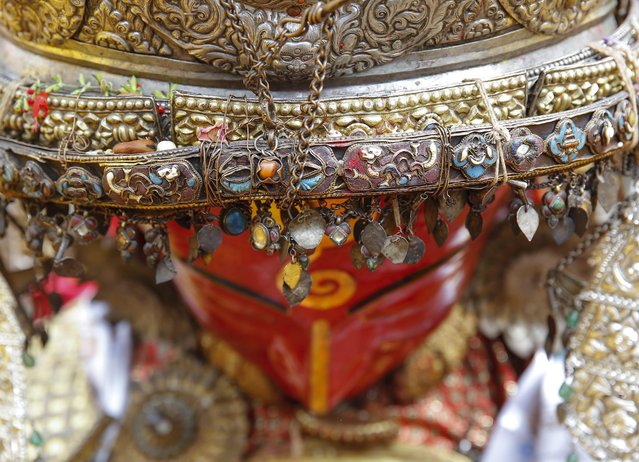
A close up of ornaments of centuries-old idols of Lord Buddha during the Pancha Daan, Five donation, festival in Bhaktapur, Nepal, 30 August 2016. Thousands of Buddhist pilgrims observe the main day of the Pancha Daan also known as a five summer gifts (rice, grain, salt, money and fruits) festival which is observes for world peace and human welfare. (Photo by Narendra Shrestha/EPA)
A hot air balloon in the likeness of Yoda from Star Wars prepares for liftoff at the 21st Philippine International Hot Air Balloon Festival at the former Clark US Air Force base in Pampanga Province, Philippines on February 9, 2017. (Photo by Xinhua News Agency/Rex Features/Shutterstock)
Victoria's Secret Angel Martha Hunt celebrates the 2015 What Is s*xy? List in San Diego on September 26, 2015 in San Diego, California. (Photo by Joe Scarnici/Getty Images for Victoria's Secret)
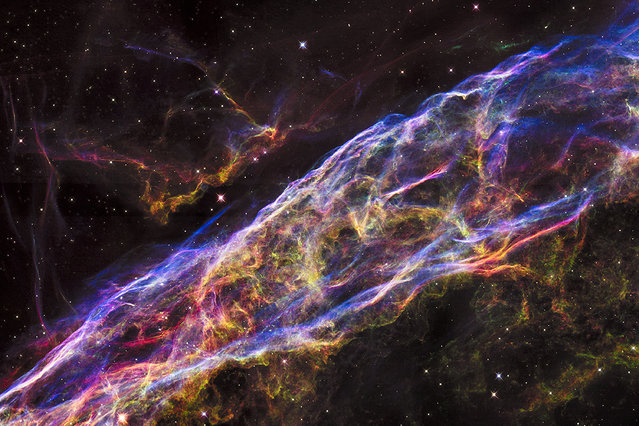
A small section of the expanding remains of the Veil Nebula, a massive star that exploded about 8,000 years ago. The entire nebula is 110 light-years across, covering six full moons on the sky as seen from Earth, and resides about 2,100 light-years away in the constellation Cygnus, the Swan. Image taken by NASA's Hubble Space Telescope. Released September 24, 2015. (Photo by Reuters/NASA/ESA/Hubble Heritage Team)
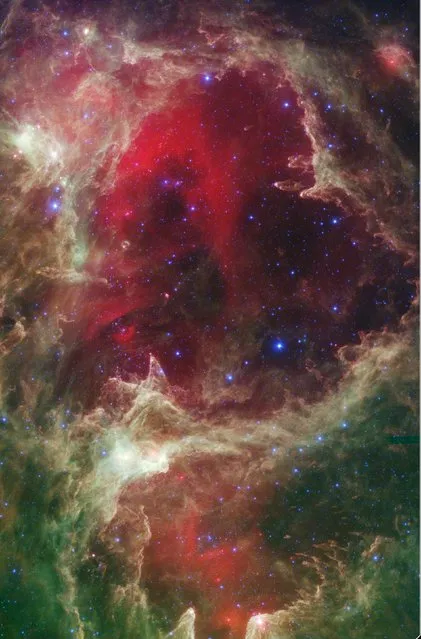
An infrared portrait from NASA's Spitzer Space Telescope which shows generations of stars is seen in this undated NASA handout image released February 14, 2013. In this wispy star-forming region, called W5, the oldest stars can be seen as blue dots in the centers of the two hollow cavities (other blue dots are background and foreground stars not associated with the region). Red shows heated dust that pervades the region's cavities, while green highlights dense clouds. (Photo by NASA/Reuters/JPL-Caltech/Harvard-Smithsonian/Handout)