Loading...
Done
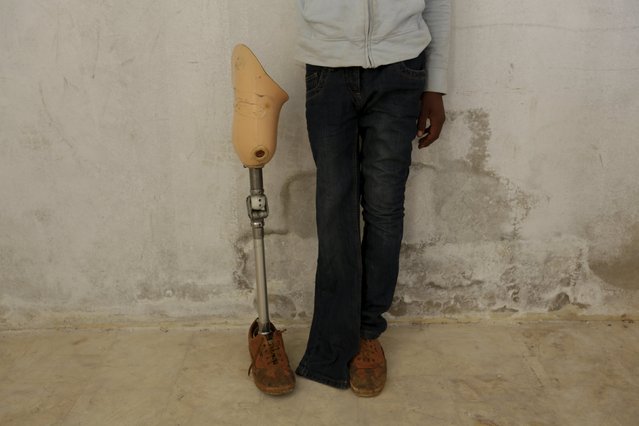
A young man with an amputated leg poses for a photograph standing by his broken artificial limb in the rebel-controlled area of Maaret al-Numan town in Idlib province, Syria March 20, 2016. (Photo by Khalil Ashawi/Reuters)

A young man with an amputated leg poses for a photograph standing by his broken artificial limb in the rebel-controlled area of Maaret al-Numan town in Idlib province, Syria March 20, 2016. Two university students forced to interrupt their studies have learnt to make and fit hundreds of new limbs in the past four years in opposition-held areas of Syria. A mobile clinic operating from a truck has gone some way to improve access to treatment. While most patients are between 15 and 45, the clinic also helps children and the elderly with replacement limbs. (Photo by Khalil Ashawi/Reuters)
Details
16 Apr 2016 12:03:00
Kawakanih Yawalapiti, 9, Upper Xingu region of Mato Grosso, Brazil, 2018: Kawakanih lives with her tribe, the Yawalapiti, in Xingu national park, a preserve in the Amazon basin of Brazil. The Yawalapiti collect seeds to preserve species unique to their ecosystem, which lies between the rain forest and savannah. Kawakanih’s diet is simple, consisting mainly of fish, cassava, porridge, fruit and nuts. “It takes five minutes to catch dinner”, says Kawakanih. “When you’re hungry, you just go to the river with your net”. (Photo by Gregg Segal/The Guardian)

Photographer Gregg Segal travelled the world to document children and the food they eat in a week. Partly inspired by the increasing problems of childhood obesity, he tracked traditional regional diets as yet unaffected by globalisation, and ironically, found that the healthiest diets were often eaten by the least well off. (Photo by Gregg Segal/The Guardian)
Details
03 Jul 2019 00:03:00
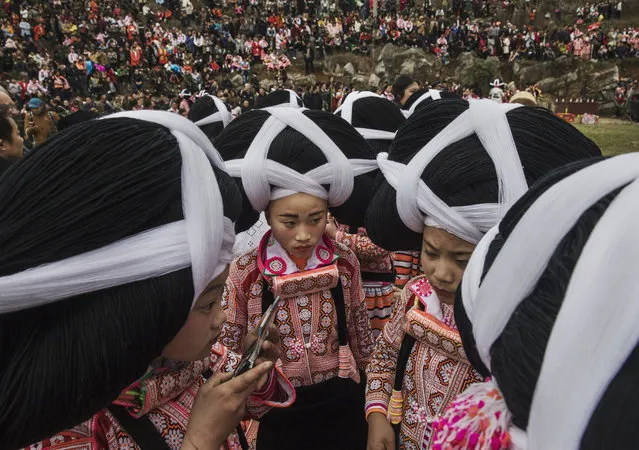
Girls of the Long Horn Miao ethnic minority group wear headdresses as they prepare gather for Tiaohua or Flower Festival as part of the Lunar New Year on February 6, 2017 in Longga village, Guizhou province, southern China. The Long Horn Miao are recognized for their declining practice of wrapping a blend of linen, wool, and the hair of their ancestors around animal horns or a wooden clip to make headdresses. Many young women say they now wear the headdresses only for special occasions and festivals, as the ornaments, which are attached by the horns to their real hair, have proved impractical for modern daily life in a fast changing world. China officially recognizes 56 different ethnic minorities, and statistics show over 7 million Chinese identifying themselves as Miao. But the small Long Horn Miao community counts only around 5000 people living in 12 villages, whose age-old traditions, language, and culture are fading. It is increasingly difficult in a modernizing China, as young people are drawn from remote rural villages to opportunities in bigger cities amongst wide-scale urbanization. Farming and labour remain the mainstays of life for the Long Horn Miao, leaving the area relatively poor in comparison with many parts of China. The government has invested significant amounts into local infrastructure and the tourism industry to try to bolster the local economy. (Photo by Kevin Frayer/Getty Images)

Girls of the Long Horn Miao ethnic minority group wear headdresses as they prepare gather for Tiaohua or Flower Festival as part of the Lunar New Year on February 6, 2017 in Longga village, Guizhou province, southern China. (Photo by Kevin Frayer/Getty Images)
Details
13 Feb 2017 00:01:00
Nature – first prize, stories. Pandemic Pigeons – A Love Story. The photographer’s daughter, Merel, cowers after Dollie flies past and perches on the balcony before entering the house in Vlaardingen in the Netherlands on 6 April 2020. “She’s still frightened when Dollie suddenly lands on the balcony railing. I hide my smile behind the camera, as I try to comfort her by saying they won’t hurt you. “I thought he was going to attack me”, she replies. As the nesting pigeons keep coming back to our place, slowly my girls have started to appreciate them – perhaps not as much as I do, but it’s a start”. (Photo by Jasper Doest/World Press Photo 2021)

Nature – first prize, stories. Pandemic Pigeons – A Love Story. The photographer’s daughter, Merel, cowers after Dollie flies past and perches on the balcony before entering the house in Vlaardingen in the Netherlands on 6 April 2020. “She’s still frightened when Dollie suddenly lands on the balcony railing. I hide my smile behind the camera, as I try to comfort her by saying they won’t hurt you. “I thought he was going to attack me”, she replies. As the nesting pigeons keep coming back to our place, slowly my girls have started to appreciate them – perhaps not as much as I do, but it’s a start”. (Photo by Jasper Doest/World Press Photo 2021)
Details
17 Apr 2021 09:30:00
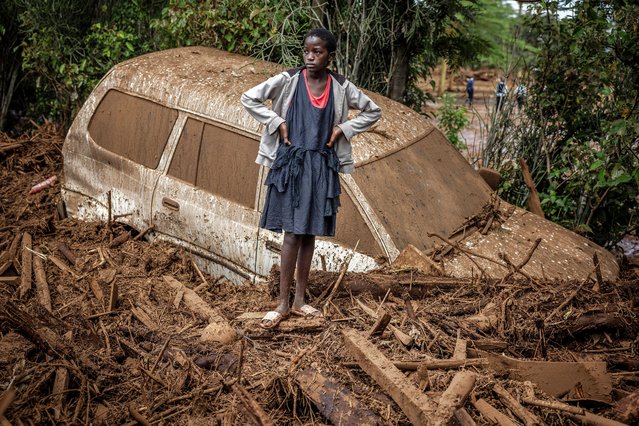
A girl looks on next to a damaged car buried in mud in an area heavily affected by torrential rains and flash floods in the village of Kamuchiri, near Mai Mahiu, on April 29, 2024. At least 45 people died when a dam burst its banks near a town in Kenya's Rift Valley, police said on April 29, 2024, as torrential rains and floods battered the country The disaster raises the total death toll over the March-May wet season in Kenya to more than 120 as heavier than usual rainfall pounds East Africa, compounded by the El Nino weather pattern. (Photo by Luis Tato/AFP Photo)

A girl looks on next to a damaged car buried in mud in an area heavily affected by torrential rains and flash floods in the village of Kamuchiri, near Mai Mahiu, on April 29, 2024. At least 45 people died when a dam burst its banks near a town in Kenya's Rift Valley, police said on April 29, 2024, as torrential rains and floods battered the country The disaster raises the total death toll over the March-May wet season in Kenya to more than 120 as heavier than usual rainfall pounds East Africa, compounded by the El Nino weather pattern. (Photo by Luis Tato/AFP Photo)
Details
07 May 2024 03:35:00
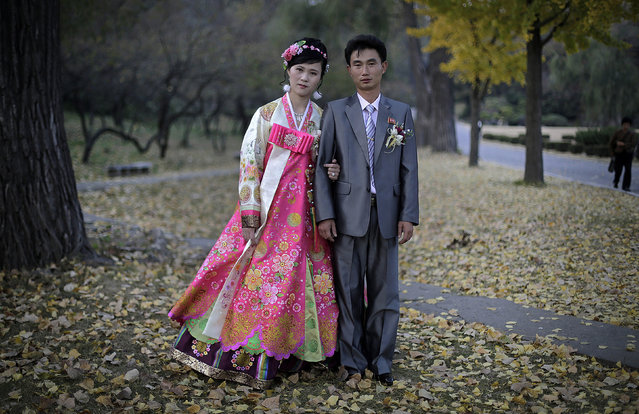
In this October 25, 2014, file photo, North Korean bride Ri Ok Ran, 28, and groom Kang Sung Jin, 32, pose for a portrait at the Moran Hill where they went to take wedding pictures, in Pyongyang, North Korea. The couple were married after dating for about two years. Their motto: “To have many children so that they can serve in the army and defend and uphold our leader and country, for many years into the future”. (Photo by Wong Maye-E/AP Photo)

Associated Press photographer Wong Maye-E tries to get her North Korean subjects to open up as much as is possible in an authoritarian country with no tolerance for dissent and great distrust of foreigners. She has taken dozens of portraits of North Koreans over the past three years, often after breaking the ice by taking photos with an instant camera and sharing them. Her question for everyone she photographs: What is your motto? Their answers reflect both their varied lives and the government that looms incessantly over all of them. (Photo by Wong Maye-E/AP Photo)
Details
16 Jun 2017 06:28:00
Maj. Matt O'Donnell of Glenelg, MD shields himself from rotor wash as Ospreys carrying the delegation of U.S. Secretary of Defense Leon Panetta leaves on March 14, 2012 at Forward Operating Base Shukvani, Afghanistan

Maj. Matt O'Donnell of Glenelg, MD shields himself from rotor wash as Ospreys carrying the delegation of U.S. Secretary of Defense Leon Panetta leaves on March 14, 2012 at Forward Operating Base Shukvani, Afghanistan. Panetta is also scheduled to meet with President Karzai during his two-day visit to Afghanistan. The trip comes as the Taliban has vowed revenge following this past weekend's killing spree by a U.S. soldier who is accused of killing 16 civilians in Afghanistan. Most of those killed were children and women. (Photo by Scott Olson/Getty Images)
Details
16 Mar 2012 10:34:00
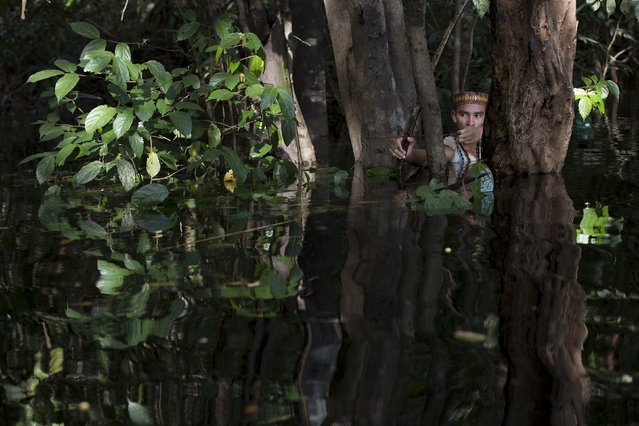
Kambeba Indian, Dream Braga, 18, aims his arrow in a jungle near the village Tres Unidos, Amazon state May 9, 2015. Dream Braga has been shooting fish with a bow and arrow for most of his life. In the Amazonian village where he grew up, that was what kids did for food and fun. (Photo by Bruno Kelly/Reuters)

Kambeba Indian, Dream Braga, 18, aims his arrow in a jungle near the village Tres Unidos, Amazon state May 9, 2015. Dream Braga has been shooting fish with a bow and arrow for most of his life. In the Amazonian village where he grew up, that was what kids did for food and fun. He participated in the Indigenous Archery Project which recruits Amazon native children to compete with modern archery equipment and try for a place on the national team, with the 2016 Olympics in Rio de Janeiro as their ultimate goal. After training with Olympic coaches for three months, he has now been promoted to Brazil's national team. (Photo by Bruno Kelly/Reuters)
Details
17 May 2015 11:19:00