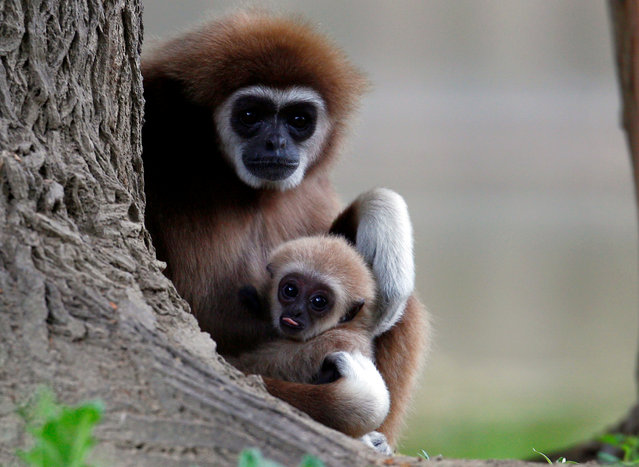
A first white-handed gibbon infant born at the Skopje Zoo is seen with his mother in Skopje, North Macedonia on May 9, 2019. (Photo by Ognen Teofilovski/Reuters)
People take part in a gay pride parade in Warsaw, Poland, on Saturday, June 8, 2019. The Equality Parade is the largest gay pride parade in central and Eastern Europe. It brought thousands of people to the streets of Warsaw at a time when the LGBT rights movement in Poland is targeted by hate speeches and a government campaign depicting it as a threat to families and society. (Photo by Czarek Sokolowski/AP Photo)
Serena Williams awaits a return with partner Venus Williams (not pictured) of the United States against Lucie Hradecka and Linda Noskova of Czech Republic during the Women’s Doubles First Round match on Day Four of the 2022 US Open at USTA Billie Jean King National Tennis Center on September 01, 2022 in the Flushing neighborhood of the Queens borough of New York City. (Photo by Jamie Squire/Getty Images)
Revellers perform during the “Salsodromo”, the kick-off of the music and cultural festival Feria de Cali (Cali Fair) in Cali, Colombia, on December 25, 2021. The “Salsodromo”, an event in which more than 2,500 revellers and salsa music dancers perform along a kilometre-long stripe, marks the start of the Feria de Cali festival every year. (Photo by Paola Mafla/AFP Photo)
Children wearing cardboard lion dance masks walk along a street in Beijing on January 13, 2023. China has announced its first overall population decline in recent years amid an aging society and plunging birthrate. (Photo by Mark Schiefelbein/AP Photo)
Spectators pose for a selfie before the running of the Melbourne Cup at the Flemington Racecourse in Melbourne, Australia, Tuesday, November 6, 2018. (Photo by Andy Brownbill/AP Photo)
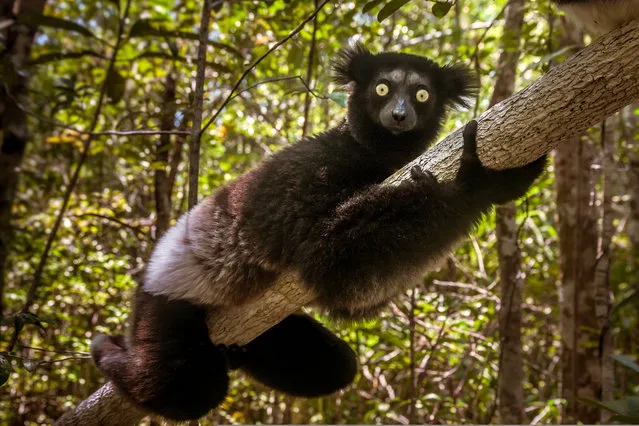
The secretive indri (Indri indri) of Madagascar, the largest living lemur. It is also critically endangered and highly evolutionarily distinct with no close relatives, which makes its branch one of most precarious on the mammal evolutionary tree. In the likely event that the indri goes extinct, we will lose 19m years of unique evolutionary history from the mammal tree of life. (Photo by Pierre-Yves Babelon/Aarhus University)