Loading...
Done
Indian groom Prakash Sing (R) and bride Durga Prasad (C) perform marriage rituals at the Lord Shiva temple during the Maha Shivratri festival, in Kolkata, eastern India, 01 March 2022. Maha Shivaratri is celebrated with great devotion and religious fervor by Hindus, in honor of Lord Shiva with ritual bathing of Shivalingams and prayers. Unmarried women observe fast from dawn to dusk and pray to Lord Shiva to give them a good spouse. According to one of the most popular legends, Shivaratri is the wedding day of Lord Shiva and Parvati. (Photo by Piyal Adhikary/EPA/EFE)

Indian groom Prakash Sing (R) and bride Durga Prasad (C) perform marriage rituals at the Lord Shiva temple during the Maha Shivratri festival, in Kolkata, eastern India, 01 March 2022. Maha Shivaratri is celebrated with great devotion and religious fervor by Hindus, in honor of Lord Shiva with ritual bathing of Shivalingams and prayers. Unmarried women observe fast from dawn to dusk and pray to Lord Shiva to give them a good spouse. According to one of the most popular legends, Shivaratri is the wedding day of Lord Shiva and Parvati. (Photo by Piyal Adhikary/EPA/EFE)
Details
15 Mar 2022 05:45:00
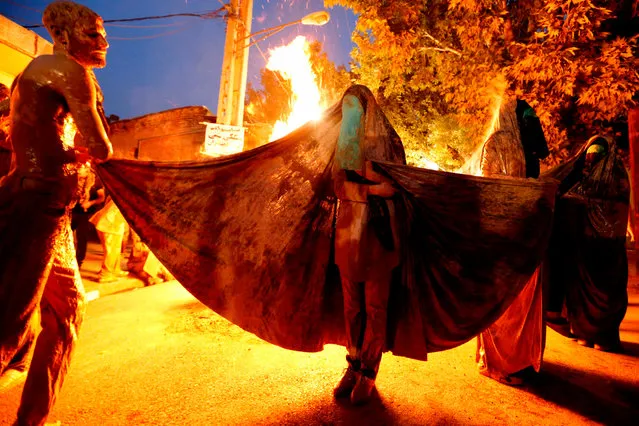
Iranian Shiite Muslim women gather around a bonfire after rubbing mud on their body during the “Kharrah Mali” (Mud Rubbing) ritual to mark the Ashura religious ceremony in the city of Khorramabad, some 470 kms southwest of Tehran, early in the morning on October 1, 2017. “Khrreh Mali” or “Mud Rubbing” is a ritual that is held in the city of Khorramabad every year to commemorate the seventh century slaying of Prophet Mohammed' s grandson Imam Hussein, in which Iranian men roll over in mud and dry themselves by gathering around the bonfires before flagellating themselves. (Photo by Atta Kenare/AFP Photo)

Iranian Shiite Muslim women gather around a bonfire after rubbing mud on their body during the “Kharrah Mali” (Mud Rubbing) ritual to mark the Ashura religious ceremony in the city of Khorramabad, some 470 kms southwest of Tehran, early in the morning on October 1, 2017. “Khrreh Mali” or “Mud Rubbing” is a ritual that is held in the city of Khorramabad every year to commemorate the seventh century slaying of Prophet Mohammed' s grandson Imam Hussein, in which Iranian men roll over in mud and dry themselves by gathering around the bonfires before flagellating themselves. (Photo by Atta Kenare/AFP Photo)
Details
02 Oct 2017 08:38:00
Two women enjoy drinks outside a pub in the soho area of central London on November 4, 2020, on the eve of a second novel coronavirus COVID-19 lockdown in an effort to combat soaring infections. English pubs call last orders at the bar for a month on Wednesday evening, as the country effectively shuts down from November 5, for the second time this year to try to cut coronavirus cases. Prime Minister Boris Johnson insisted that the lockdown for England would end “automatically” in four weeks, as he tried to placate party critics over the spiralling economic fallout. (Photo by Stephen Lock/i-Images)

Two women enjoy drinks outside a pub in the soho area of central London on November 4, 2020, on the eve of a second novel coronavirus COVID-19 lockdown in an effort to combat soaring infections. English pubs call last orders at the bar for a month on Wednesday evening, as the country effectively shuts down from November 5, for the second time this year to try to cut coronavirus cases. Prime Minister Boris Johnson insisted that the lockdown for England would end “automatically” in four weeks, as he tried to placate party critics over the spiralling economic fallout. (Photo by Stephen Lock/i-Images)
Details
06 Nov 2020 00:07:00
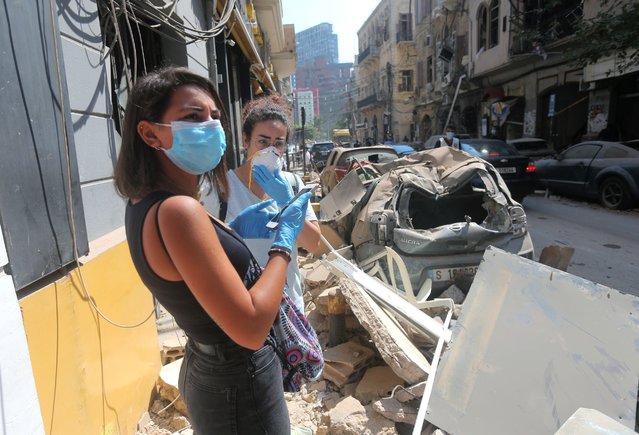
Young Lebanese women wearing protective masks and gloves against the coronavirus pandemic, stand on August 5, 2020 amid the rubble in Beirut's Gimmayzeh commercial district which was heavily damaged by the previous day's powerful explosion that tore through Lebanon's capital, resulting from the ignition of a huge depot of ammonium nitrate at the city's main port. Rescuers searched for survivors in Beirut after a cataclysmic explosion at the port sowed devastation across entire neighbourhoods, killing more than 100 people, wounding thousands and plunging Lebanon deeper into crisis. The blast, which appeared to have been caused by a fire igniting 2,750 tonnes of ammonium nitrate left unsecured in a warehouse, was felt as far away as Cyprus, some 150 miles (240 kilometres) to the northwest. (Photo by AFP Photo/Stringer)

Young Lebanese women wearing protective masks and gloves against the coronavirus pandemic, stand on August 5, 2020 amid the rubble in Beirut's Gimmayzeh commercial district which was heavily damaged by the previous day's powerful explosion that tore through Lebanon's capital, resulting from the ignition of a huge depot of ammonium nitrate at the city's main port. Rescuers searched for survivors in Beirut after a cataclysmic explosion at the port sowed devastation across entire neighbourhoods, killing more than 100 people, wounding thousands and plunging Lebanon deeper into crisis. The blast, which appeared to have been caused by a fire igniting 2,750 tonnes of ammonium nitrate left unsecured in a warehouse, was felt as far away as Cyprus, some 150 miles (240 kilometres) to the northwest. (Photo by AFP Photo/Stringer)
Details
10 Aug 2020 00:05:00
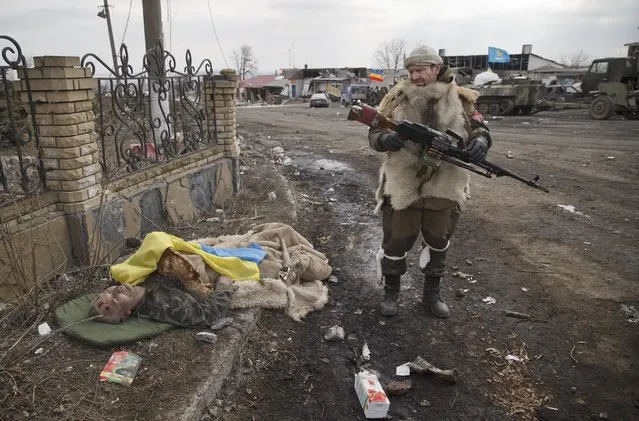
A Russia-backed rebel looks at the flag covered body of an Ukrainian serviceman in Debaltseve, Ukraine, February 20, 2015. The struggle for the strategic rail hub, Debaltseve, a sleepy town with a pre-war population of 25,000 people, left the town in ruins and became one of the darkest pages in the ongoing conflict in eastern Ukraine, which has already killed more than 6,000 people. (Photo by Vadim Ghirda/AP Photo/File)

A Russia-backed rebel looks at the flag covered body of an Ukrainian serviceman in Debaltseve, Ukraine, February 20, 2015. The struggle for the strategic rail hub, Debaltseve, a sleepy town with a pre-war population of 25,000 people, left the town in ruins and became one of the darkest pages in the ongoing conflict in eastern Ukraine, which has already killed more than 6,000 people. (Photo by Vadim Ghirda/AP Photo/File)
Details
12 Feb 2022 06:20:00
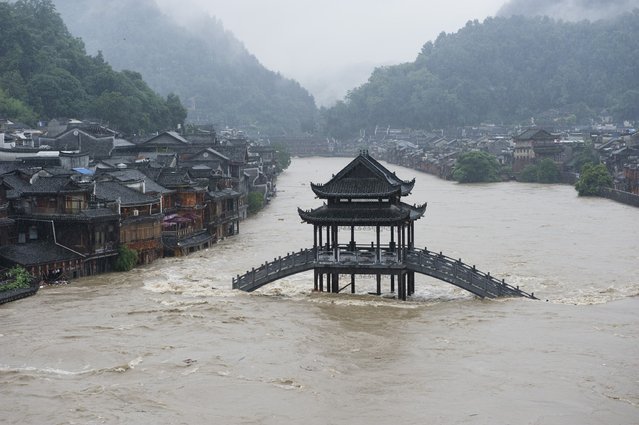
This picture taken on July 15, 2014 shows a bridge submerged in floodwaters in the ancient town of Fenghuang, central China's Hunan province. Rainstorms lashed central China's Hunan Province and southwest China's Guizhou Province, affecting over 1 million people and flooding a historical town, state media reported. (Photo by AFP Photo)

This picture taken on July 15, 2014 shows a bridge submerged in floodwaters in the ancient town of Fenghuang, central China's Hunan province. Rainstorms lashed central China's Hunan Province and southwest China's Guizhou Province, affecting over 1 million people and flooding a historical town, state media reported. (Photo by AFP Photo)
Details
19 Jul 2014 10:30:00
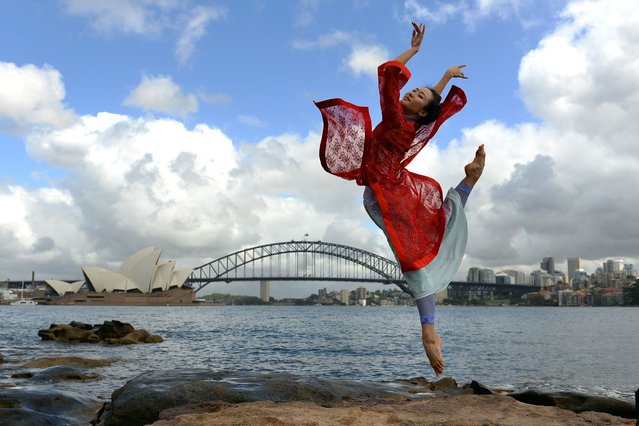
Performer Zhang Yashu from a Chinese ballet company perform during a photo shoot in front of the Australia's iconic landmarks Opera House (L) and Habour Bridge in Sydney on February 17, 2014. One of China's celebrated dance campanies is bringing one of the country's biggest ballet production to Australia for a series of performances in Sydney and Melbourne. (Photo by Saeed Khan/AFP Photo)

Performer Zhang Yashu from a Chinese ballet company perform during a photo shoot in front of the Australia's iconic landmarks Opera House (L) and Habour Bridge in Sydney on February 17, 2014. One of China's celebrated dance campanies is bringing one of the country's biggest ballet production to Australia for a series of performances in Sydney and Melbourne. (Photo by Saeed Khan/AFP Photo)
Details
22 Feb 2014 13:27:00
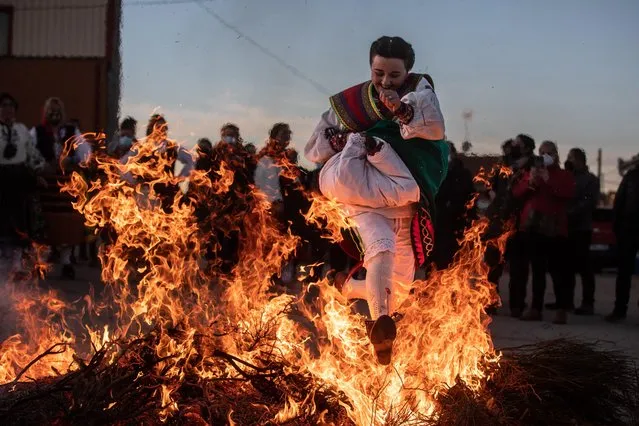
People celebrate the traditional Fiesta de las Aguedas on February 6, 2022 in Andavias, Zamora, Castilla y Leon, Spain. This celebration, also known as “El dia de las mujeres”, is a deep-rooted tradition in Castilla y Leon, especially in rural areas. The day of the Aguedas has its origin in the cult of Santa Agueda, and is celebrated every February 5. During this day, women are the protagonists and take over the city. For their part, the town councils give them the baton as a sign of authority. Around seven days of festivities are celebrated where the attendees dance, eat, sing, and even jump over a bonfire. (Photo By Emilio Fraile/Europa Press via Getty Images)

People celebrate the traditional Fiesta de las Aguedas on February 6, 2022 in Andavias, Zamora, Castilla y Leon, Spain. This celebration, also known as “El dia de las mujeres”, is a deep-rooted tradition in Castilla y Leon, especially in rural areas. The day of the Aguedas has its origin in the cult of Santa Agueda, and is celebrated every February 5. (Photo By Emilio Fraile/Europa Press via Getty Images)
Details
31 Mar 2022 06:18:00