Loading...
Done
Laura Paipo (L), first blind principal in Uruguay participates in a street race with her sighted guide and friend Amparo Bauter in Montevideo, October 4, 2015. (Photo by Andres Stapff/Reuters)

Laura Paipo (L), first blind principal in Uruguay participates in a street race with her sighted guide and friend Amparo Bauter in Montevideo, October 4, 2015. Paipo, 55, who took office on August 10, 2015 became the first blind principal of a special school which specializes in the education of visually impaired students. (Photo by Andres Stapff/Reuters)
Details
08 Oct 2015 08:00:00
Magnificent pictures taken by Grant Mallory. (Photo by Grant Mallory/Caters News)

Well, this is hardly a waist of time! Here’s the couple who traveled the U.S. with an LED hula hoop – taking magnificent landscape photographs as they went. The brilliantly vibrant photographs show off the lights and colors of the lit-up hula hoop – with the strikingly serene American landscapes in the background. Grant Mallory, 25, from Columbus, Ohio, took pictures of his 23-year-old fiance hula-hooping in various national parks across the United States over the course of a three month road trip in the summer of 2015. Here: Magnificent pictures taken by Grant Mallory. (Photo by Grant Mallory/Caters News)
Details
25 Oct 2015 08:07:00
A member of the 324 Squadron during the Anzac Day dawn service at Coogee Beach in Sydney, Australia on 23 April 2019.(Photo by Steven Saphore/Australian Associated Press)

A member of the 324 Squadron during the Anzac Day dawn service at Coogee Beach in Sydney, Australia on 23 April 2019. Anzac Day, held annually on 25 April, is a national day of remembrance across Australia and New Zealand, which commemorates the people who lost their lives or served in wars and conflicts. The day coincides with the first landing of the Anzacs at Gallipoli, Turkey, in World War One. (Photo by Steven Saphore/Australian Associated Press)
Details
26 Apr 2019 00:03:00
Ukrainian artist Dariya Marchenko works on a portrait of Russian President Vladimir Putin named “The Face of War” which is made out of 5,000 cartridges brought from the frontline in eastern Ukraine, in Kiev, July 23, 2015. The portrait will be presented along with a novel which will tell personal stories of six people involved in this project including Daria's own story and stories of people who helped her to collect shells from the frontline. (Photo by Gleb Garanich/Reuters)

Ukrainian artist Dariya Marchenko works on a portrait of Russian President Vladimir Putin named “The Face of War” which is made out of 5,000 cartridges brought from the frontline in eastern Ukraine, in Kiev, July 23, 2015. The portrait will be presented along with a novel which will tell personal stories of six people involved in this project including Daria's own story and stories of people who helped her to collect shells from the frontline. Daria Marchenko calls her art approach philosophic symbolism where every element has its hidden meaning. In her works cartridges mean human's life that was brutally ended. (Photo by Gleb Garanich/Reuters)
Details
28 Jul 2015 12:44:00
These girls are scantily dressed as they head out for a night out in Portsmouth, Hampshire on September 21, 2016 in matching outfits. Thousands of Portsmouth University students enjoy freshers week. Teenagers enjoy their first taste of freedom in bars and clubs near Portsmouth Guildhall which on a midweek alcohol fuelled night of fun in the early hours of Wednesday morning much to the despair of local residents who get disturbed up to 4am when they eventually wander home. Girls dressed in “Dirty Disco” outfits with “Don't tell daddy” on their bums. (Photo by Paul Jacobs/PictureExclusive.com)

These girls are scantily dressed as they head out for a night out in Portsmouth, Hampshire on September 21, 2016 in matching outfits. Thousands of Portsmouth University students enjoy freshers week. Teenagers enjoy their first taste of freedom in bars and clubs near Portsmouth Guildhall which on a midweek alcohol fuelled night of fun in the early hours of Wednesday morning much to the despair of local residents who get disturbed up to 4am when they eventually wander home. Girls dressed in “Dirty Disco” outfits with “Don't tell daddy” on their bums. (Photo by Paul Jacobs/PictureExclusive.com)
Details
22 Sep 2016 10:11:00
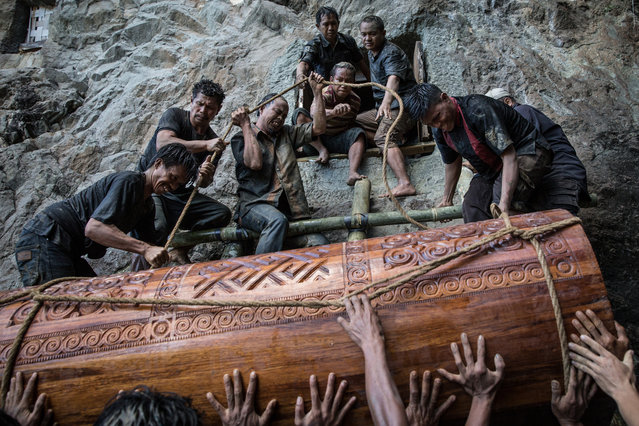
It is said that Torajans are people who “live to die”. For this Indonesian ethnic group, funerals are such extravagant events that they sometimes attract tourists. Families can postpone burials years (and the deceased are considered sick and hosted at home until the funeral) until the family can raise enough money and gather as many relatives as possible. And then it’s a jubilant multiday social event with a parade, dances and animal sacrifices. Agung Parameswara photographed these funerary practices when he traveled to South Sulawesi province, where the Torajans live. But often, their funeral isn’t the last time the dead are seen. In August, crypts are opened, coffins are slid back out and bodies delicately unsheathed. This tender ritual is known as Ma’Nene, which is customarily performed every few years. (Photo by Agung Parameswara/The Washington Post)

It is said that Torajans are people who “live to die”. For this Indonesian ethnic group, funerals are such extravagant events that they sometimes attract tourists. Families can postpone burials years (and the deceased are considered sick and hosted at home until the funeral) until the family can raise enough money and gather as many relatives as possible. And then it’s a jubilant multiday social event with a parade, dances and animal sacrifices. Agung Parameswara photographed these funerary practices when he traveled to South Sulawesi province, where the Torajans live. (Photo by Agung Parameswara/The Washington Post)
Details
06 Oct 2016 09:15:00
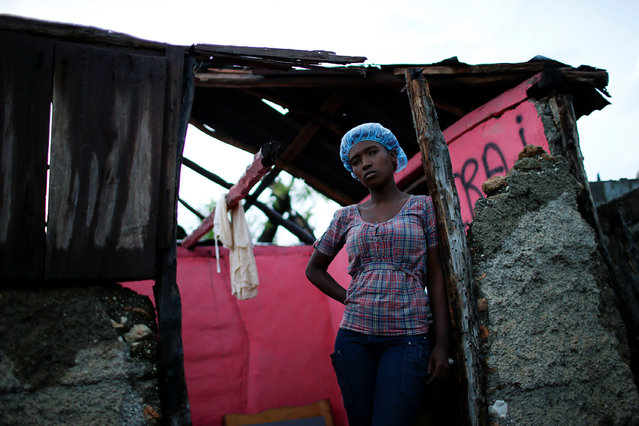
Carine Louis-Jean, 22, poses for a photograph in her destroyed house after Hurricane Matthew hit Jeremie, Haiti, October 17, 2016. “The roof of my house is completely gone and some of walls were destroyed. I have lost everything I had, but I thank God that I have a friend who is letting me stay at her house. I could say I'm lucky, because none of my family died during the hurricane, but I do not think I'm lucky”, said Louis-Jean. (Photo by Carlos Garcia Rawlins/Reuters)

Carine Louis-Jean, 22, poses for a photograph in her destroyed house after Hurricane Matthew hit Jeremie, Haiti, October 17, 2016. “The roof of my house is completely gone and some of walls were destroyed. I have lost everything I had, but I thank God that I have a friend who is letting me stay at her house. I could say I'm lucky, because none of my family died during the hurricane, but I do not think I'm lucky”, said Louis-Jean. (Photo by Carlos Garcia Rawlins/Reuters)
Details
11 Nov 2016 08:23:00
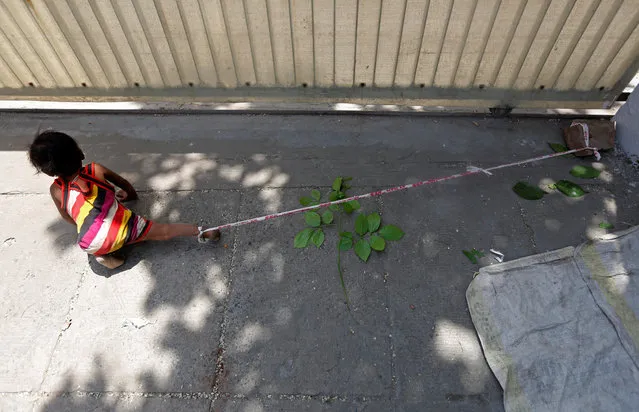
Barrier tape is tied around 15-month-old Shivani's ankle to prevent her from running away, while her mother Sarta Kalara works at a construction site nearby, in Ahmedabad, India, April 19, 2016. Kalara says she has no option but to tether her daughter Shivani to a stone despite her crying, while she and her husband work for 250 rupees ($3.8) each a shift digging holes for electricity cables in the city of Ahmedabad. There are about 40 million construction workers in India, at least one in five of them women, and the majority poor migrants who shift from site to site, building infrastructure for India's booming cities. Across the country it is not uncommon to see young children rolling in the sand and mud as their parents carry bricks or dig for new roads or luxury houses. (Photo by Amit Dave/Reuters)

Barrier tape is tied around 15-month-old Shivani's ankle to prevent her from running away, while her mother Sarta Kalara works at a construction site nearby, in Ahmedabad, India, April 19, 2016. Kalara says she has no option but to tether her daughter Shivani to a stone despite her crying, while she and her husband work for 250 rupees ($3.8) each a shift digging holes for electricity cables in the city of Ahmedabad. There are about 40 million construction workers in India, at least one in five of them women, and the majority poor migrants who shift from site to site, building infrastructure for India's booming cities. Across the country it is not uncommon to see young children rolling in the sand and mud as their parents carry bricks or dig for new roads or luxury houses. (Photo by Amit Dave/Reuters)
Details
14 Dec 2016 07:39:00