Loading...
Done
Spectacular images offering insight into the lives of the Huaorani people in the Ecuadorian Amazon have been revealed showing how they use traditional methods to hunt monkeys for food. The stunning pictures were taken by conservation photographer Pete Oxford from Torquay, Devon in the Ecuadorian Amazon. “The Huaorani Indians are a forest people highly in tune with their environment. Many are now totally acculturated since the 1950s by missionaries”, said Pete. “Today they face radical change to their culture to the proximity of oil exploration within their territory and the Yasuni National Park and Biosphere Reserve, they are vastly changed. Some still live very traditionally and for this shoot, through my Huaorani friend, a direct relative of those photographed he wanted to depict them as close to their original culture as possible. They still largely hunt with blow pipes and spears eating a lot of monkeys and peccaries”. The Huaorani are also known as the Waorani, Waodani or the Waos and are native Amerindians. Their lands are located between the Curaray and Napo rivers and speak the Huaorani language. Pete says that during his visit he was welcomed into the group and hopes that ancient cultures can be saved. Here: The tribe were seen celebrating after a hunter returned to camp with a wild pig. (Photo by Pete Oxford/Mediadrumworld.com)

Spectacular images offering insight into the lives of the Huaorani people in the Ecuadorian Amazon have been revealed showing how they use traditional methods to hunt monkeys for food. The stunning pictures were taken by conservation photographer Pete Oxford from Torquay, Devon in the Ecuadorian Amazon. Here: The tribe were seen celebrating after a hunter returned to camp with a wild pig. (Photo by Pete Oxford/Mediadrumworld.com)
Details
20 Jan 2017 07:58:00
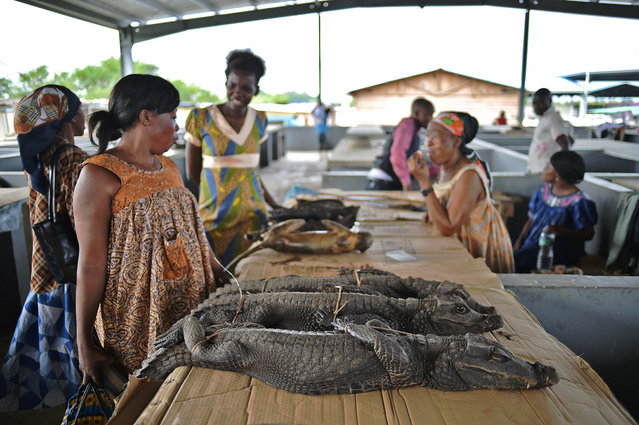
Shoppers walk past crocodiles for sale at a market in Bata on February 3, 2015. Markets in Equatorial Guinea sell a variety of animals including pangolins, monkeys and crocodiles as food. (Photo by Carl de Souza/AFP Photo)

Shoppers walk past crocodiles for sale at a market in Bata on February 3, 2015. Markets in Equatorial Guinea sell a variety of animals including pangolins, monkeys and crocodiles as food. (Photo by Carl de Souza/AFP Photo)
Details
30 Nov 2017 08:33:00
Twenty-year-old women draped in traditional kimonos gather for their “Coming-of-Age Day” ceremony at the Tokyo Disneyland in Urayasu, eastern suburb of Tokyo on January 13, 2020. (Photo by Kazuhiro Nogi/AFP Photo)

Twenty-year-old women draped in traditional kimonos gather for their “Coming-of-Age Day” ceremony at the Tokyo Disneyland in Urayasu, eastern suburb of Tokyo on January 13, 2020. (Photo by Kazuhiro Nogi/AFP Photo)
Details
01 Jan 2021 00:01:00
A woman poses after she got an image of a lion tattooed on her back as part of awareness campaign to save Asiatic lions and in preparations for the upcoming Navratri festival in Ahmedabad, India, October 5, 2018. (Photo by Amit Dave/Reuters)

A woman poses after she got an image of a lion tattooed on her back as part of awareness campaign to save Asiatic lions and in preparations for the upcoming Navratri festival in Ahmedabad, India, October 5, 2018. (Photo by Amit Dave/Reuters)
Details
15 Oct 2018 00:05:00
Participants dance during the Water Gun Festival on July 07, 2019 in Seoul, South Korea. Thousands of people enjoyed the annual festival which is being held over the weekend during the scorching heat summer in Korea. (Photo by Chung Sung-Jun/Getty Images)

Participants dance during the Water Gun Festival on July 07, 2019 in Seoul, South Korea. Thousands of people enjoyed the annual festival which is being held over the weekend during the scorching heat summer in Korea. (Photo by Chung Sung-Jun/Getty Images)
Details
09 Jul 2019 00:07:00
Makeup artist He Yuhong, also known as “Yuya”, checks herself in the mirror during a photo shoot following her transformation into the “Girl with a Pearl Earring”, the 17th century oil painting by Dutch painter Johannes Vermeer, at her house in Chongqing, China on August 14, 2018. (Photo by Thomas Suen/Reuters)

Makeup artist He Yuhong, also known as “Yuya”, checks herself in the mirror during a photo shoot following her transformation into the “Girl with a Pearl Earring”, the 17th century oil painting by Dutch painter Johannes Vermeer, at her house in Chongqing, China on August 14, 2018. (Photo by Thomas Suen/Reuters)
Details
07 Oct 2018 00:05:00
A surfer rides a wave as bioluminescent plankton lights up the surf around him during the coronavirus outbreak, Thursday, April 30, 2020, in Newport Beach, Calif. California Gov. Gavin Newsom on Thursday temporarily closed Orange County's coastline after large crowds were seen there. (Photo by Mark J. Terrill/AP Photo)

A surfer rides a wave as bioluminescent plankton lights up the surf around him during the coronavirus outbreak, Thursday, April 30, 2020, in Newport Beach, Calif. California Gov. Gavin Newsom on Thursday temporarily closed Orange County's coastline after large crowds were seen there. (Photo by Mark J. Terrill/AP Photo)
Details
09 May 2020 00:01:00
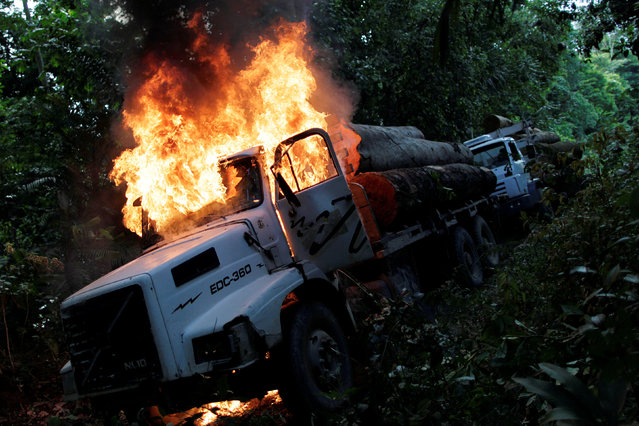
Trucks loaded with tree trunks are burned by agents of the Brazilian Institute for the Environment and Renewable Natural Resources, or Ibama, during an operation to combat illegal mining and logging, in the municipality of Novo Progresso, Para State, northern Brazil, November 11, 2016. When able to do their job, agents of the Brazilian Institute for the Environment and Renewable Natural Resources, or Ibama, are decisive, punishing illegal loggers on the spot. Nearly twice the size of India, the Amazon absorbs an estimated 2 billion tonnes of carbon dioxide per year, making its preservation vital in the fight to halt global warming. Ibama, responsible for preserving Brazil's 65 percent share of the world's largest rainforest, is one of the most important groups in that fight. But after years of surprising success, the rate of deforestation is on the rise again. Over the past four years it has risen 35 percent, as Ibama suffered from a lack of funding amid Brazil's worst recession in a century. (Photo by Ueslei Marcelino/Reuters)

Trucks loaded with tree trunks are burned by agents of the Brazilian Institute for the Environment and Renewable Natural Resources, or Ibama, during an operation to combat illegal mining and logging, in the municipality of Novo Progresso, Para State, northern Brazil, November 11, 2016. When able to do their job, agents of the Brazilian Institute for the Environment and Renewable Natural Resources, or Ibama, are decisive, punishing illegal loggers on the spot. Nearly twice the size of India, the Amazon absorbs an estimated 2 billion tonnes of carbon dioxide per year, making its preservation vital in the fight to halt global warming. (Photo by Ueslei Marcelino/Reuters)
Details
30 Nov 2016 12:36:00