Loading...
Done
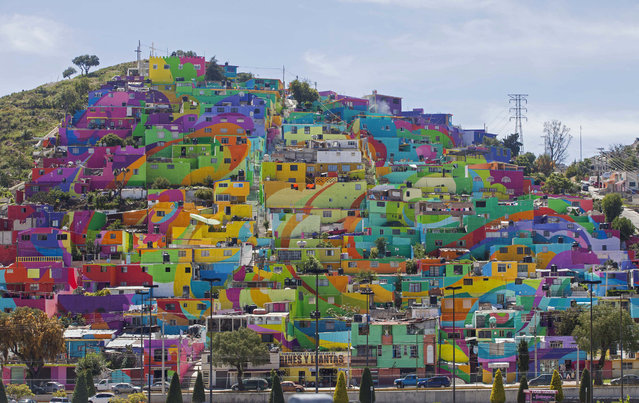
Hundreds of houses painted in bright colors in what organizers claim is Mexico's largest mural, is part of a government-sponsored project is called Pachuca Paints Itself, in the Palmitas neighborhood, in Pachuca, Mexico, Thursday, July 30, 2015. German Crew is the artist collective responsible for painting the mural project. Director Enrique Gomez, who goes by MYBE, said the crew has painted 1,500 square meters with 20,000 liters of paint. (Photo by Sofia Jaramillo/AP Photo)

Hundreds of houses painted in bright colors in what organizers claim is Mexico's largest mural, is part of a government-sponsored project is called Pachuca Paints Itself, in the Palmitas neighborhood, in Pachuca, Mexico, Thursday, July 30, 2015. German Crew is the artist collective responsible for painting the mural project. Director Enrique Gomez, who goes by MYBE, said the crew has painted 1,500 square meters with 20,000 liters of paint. Working hand-in-hand with residents, muralists have painted the facades of 200 homes bright lavender, lime green, incandescent orange – hues more commonly found in a bag of Skittles than in the drab, cement-and-cinderblock neighborhoods where many of Mexico's poor live. The project aims to bring the community together and rehabilitate the area. (Photo by Sofia Jaramillo/AP Photo)
Details
03 Aug 2015 12:02:00
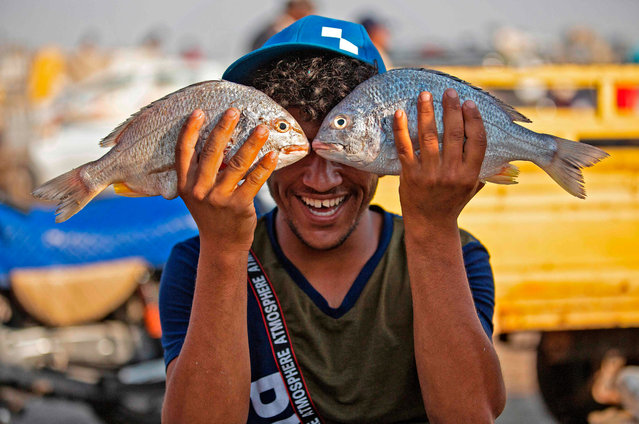
A youth poses while holding two fishes before his face in Iraq's southern port city of al-Faw, 90 kilometres south of Basra near the Shatt al-Arab and the Gulf, on May 18, 2020. In Iraq, a national lockdown to halt the COVID-19 coronavirus pandemic has found some unexpected fans: local businesses who no longer have to compete with Turkish, Iranian or Chinese imports. Those countries, as well as Saudi Arabia, Jordan and Kuwait, typically flood Iraqi markets with inexpensive products at prices local producers can't compete with. (Photo by Hussein Faleh/AFP Photo)

A youth poses while holding two fishes before his face in Iraq's southern port city of al-Faw, 90 kilometres south of Basra near the Shatt al-Arab and the Gulf, on May 18, 2020. In Iraq, a national lockdown to halt the COVID-19 coronavirus pandemic has found some unexpected fans: local businesses who no longer have to compete with Turkish, Iranian or Chinese imports. Those countries, as well as Saudi Arabia, Jordan and Kuwait, typically flood Iraqi markets with inexpensive products at prices local producers can't compete with. (Photo by Hussein Faleh/AFP Photo)
Details
02 Jul 2020 00:01:00
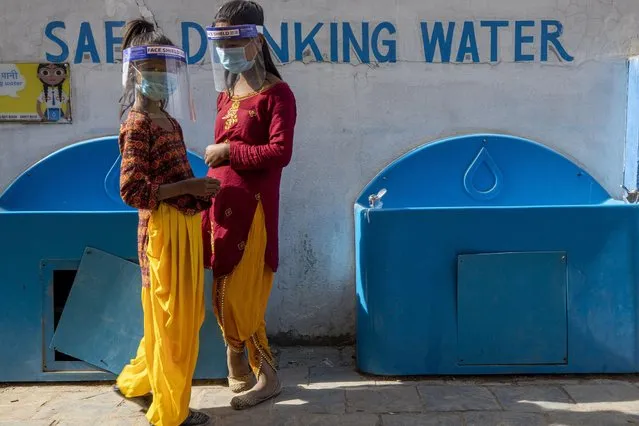
Students of Yuba Pratibha School, wearing a face shield and masks at school during a coronavirus pandemic in Kathmandu, Nepal, 26 November 2020. The head Teacher of Yuba Pratibha School, Yanga Raj Dahal, started to conduct classes for students, who can’t afford and attend online classes, with strict sanitary regime, providing also free face masks and shields for students. However majority of schools have been conducting online classes in Nepal from 19 March 2020 as part of precautionary measures against the spread of the coronavirus Covid-19. (Photo by Narendra Shrestha/EPA/EFE)

Students of Yuba Pratibha School, wearing a face shield and masks at school during a coronavirus pandemic in Kathmandu, Nepal, 26 November 2020. The head Teacher of Yuba Pratibha School, Yanga Raj Dahal, started to conduct classes for students, who can’t afford and attend online classes, with strict sanitary regime, providing also free face masks and shields for students. However majority of schools have been conducting online classes in Nepal from 19 March 2020 as part of precautionary measures against the spread of the coronavirus Covid-19. (Photo by Narendra Shrestha/EPA/EFE)
Details
16 Dec 2020 00:05:00
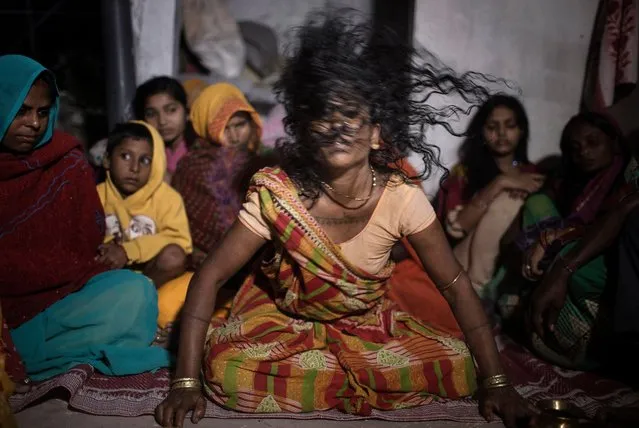
Marani Devi Chaudhary (C), aged 40, performs a ritual in front of shaman Paltan Yadav (unseen) at her home in Rajaur village in Dhanusha district, Nepal, 02 November 2017. The shaman identified Marani Devi to be possessed by their lineage god who was dissatisfied by their worship is thought by the family to have caused them misfortune and is even feared lead to their death. Therefore Marani Devi spent 1,500 USD to perform a healing ritual at the Ghost Festival held at the banks of Kamala River in Dhanusha district two days later. Every family or community has their own sacred god, called 'Kuldevta' in Nepali which means family deity or lineage god. Only family members or people within communities of the same caste can worship to the deity. They have their own rules and regulations of worship which varies from one family and community to another. Being unable to follow the rules and regulations or carry out worship is believed to cause misfortune. (Photo by Narendra Shrestha/EPA/EFE)

Marani Devi Chaudhary (C), aged 40, performs a ritual in front of shaman Paltan Yadav (unseen) at her home in Rajaur village in Dhanusha district, Nepal, 02 November 2017. The shaman identified Marani Devi to be possessed by their lineage god who was dissatisfied by their worship is thought by the family to have caused them misfortune and is even feared lead to their death. (Photo by Narendra Shrestha/EPA/EFE)
Details
17 Nov 2017 06:53:00
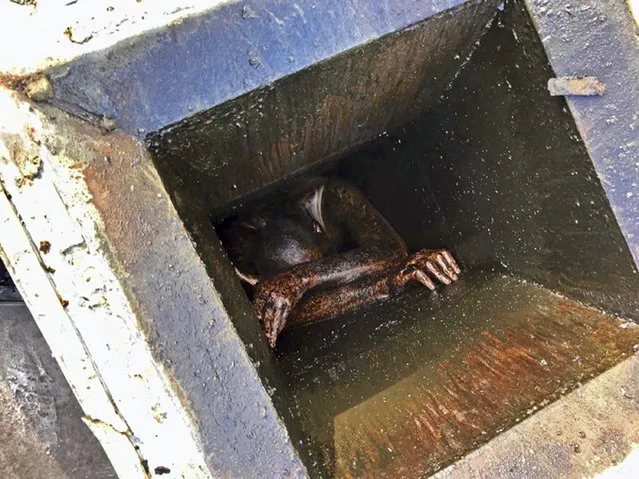
This photo provided by the Alameda County Sheriff's Office shows a man who was possibly trying to burglarize an abandoned Chinese restaurant in San Lorenzo, Calif., trapped in a grease vent before he was rescued Wednesday, December 12, 2018. Officials say he had been trapped for two days. Deputies and firefighters were called to the vacant building on Wednesday after someone heard cries for help. The sheriff tweeted that the man was trespassing and possibly trying to burglarize the empty restaurant. (Photo by Alameda County Sheriff's Office via AP Photo)

This photo provided by the Alameda County Sheriff's Office shows a man who was possibly trying to burglarize an abandoned Chinese restaurant in San Lorenzo, Calif., trapped in a grease vent before he was rescued Wednesday, December 12, 2018. Officials say he had been trapped for two days. Deputies and firefighters were called to the vacant building on Wednesday after someone heard cries for help. The sheriff tweeted that the man was trespassing and possibly trying to burglarize the empty restaurant. (Photo by Alameda County Sheriff's Office via AP Photo)
Details
14 Dec 2018 00:15:00
A student of the Sri Lankan ancient martial art “Angampora” performs during a practice session at the angam maduwa or fighting field, in Korathota, a suburb of Colombo, Sri Lanka, 07 September 2022. Sri Lanka's ancient martial art, Angampora, is thought to be thousands of years old. Anga translates to “body parts” and Angampora is a fighting art that uses body parts. Martial arts practitioners in Angampora were mostly in the king's service, and they were tasked with protecting the king and his kingdom. Angampora was practiced in secret for most centuries because the British, who colonized Sri Lanka, banned it in 1818 after seeing it as a threat. (Photo by Chamila Karunarathne/EPA/EFE)

A student of the Sri Lankan ancient martial art “Angampora” performs during a practice session at the angam maduwa or fighting field, in Korathota, a suburb of Colombo, Sri Lanka, 07 September 2022. Sri Lanka's ancient martial art, Angampora, is thought to be thousands of years old. Anga translates to “body parts” and Angampora is a fighting art that uses body parts. Martial arts practitioners in Angampora were mostly in the king's service, and they were tasked with protecting the king and his kingdom. Angampora was practiced in secret for most centuries because the British, who colonized Sri Lanka, banned it in 1818 after seeing it as a threat. (Photo by Chamila Karunarathne/EPA/EFE)
Details
14 Oct 2022 04:47:00
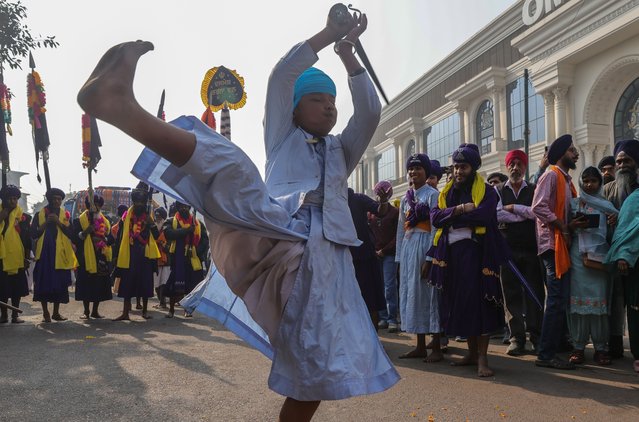
A Nihang Sikh, belonging to the Sikh warrior clan, performs Gatka, a form of Sikh martial arts, during a religious procession marking the 350th martyrdom anniversary of Guru Tegh Bahadur Ji in New Delhi, India, 25 November 2025. The procession commemorates the martyrdom of the 9th Sikh Guru, Sri Guru Tegh Bahadur Ji, who was executed in 1675 AD for refusing to convert to Islam on the orders of Mughal Emperor Aurangzeb. The event is observed at Gurudwara Sis Ganj in Delhi. Guru Tegh Bahadur, the youngest of the five sons of Guru Hargobind, was born in Amritsar in 1621. (Photo by Rajat Gupta/EPA)

A Nihang Sikh, belonging to the Sikh warrior clan, performs Gatka, a form of Sikh martial arts, during a religious procession marking the 350th martyrdom anniversary of Guru Tegh Bahadur Ji in New Delhi, India, 25 November 2025. The procession commemorates the martyrdom of the 9th Sikh Guru, Sri Guru Tegh Bahadur Ji, who was executed in 1675 AD for refusing to convert to Islam on the orders of Mughal Emperor Aurangzeb. The event is observed at Gurudwara Sis Ganj in Delhi. Guru Tegh Bahadur, the youngest of the five sons of Guru Hargobind, was born in Amritsar in 1621. (Photo by Rajat Gupta/EPA)
Details
06 Dec 2025 03:16:00
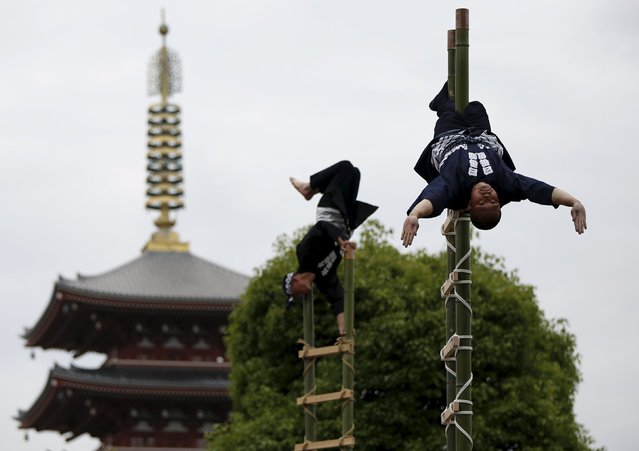
Men wearing costume of traditional firefighters perform acrobatic stunts atop a bamboo ladder following a memorial service for firefighters at Sensoji temple in Tokyo's downtown of Asakusa May 25, 2015. (Photo by Issei Kato/Reuters)

Men wearing costume of traditional firefighters perform acrobatic stunts atop a bamboo ladder following a memorial service for firefighters at Sensoji temple in Tokyo's downtown of Asakusa May 25, 2015. Hundreds of firefighters in traditional costume gathered on Monday for the memorial service for firefighters who were killed performing their duties during the past 300 years. (Photo by Issei Kato/Reuters)
Details
26 May 2015 10:45:00