Loading...
Done
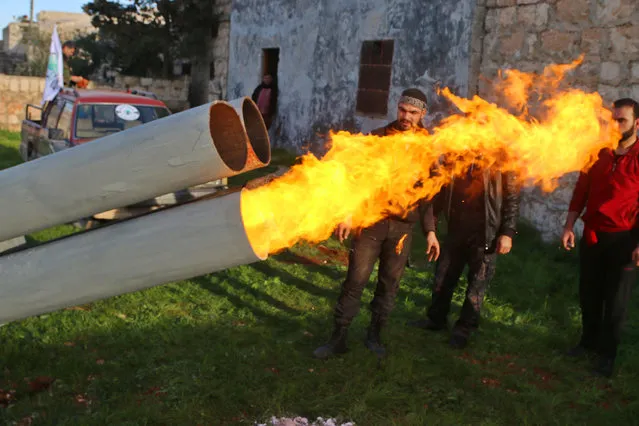
Al-Shamiyah Front fighters inspect a new locally-made cannon named “Borkan” (Volcano) as it was being launched towards forces loyal to Syria's president Bashar Al-Assad located in Aleppo artillery school, March 7, 2015. The “Borkan” is made out of four tubes attached to a loader, which can fire four shells at a time, and have a range of three kilometers (1.86 miles). (Photo by Abdalrhman Ismail/Reuters)

Al-Shamiyah Front fighters inspect a new locally-made cannon named “Borkan” (Volcano) as it was being launched towards forces loyal to Syria's president Bashar Al-Assad located in Aleppo artillery school, March 7, 2015. The “Borkan” is made out of four tubes attached to a loader, which can fire four shells at a time, and have a range of three kilometers (1.86 miles). (Photo by Abdalrhman Ismail/Reuters)
Details
24 Mar 2015 10:11:00
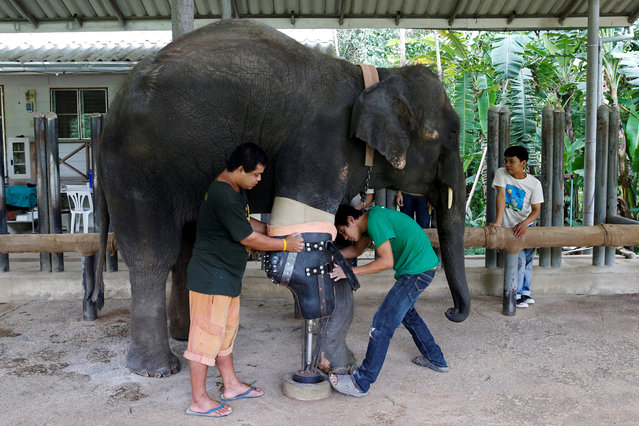
Mosha, the elephant that was injured by a landmine, has her prosthetic leg attached at the Friends of the Asian Elephant Foundation in Lampang, Thailand, June 29, 2016. Mosha was 7 months old when she stepped on a land mine near Thailand’s border with Myanmar and lost a front leg. That was a decade ago. Mosha is one of more than a dozen elephants who have been wounded by land mines in the border region, where rebels have been fighting the Myanmar government for decades. She was the first elephant to be fitted with a prosthetic limb at the hospital near Lampang. Mosha weighed about 1,300 pounds (590 kg) when she was wounded. (Photo by Athit Perawongmetha/Reuters)

Mosha, the elephant that was injured by a landmine, has her prosthetic leg attached at the Friends of the Asian Elephant Foundation in Lampang, Thailand, June 29, 2016. Mosha was 7 months old when she stepped on a land mine near Thailand’s border with Myanmar and lost a front leg. That was a decade ago... (Photo by Athit Perawongmetha/Reuters)
Details
24 Aug 2016 11:19:00
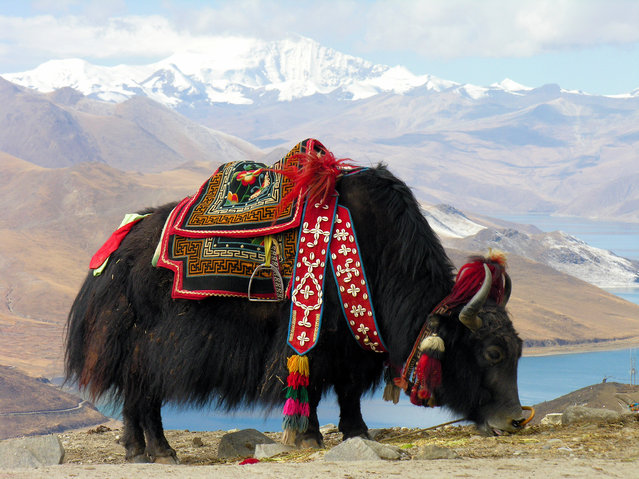
Yak near Yamdrok lake, Tibet. It is a long-haired bovinae found throughout the Himalayan region of south Central Asia, the Tibetan Plateau and as far north as Mongolia and Russia. The Tibetan economy is dominated by subsistence agriculture. Due to limited arable land, the primary occupation of the Tibetan Plateau is raising livestock, such as sheep, cattle, goats, camels, yaks, dzo, and horses. The Tibetan yak is an integral part of Tibetan life. (Photo by Dennis Jarvis)

Yak near Yamdrok lake, Tibet. It is a long-haired bovinae found throughout the Himalayan region of south Central Asia, the Tibetan Plateau and as far north as Mongolia and Russia. The Tibetan economy is dominated by subsistence agriculture. Due to limited arable land, the primary occupation of the Tibetan Plateau is raising livestock, such as sheep, cattle, goats, camels, yaks, dzo, and horses. The Tibetan yak is an integral part of Tibetan life. (Photo by Dennis Jarvis)
Details
10 Jun 2015 10:48:00
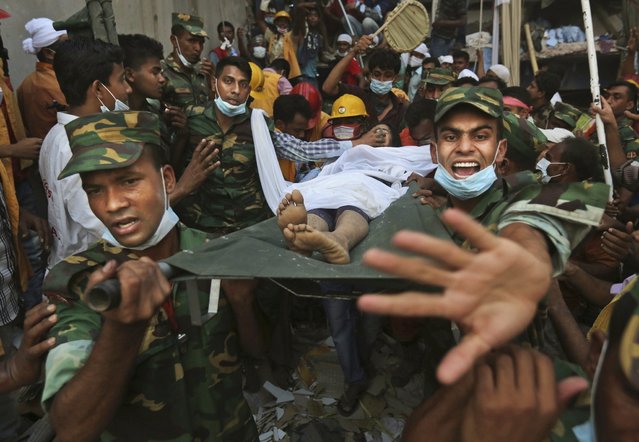
Bangladesh soldiers carry a woman survivor from the rubble at the site of a building that collapsed Wednesday in Savar, near Dhaka, Bangladesh, Thursday, April 25, 2013. By Thursday, the death toll reached at least 194 people as rescuers continued to search for injured and missing, after a huge section of an eight-story building that housed several garment factories splintered into a pile of concrete. (Photo by Kevin Frayer/AP Photo)

Bangladesh soldiers carry a woman survivor from the rubble at the site of a building that collapsed Wednesday in Savar, near Dhaka, Bangladesh, Thursday, April 25, 2013. By Thursday, the death toll reached at least 194 people as rescuers continued to search for injured and missing, after a huge section of an eight-story building that housed several garment factories splintered into a pile of concrete. (Photo by Kevin Frayer/AP Photo)
Details
27 Apr 2013 09:26:00
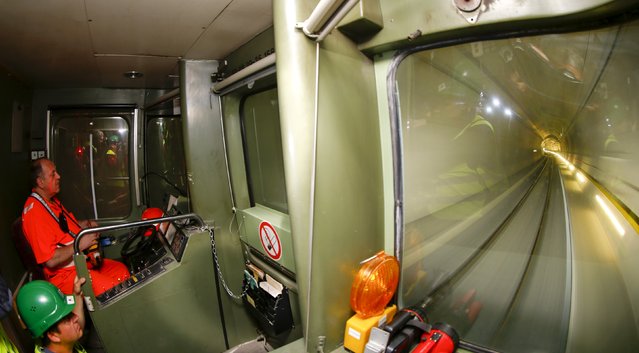
Engine driver Josef Kowatsch (top L) steers a train through the NEAT Gotthard Base Tunnel during a media visit near the town of Erstfeld August 24, 2015. (Photo by Arnd Wiegmann/Reuters)

Engine driver Josef Kowatsch (top L) steers a train through the NEAT Gotthard Base Tunnel during a media visit near the town of Erstfeld August 24, 2015. Crossing the Alps, the world's longest train tunnel should become operational at the end of 2016, consisting of two parallel single track tunnels, each of a length of 57 km (35 miles). (Photo by Arnd Wiegmann/Reuters)
Details
25 Aug 2015 10:42:00
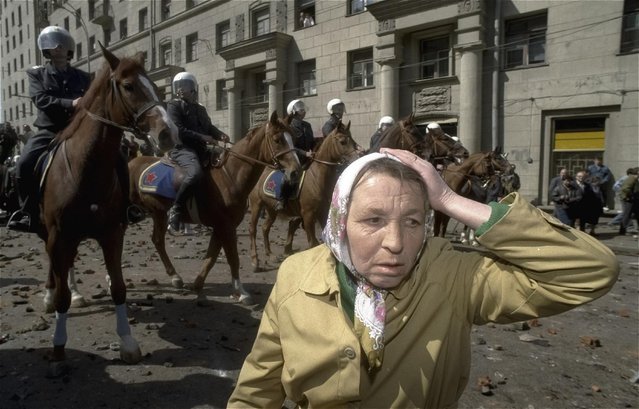
In this file photo taken on Saturday May 1, 1993, an elderly communist woman clutches her head as police on horseback patrol the streets in Moscow. When Alexander Zemlianichenko started working as an AP photographer in Moscow, the Soviet Union was nearing its demise. (Photo by Alexander Zemlianichenko/AP Photo)

In this file photo taken on Saturday May 1, 1993, an elderly communist woman clutches her head as police on horseback patrol the streets in Moscow. When Alexander Zemlianichenko started working as an AP photographer in Moscow, the Soviet Union was nearing its demise. (Photo by Alexander Zemlianichenko/AP Photo)
Details
01 Jan 2017 09:37:00
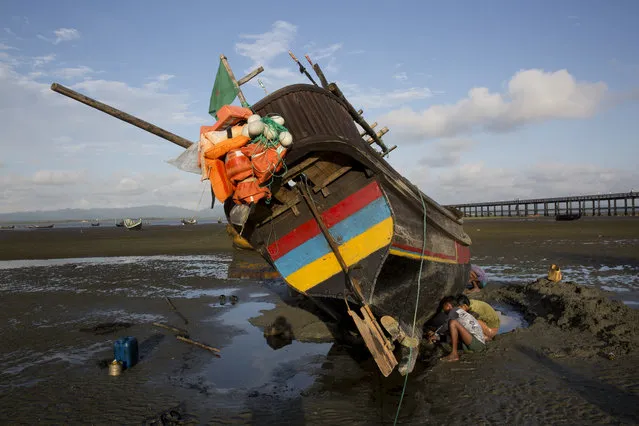
In this September 21, 2017, local villagers repair a fishing boat in Shah Porir Dwip, an island by the Bay of Bengal at Bangladesh’s southern tip. This island can mean both hope and death for the Rohingya Muslims who are desperate to escape the violence that has engulfed their lives in Myanmar’s Rakhine state. High tide or low, day or night, rough waters or calm, when they can find a boat, the Rohingya take their chance to flee to Bangladesh. More than 430,000 have left Myanmar in less than a month. (Photo by Bernat Armangue/AP Photo)

In this September 21, 2017, local villagers repair a fishing boat in Shah Porir Dwip, an island by the Bay of Bengal at Bangladesh’s southern tip. This island can mean both hope and death for the Rohingya Muslims who are desperate to escape the violence that has engulfed their lives in Myanmar’s Rakhine state. High tide or low, day or night, rough waters or calm, when they can find a boat, the Rohingya take their chance to flee to Bangladesh. More than 430,000 have left Myanmar in less than a month. (Photo by Bernat Armangue/AP Photo)
Details
02 Dec 2017 07:52:00
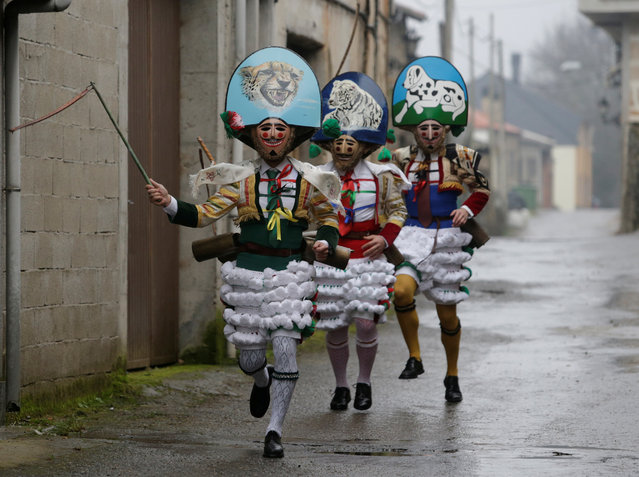
Carnival revellers dressed as “Peliqueiros” run along a street in the village of Laza, Spain February 11, 2018. “Peliqueiros”, or ancient tax collectors, pursued villagers through the streets ringing their cowbells and hitting villagers with their sticks. (Photo by Miguel Vidal/Reuters)

Carnival revellers dressed as “Peliqueiros” run along a street in the village of Laza, Spain February 11, 2018. “Peliqueiros”, or ancient tax collectors, pursued villagers through the streets ringing their cowbells and hitting villagers with their sticks. (Photo by Miguel Vidal/Reuters)
Details
12 Feb 2018 07:41:00