Loading...
Done
Fireworks explode over a floating Christmas tree in Lagoa Lake in Rio de Janeiro. (Photo by Victor R. Caivano/Associated Press)

Fireworks explode over a floating Christmas tree in Lagoa Lake in Rio de Janeiro. (Photo by Victor R. Caivano/Associated Press)
Details
13 Dec 2013 09:00:00
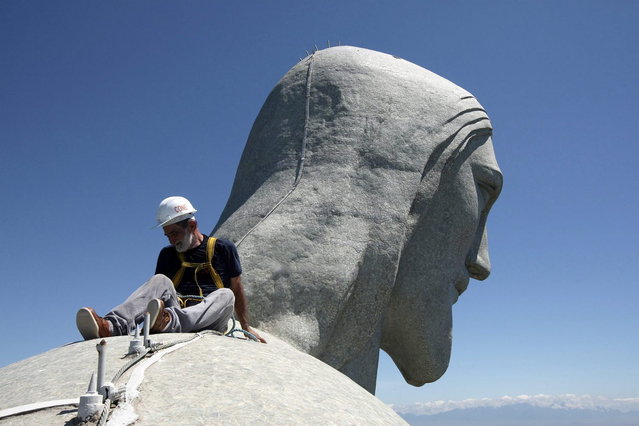
A worker inspects the Christ the Redeemer statue which was damaged during lightning storms in Rio de Janeiro January 21, 2014. (Photo by Severino Silva/Reuters/Agência o Dia)

A worker inspects the Christ the Redeemer statue which was damaged during lightning storms in Rio de Janeiro January 21, 2014. (Photo by Severino Silva/Reuters/Agência o Dia)
Details
22 Jan 2014 13:19:00
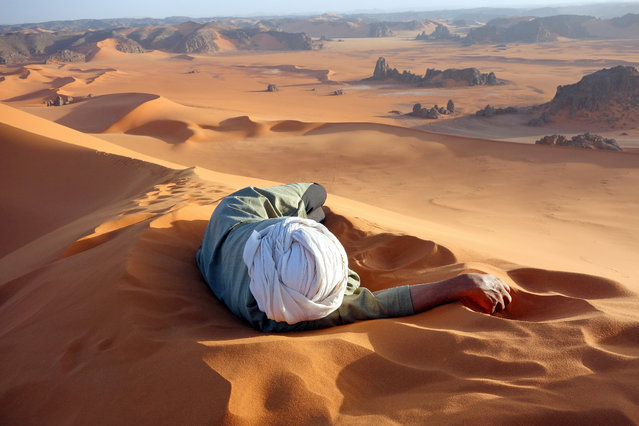
“A Well Earned Rest in the Sahara”. This photo of Moussa Macher, our Tuareg guide, was taken at the summit of Tin-Merzouga, the largest dune (or erg) in the Tadrat region of the Sahara desert in southern Algeria. Moussa rested while waiting for us to finish our 45-minute struggle to the top. Photo location: Summit of Tin-Merzouga, Tadrat, Tassili N'Ajjer National Park, Algeria. (Photo and caption by Evan Cole/National Geographic Photo Contest)


Merit Prize Winner: “A Well Earned Rest in the Sahara”. This photo of Moussa Macher, our Tuareg guide, was taken at the summit of Tin-Merzouga, the largest dune (or erg) in the Tadrat region of the Sahara desert in southern Algeria. Moussa rested while waiting for us to finish our 45-minute struggle to the top. It only took ten minutes of rolling, running, and jumping to get back down. The Tadrat is part of the Tassili N'Ajjer National Park World Heritage area, famous for its red sand and engravings and rock paintings of cattle, elephants, giraffes, and rhinos that lived there when the climate was milder. Photo location: Summit of Tin-Merzouga, Tadrat, Tassili N'Ajjer National Park, Algeria. (Photo and caption by Evan Cole/National Geographic Photo Contest)
Details
01 Aug 2014 11:38:00
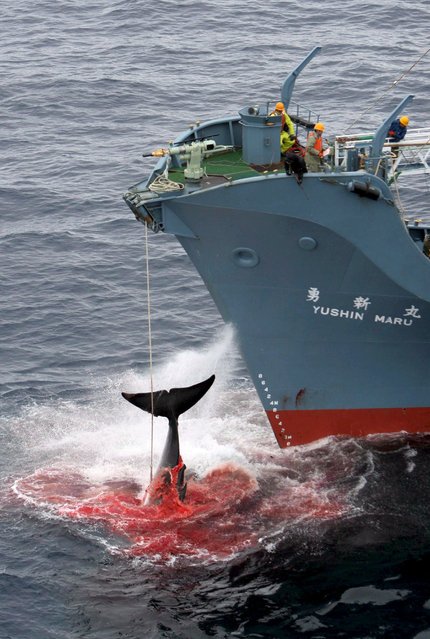
A file photograph dated 07 January 2006 and released by Greenpeace, showing the Yushin Maru, a factory ship in a Japanese whaling fleet, injuring a whale with it's first harpoon attempt. A UN court in The Hague on 31 March 2014 halted Japan's much-criticized whaling programme, ruling that it contravenes a 1986 moratorium on whale hunting. Japan must end its 'research whaling' programme, the International Court of Justice (ICJ) said. (Photo by Kate Davison/EPA)

A file photograph dated 07 January 2006 and released by Greenpeace, showing the Yushin Maru, a factory ship in a Japanese whaling fleet, injuring a whale with it's first harpoon attempt. A UN court in The Hague on 31 March 2014 halted Japan's much-criticized whaling programme, ruling that it contravenes a 1986 moratorium on whale hunting. Japan must end its 'research whaling' programme, the International Court of Justice (ICJ) said. Japan said the programme was for scientific research and permitted under international conventions. Australia had brought the case to the ICJ in 2010, charging that Japan was breaching international law by killing hundreds of whales every year for commercial purposes. Japan was “deeply disappointed” by the ruling, an unnamed government official was quoted by the Kyodo News agency as saying. But the official said Japan would stand by the ruling. (Photo by Kate Davison/EPA)
Details
01 Apr 2014 08:38:00
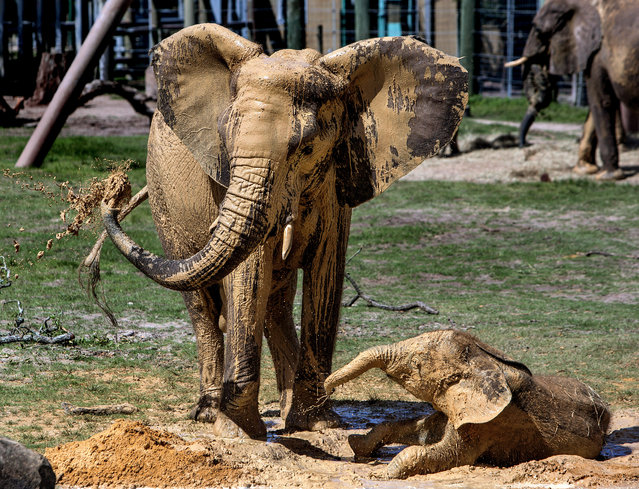
Lowry Park Zoo elephants Matjeka, 23, and her 1-year-old daughter, Mavi, apply a liberal coating of “sunscreen”  to themselves in a clay mud wallow at the park Tuesday, August 12, 2014, in Tampa, Fla., on the park's first observation of World Elephant Day to raise awareness of the wild African elephant crisis. (Photo by Cherie Diez/AP Photo/The Tampa Bay Times)

Lowry Park Zoo elephants Matjeka, 23, and her 1-year-old daughter, Mavi, apply a liberal coating of “sunscreen” to themselves in a clay mud wallow at the park Tuesday, August 12, 2014, in Tampa, Fla., on the park's first observation of World Elephant Day to raise awareness of the wild African elephant crisis. “Elephants are prone to being sunburned”, said associate curator Chris Massaro. “What they need is lot of mud or clay to roll around in and cover up their skin so it will protect it from the sun”. (Photo by Cherie Diez/AP Photo/The Tampa Bay Times)
Details
16 Aug 2014 11:38:00
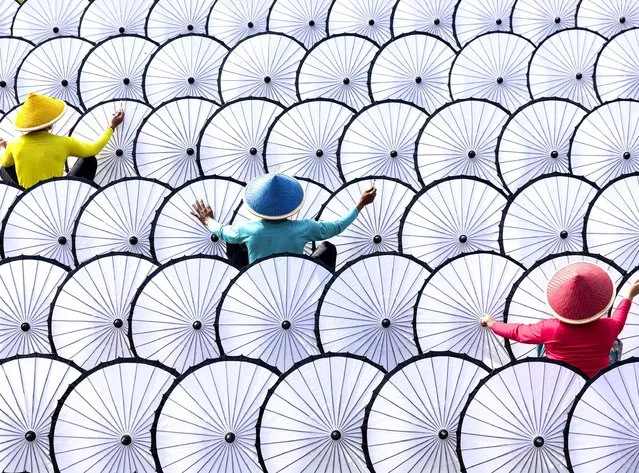
Workers lay out hundreds of umbrellas in neat lines ready for painting on May 26, 2022. The parasols are handmade using thick paper in Bogor, West Java, Indonesia. (Photo by Lisdiyanto Suhardjo/Solent News)

Workers lay out hundreds of umbrellas in neat lines ready for painting on May 26, 2022. The parasols are handmade using thick paper in Bogor, West Java, Indonesia. (Photo by Lisdiyanto Suhardjo/Solent News)
Details
04 Jun 2022 05:15:00


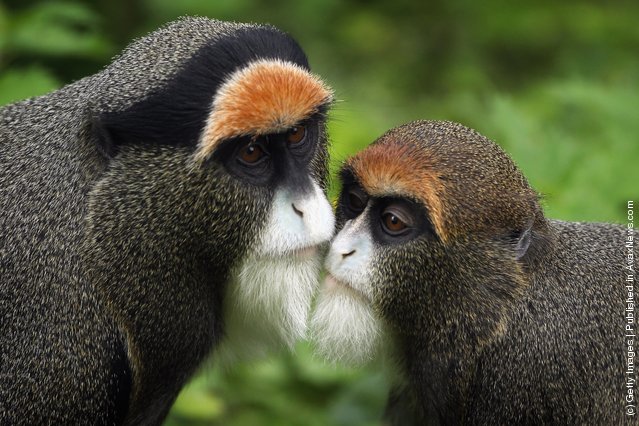
Two De Brazza's monkeys stand together at Port Lympne Wild Animal Park on June 21, 2011 in Hythe, England. Port Lympne has welcomed a host of new arrivals this year with wildebeest, colobus monkeys, gorillas and rhinos all adding to the current stock. Port Lympne and Howletts Wild Animal parks were set up by the late John Aspinall to protect and breed rare and endangered species and, where possible, return them to safe areas in the wild. The Aspinall Foundation which runs the parks also manages two gorilla rescue and rehabilitation projects in the central African countries of Gabon and Congo where they have successfully reintroduced over 50 gorillas to the wild. (Photo by Dan Kitwood/Getty Images)
Details
24 Jun 2011 10:12:00
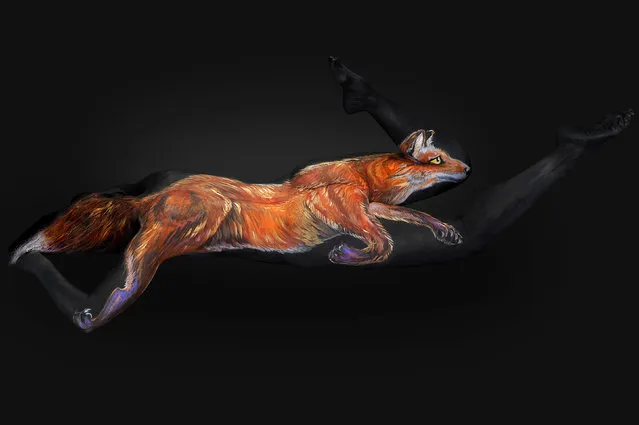
This is the stunning body of work by a talented painter – who transforms humans into amazing animals. From alligators to foxes and even owls, artist Shannon Holt, 39, paints every little detail on models to turn them into wildlife. The incredible paintings, which take anywhere between six to 12.5 hours to complete, are part of her Florida Wildlife Series. (Photo by Ryder Gledhill/Shannon Holt/Caters News)

This is the stunning body of work by a talented painter – who transforms humans into amazing animals. From alligators to foxes and even owls, artist Shannon Holt, 39, paints every little detail on models to turn them into wildlife. The incredible paintings, which take anywhere between six to 12.5 hours to complete, are part of her Florida Wildlife Series. Shannon, from DeLand, Florida, previously worked on different surfaces such as glass, metals and wood. But the animal advocate decided to experiment with human canvasses and incorporate animals in her work. Here: Red Fox. (Photo by Ryder Gledhill/Shannon Holt/Caters News)
Details
16 Dec 2014 12:13:00