Loading...
Done
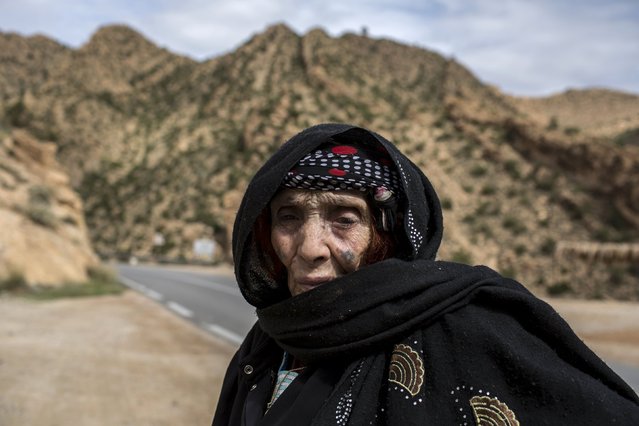
Mazouza Bouglada, 86, a berber woman from the Chaouia region, who has facial tattoos, poses for a photograph in Taghit in the Aures Mountain, Algeria October 8, 2015. Bouglada was tattooed aged 7 by a nomadic man from the Sahara region. She was advised by her mother to get tattooed. The more she got tattooed the more she showed off. Even if she still remembers the pain, she felt beautiful once it was done, Bouglada said. (Photo by Zohra Bensemra/Reuters)

Mazouza Bouglada, 86, a berber woman from the Chaouia region, who has facial tattoos, poses for a photograph in Taghit in the Aures Mountain, Algeria October 8, 2015. Bouglada was tattooed aged 7 by a nomadic man from the Sahara region. She was advised by her mother to get tattooed. The more she got tattooed the more she showed off. Even if she still remembers the pain, she felt beautiful once it was done, Bouglada said. She was very proud of her stars on her cheeks. Her eldest sister had been tattooed before her and she wanted to imitate her. Bouglada said she has now given away all her silver jewellery to atone for the sin that believers told her she had committed by being tattooed. (Photo by Zohra Bensemra/Reuters)
Details
01 Nov 2015 08:02:00
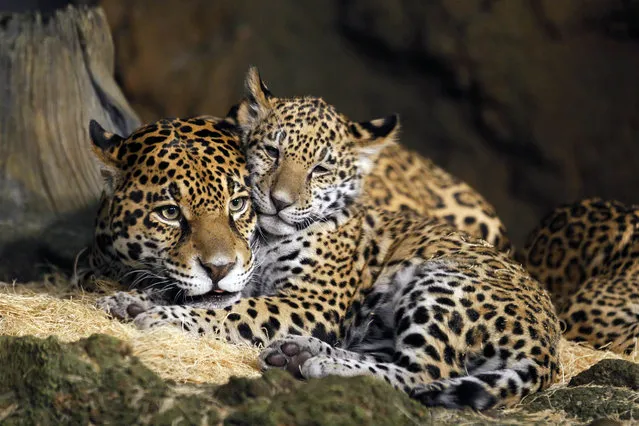
Stella the mother and her cub Zean rest together at The Milwaukee County Zoo  Zean and B'alam  are the two newest jaguar cubs with the mother Stella who are now on public exhibit, at four months old. B' alam (who has larger and darker spots as well as a square space on her forehead showing no spots) name means "Great and powerful king in Mayan.   Zean encompasses the Belize people living and working in Belize, with all cultures. She has smaller, almost greyish spots on her coat.  The names were revealaed at the Milwaukee County Zoo, Wednesday, March 13, 2013. Journal Sentinel photo by Rick Wood/RWOOD@JOURNALSENTINEL.COM

The first jaguar litter since 1975 was born at the Milwaukee County Zoo to Stella and Pat on November 13, 2013. The litter was on public display for the first time on March 13 when the jaguar baby's names were released. Belize schoolchildren named one Zean, which is the end of Belizean, and a public contest named the other B'alam, which means "great and powerful king" in Mayan. Photo: Stella the mother and her cub Zean rest together at The Milwaukee County Zoo. (Photo by Rick Wood)
Details
15 Mar 2013 07:51:00
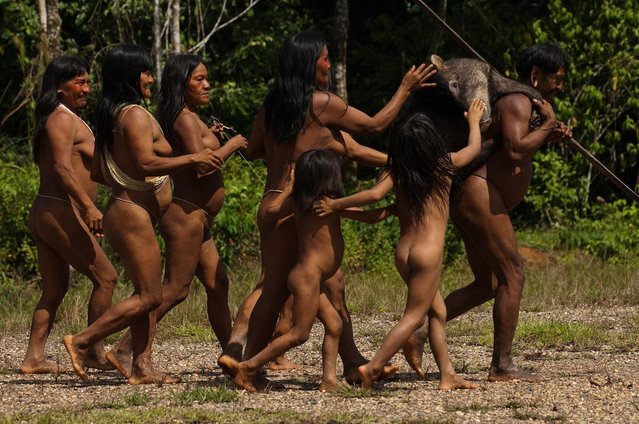
Spectacular images offering insight into the lives of the Huaorani people in the Ecuadorian Amazon have been revealed showing how they use traditional methods to hunt monkeys for food. The stunning pictures were taken by conservation photographer Pete Oxford from Torquay, Devon in the Ecuadorian Amazon. “The Huaorani Indians are a forest people highly in tune with their environment. Many are now totally acculturated since the 1950s by missionaries”, said Pete. “Today they face radical change to their culture to the proximity of oil exploration within their territory and the Yasuni National Park and Biosphere Reserve, they are vastly changed. Some still live very traditionally and for this shoot, through my Huaorani friend, a direct relative of those photographed he wanted to depict them as close to their original culture as possible. They still largely hunt with blow pipes and spears eating a lot of monkeys and peccaries”. The Huaorani are also known as the Waorani, Waodani or the Waos and are native Amerindians. Their lands are located between the Curaray and Napo rivers and speak the Huaorani language. Pete says that during his visit he was welcomed into the group and hopes that ancient cultures can be saved. Here: The tribe were seen celebrating after a hunter returned to camp with a wild pig. (Photo by Pete Oxford/Mediadrumworld.com)

Spectacular images offering insight into the lives of the Huaorani people in the Ecuadorian Amazon have been revealed showing how they use traditional methods to hunt monkeys for food. The stunning pictures were taken by conservation photographer Pete Oxford from Torquay, Devon in the Ecuadorian Amazon. Here: The tribe were seen celebrating after a hunter returned to camp with a wild pig. (Photo by Pete Oxford/Mediadrumworld.com)
Details
20 Jan 2017 07:58:00
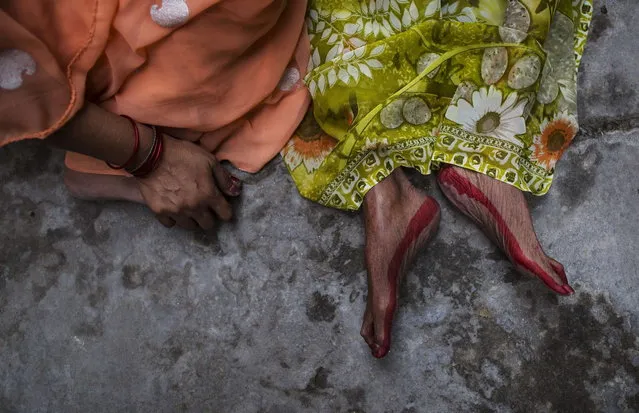
A relative (L) of Champa Devi, 88, sits next to her body, minutes after her death at Mukti Bhavan (Salvation House) at Varanasi, in the northern Indian state of Uttar Pradesh, June 21, 2014. (Photo by Danish Siddiqui/Reuters)

A relative (L) of Champa Devi, 88, sits next to her body, minutes after her death at Mukti Bhavan (Salvation House) at Varanasi, in the northern Indian state of Uttar Pradesh, June 21, 2014. The city of Varanasi, on the banks of the River Ganges, is widely considered Hinduism's holiest city and many Hindus believe that dying there and having their remains scattered in the Ganges allows their soul to escape a cycle of death and rebirth, attaining “moksha” or salvation. “Mukti Bhavan” or “Salvation House”, is a charity-run hostel that caters for people who wish to come to Varanasi to die. Guests can normally stay up to two weeks after which, if they haven't yet passed away, they are gently asked to leave. (Photo by Danish Siddiqui/Reuters)
Details
24 Jul 2014 12:32:00
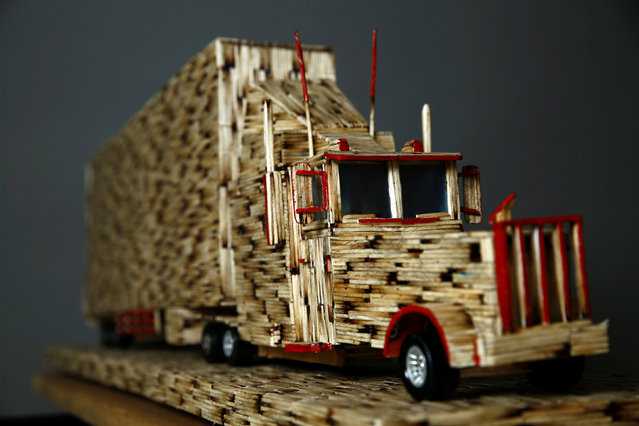
A replica of the truck made from matchsticks by Janusz Urbanski is pictured at his flat in Ruda Slaska, Poland May 4, 2016. (Photo by Kacper Pempel/Reuters)

A replica of the truck made from matchsticks by Janusz Urbanski is pictured at his flat in Ruda Slaska, Poland May 4, 2016. Janusz Urbanski has a one of a kind chessboard he never plays, a personalised guitar he does not strum and a boat he cannot sail. Why? They are all made from tens of thousands of matches. For the last 40 years, the former Polish miner and ironworker has harboured a passion to build replicas of objects, buildings and famous sites with just matchsticks and glue. (Photo by Kacper Pempel/Reuters)
Details
07 May 2016 12:54:00
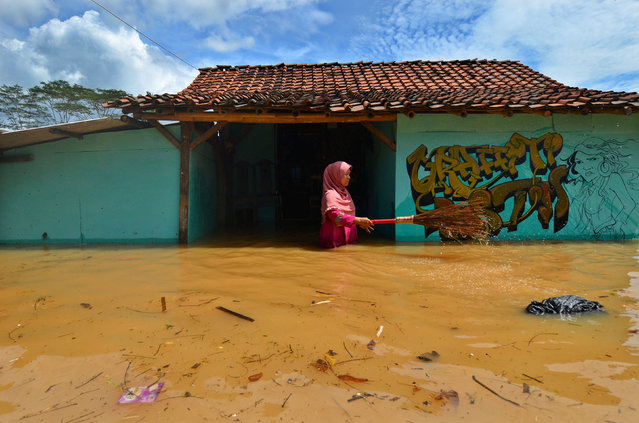
A woman villager cleans garbage in front of her house as flood hits Tanjungsari village in Tasikmalaya, Indonesia, February 23, 2018. (Photo by Adeng Bustomi/Reuters/Antara Foto)

A woman villager cleans garbage in front of her house as flood hits Tanjungsari village in Tasikmalaya, Indonesia, February 23, 2018. (Photo by Adeng Bustomi/Reuters/Antara Foto)
Details
24 Feb 2018 06:10:00
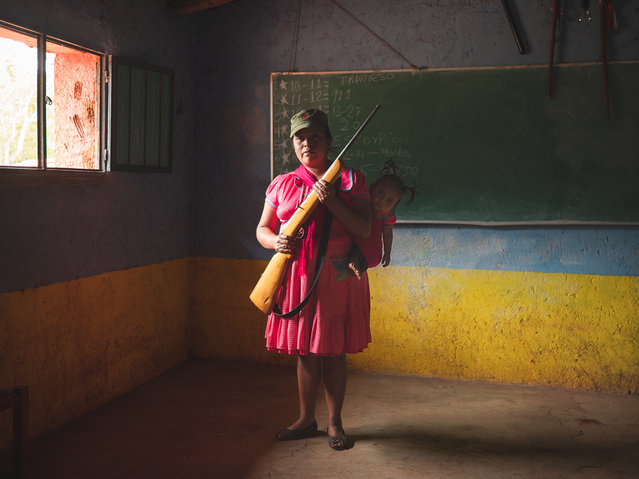
Forgotten Guerrero. A female member of the community defence force holds her weapon. Since early 2019, the village has been attacked repeatedly by Los Ardillos cartel, prompting residents to take action. Rincón de Chautla, Guerrero, 10 June 2019. (Photo by Alfredo Bosco/Luz with the support of Le Figaro Magazine, Winner of the 2020 Humanitarian Visa d’or award, International Committee of the Red Cross/International Festival of Photojournalism 2020)

Forgotten Guerrero. A female member of the community defence force holds her weapon. Since early 2019, the village has been attacked repeatedly by Los Ardillos cartel, prompting residents to take action. Rincón de Chautla, Guerrero, 10 June 2019. (Photo by Alfredo Bosco/Luz with the support of Le Figaro Magazine, Winner of the 2020 Humanitarian Visa d’or award, International Committee of the Red Cross/International Festival of Photojournalism 2020)
Details
02 Sep 2020 00:05:00
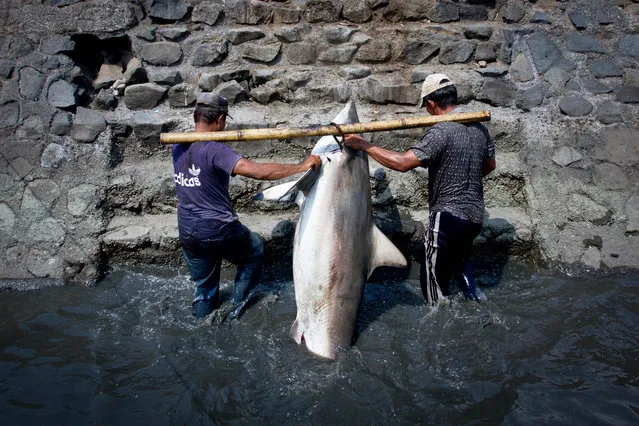
The Predator’s Fins: Atho Ullah, Indonesia. 3rd place, Portfolio category. A freshly caught shark is taken ashore. Efforts to regulate shark fishing in Indonesia are not effective enough. Lack of awareness of the role sharks play in the ocean’s ecosystem poses a major threat to marine life. (Photo by Atho Ullah/2020 Hamdan International Photography Award)

The Predator’s Fins: Atho Ullah, Indonesia. 3rd place, Portfolio category. A freshly caught shark is taken ashore. Efforts to regulate shark fishing in Indonesia are not effective enough. Lack of awareness of the role sharks play in the ocean’s ecosystem poses a major threat to marine life. (Photo by Atho Ullah/2020 Hamdan International Photography Award)
Details
25 Jun 2020 00:03:00