Loading...
Done
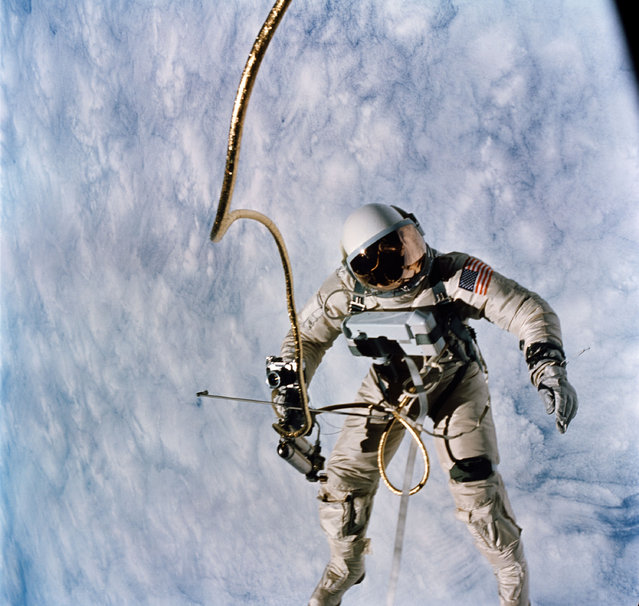
Astronaut Edward H. White II, pilot for the Gemini-Titan 4 (GT-4) spaceflight, floats in the zero-gravity of space during the third revolution of the GT-4 spacecraft on June 3, 1965. White wears a specially designed spacesuit. His face is shaded by a gold-plated visor to protect him from unfiltered rays of the sun. (Photo by NASA)

Astronaut Edward H. White II, pilot for the Gemini-Titan 4 (GT-4) spaceflight, floats in the zero-gravity of space during the third revolution of the GT-4 spacecraft on June 3, 1965. White wears a specially designed spacesuit. His face is shaded by a gold-plated visor to protect him from unfiltered rays of the sun. In his right hand he carries a Hand-Held Self-Maneuvering Unit (HHSMU) that gives him control over his movements in space. White also wears an emergency oxygen chest pack; and he carries a camera mounted on the HHSMU for taking pictures of the sky, Earth and the GT-4 spacecraft. He is secured to the spacecraft by a 25-feet umbilical line and a 23-feet tether line. Both lines are wrapped together in gold tape to form one cord. Astronaut James A. McDivitt, command pilot, remained inside the spacecraft during the extravehicular activity (EVA). Astronaut White died in the Apollo/Saturn 204 fire at Cape Kennedy on January 27, 1967. (Photo by NASA)
Details
22 Jul 2014 12:05:00
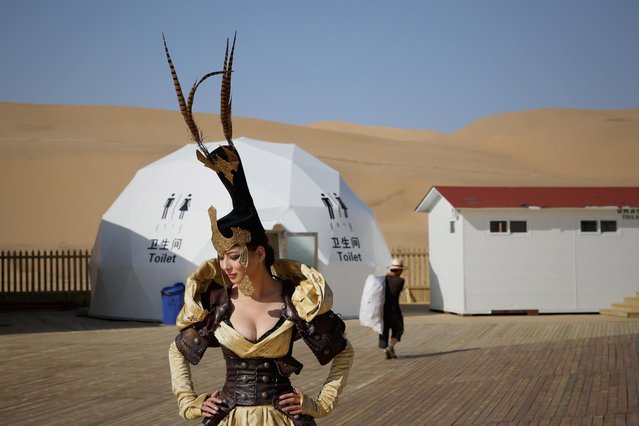
A model in Mongolia costumes prepares backstage in Xiangshawan Desert, also called Sounding Sand Desert on July 18, 2013 in Ordos of Inner Mongolia Autonomous Region, China. Xiangshawan is China's famous tourist resort in the desert. It is located along the middle section of Kubuqi Desert on the south tip of Dalate League under Ordos City. Sliding down from the 110-metre-high, 45-degree sand hill, running a course of 200 metres, the sands produce the sound of automobile engines, a natural phenomenon that nobody can explain. (Photo by Feng Li/Getty Images)

A model in Mongolia costumes prepares backstage in Xiangshawan Desert, also called Sounding Sand Desert on July 18, 2013 in Ordos of Inner Mongolia Autonomous Region, China. Xiangshawan is China's famous tourist resort in the desert. It is located along the middle section of Kubuqi Desert on the south tip of Dalate League under Ordos City. Sliding down from the 110-metre-high, 45-degree sand hill, running a course of 200 metres, the sands produce the sound of automobile engines, a natural phenomenon that nobody can explain. (Photo by Feng Li)
Details
26 Aug 2013 08:43:00
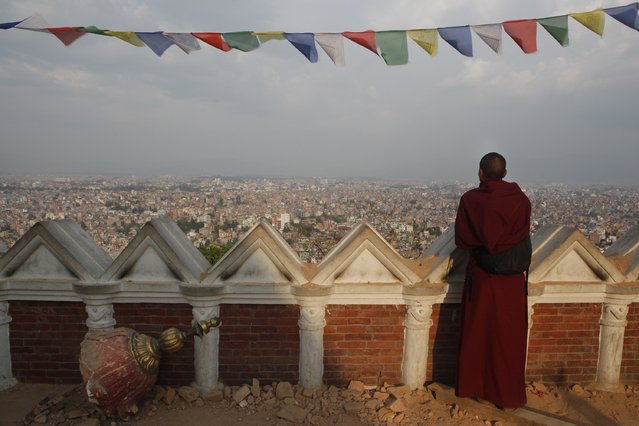
A Buddhist monk catches an aerial view of Kathmandu from the damaged Swayambhunath Stupa premises in Kathmandu, Nepal, Wednesday, May 6, 2015. The April 25 earthquake killed thousands and injured many more as it flattened mountain villages and destroyed buildings and archaeological sites in Kathmandu. (Photo by Niranjan Shrestha/AP Photo)

A Buddhist monk catches an aerial view of Kathmandu from the damaged Swayambhunath Stupa premises in Kathmandu, Nepal, Wednesday, May 6, 2015. The April 25 earthquake killed thousands and injured many more as it flattened mountain villages and destroyed buildings and archaeological sites in Kathmandu. (Photo by Niranjan Shrestha/AP Photo)
Details
08 May 2015 13:20:00
A woman eats candy in the shape of a phallus during the Kanamara Matsuri, or Iron Phallus Festival through a street near the Kanamara shrine in Kawasaki outside of Tokyo April 5, 2015. The festival celebrates fertility and is used to raise awareness and money for the prevention of sexually transmitted diseases. (Photo by Thomas Peter/Reuters)

A woman eats candy in the shape of a phallus during the Kanamara Matsuri, or Iron Phallus Festival through a street near the Kanamara shrine in Kawasaki outside of Tokyo April 5, 2015. The festival celebrates fertility and is used to raise awareness and money for the prevention of sexually transmitted diseases. (Photo by Thomas Peter/Reuters)
Details
11 Apr 2015 10:13:00
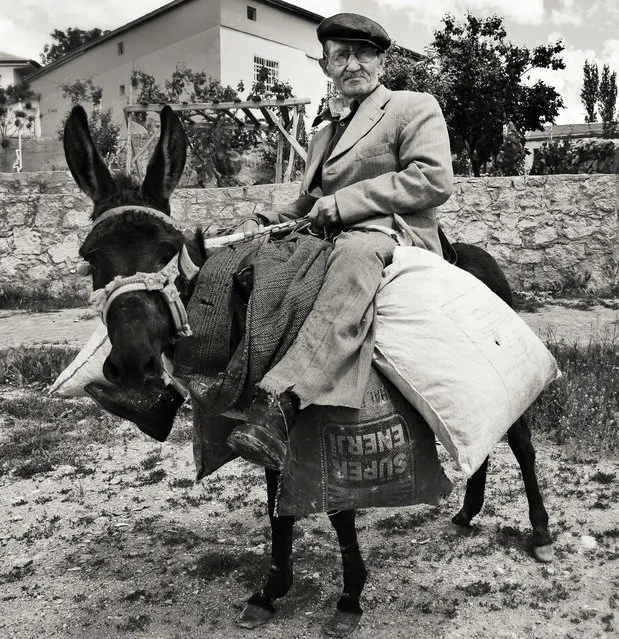
“Super Enerji”. Taken on my road trip through Turkey. (Photo and caption by Michelle Brandemuehl/National Geographic Traveler Photo Contest)

“Super Enerji”. Taken on my road trip through Turkey. (Photo and caption by Michelle Brandemuehl/National Geographic Traveler Photo Contest)

ATTENTION! All pictures are presented in high resolution. To see Hi-Res images – just TWICE click on any picture. In other words, click small picture – opens the BIG picture. Click BIG picture – opens VERY BIG picture.
Details
05 Jul 2013 11:17:00
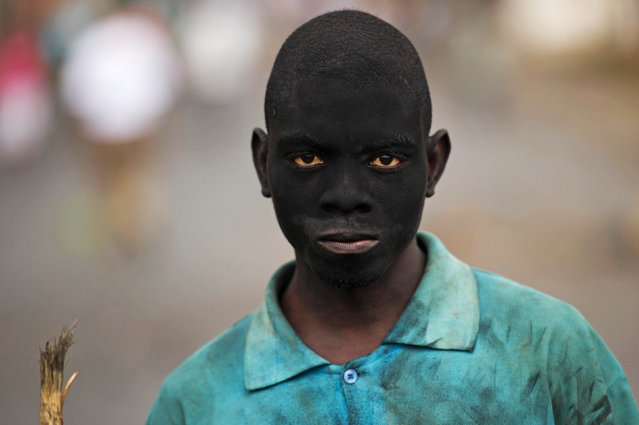
A protester with his face smeared with soot from burning barricades stands in the Musaga neighbourhood of Bujumbura on May 6, 2015. Government and opposition rivals are meeting in Burundi in a bid to end deadly demonstrations against a third term bid by the president, as regional foreign ministers arrived to add pressure. (Photo by Phil Moore/AFP Photo)

A protester with his face smeared with soot from burning barricades stands in the Musaga neighbourhood of Bujumbura on May 6, 2015. Government and opposition rivals are meeting in Burundi in a bid to end deadly demonstrations against a third term bid by the president, as regional foreign ministers arrived to add pressure. (Photo by Phil Moore/AFP Photo)
Details
10 May 2015 10:54:00
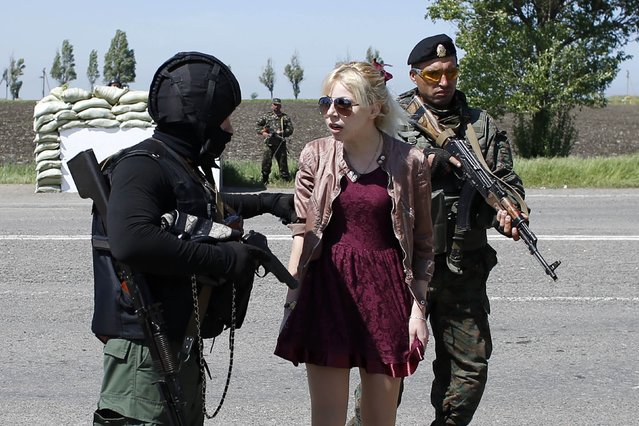
A woman is led aside as her partner is detained by Ukrainian security forces for being aggressive at an army checkpoint in the southeastern port city of Mariupol, on May 11, 2014. Residents’ attitudes appear to have hardened considerably with the deaths of dozens of pro-Russian activists in the city of Odessa this month and with reports that troops fired at a crowd in Mariupol last week. (Photo by Marko Djurica/Reuters)

A woman is led aside as her partner is detained by Ukrainian security forces for being aggressive at an army checkpoint in the southeastern port city of Mariupol, on May 11, 2014. Residents’ attitudes appear to have hardened considerably with the deaths of dozens of pro-Russian activists in the city of Odessa this month and with reports that troops fired at a crowd in Mariupol last week. (Photo by Marko Djurica/Reuters)
Details
12 May 2014 09:53:00
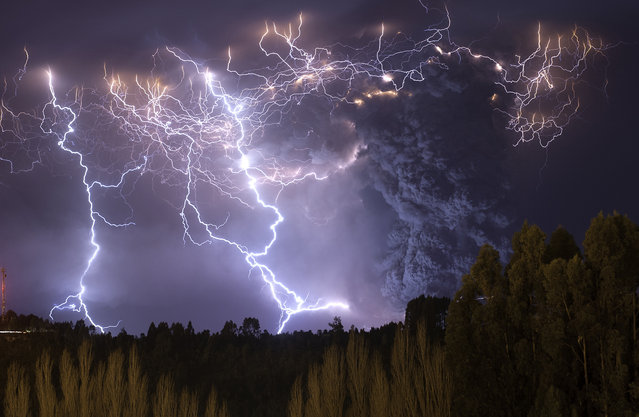
The eruption of Cordon Caulle began on June 4, 2011, located in the Region of Los Rios in Chile. For about 12 months, people and animals became accustomed to living with the daily fall of ash, which also caused problems in the air traffic in South America. The explosions and lightning during first days of the eruption could be seen from hundreds of miles around. This photograph was taken on the second night of eruption from the town of Lago Ranco. (Photo and caption by Francisco Negroni/National Geographic Traveler Photo Contest)

The eruption of Cordon Caulle began on June 4, 2011, located in the Region of Los Rios in Chile. For about 12 months, people and animals became accustomed to living with the daily fall of ash, which also caused problems in the air traffic in South America. The explosions and lightning during first days of the eruption could be seen from hundreds of miles around. This photograph was taken on the second night of eruption from the town of Lago Ranco. (Photo and caption by Francisco Negroni/National Geographic Traveler Photo Contest)

ATTENTION! All pictures are presented in high resolution. To see Hi-Res images – just TWICE click on any picture. In other words, click small picture – opens the BIG picture. Click BIG picture – opens VERY BIG picture.
Details
23 Jun 2013 11:24:00