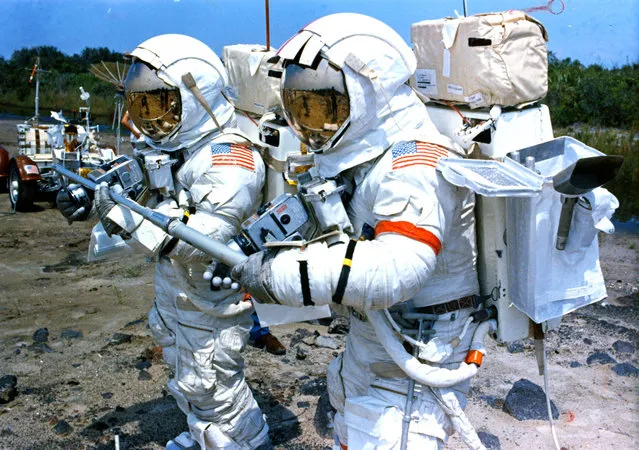
Astronauts Harrison Schmitt (left) and Eugene Andrew Cernan practice taking geological samples at the Kennedy Space Center in Florida, in preparation for NASA's scheduled Apollo 17 lunar landing mission, on August 28, 1972. Schmitt is the Lunar Module Pilot and Cernan is the mission's Commander. They are training for their period of EVA (extravehicular activity) on the Moon. (Photo by Space Frontiers/Getty Images)
Devotees perform religious rituals by splashing holy water during the Madhav Narayan Festival, a month-long event dedicated to Lord Madhav Narayan, an incarnation of Lord Vishnu in Thacho, Lalitpur, Nepal on February 10, 2025. Devotees also carry butter lamps and blow conch shells (shankha) as part of the sacred observance. (Photo by Safal Prakash Shrestha/ZUMA Press Wire)
View at one of the sculptures by Swiss artist H.R. Giger during the opening of the Ars Electronica 2013 exhibition “HR Giger. The Art of Biomechanics” in Linz, Austria, 04 September 2013. (Photo by EPA/RUBRA)
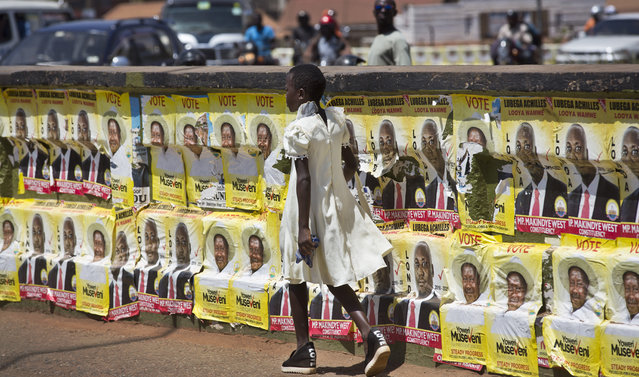
A girl walks past campaign posters for long-time President Yoweri Museveni, as well as for local members of Parliament, on a street in Kampala, Uganda Wednesday, February 17, 2016. On the eve of presidential elections, a heavy police and military presence could be seen in the capital Kampala. (Photo by Ben Curtis/AP Photo)
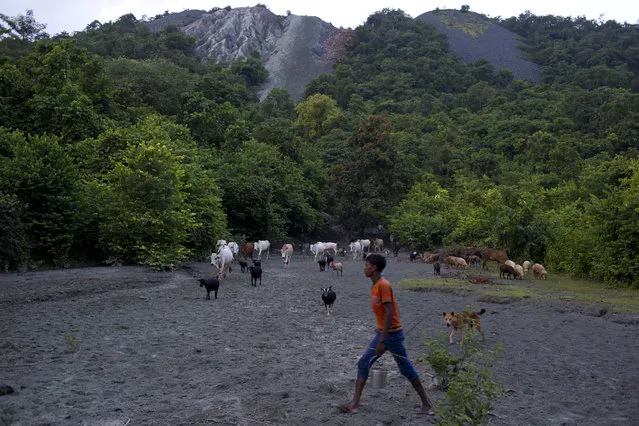
In this September 11, 2014 photo, villagers climb down the side of a hill used earlier as a dumping ground of asbestos waste on Roro hills in Roro, India. An asbestos mine, abandoned nearly three decades ago still affects the people around it and 18 along with Jema were diagnosed with asbestosis in 2012. Tens of thousands more, some former mine workers, remain untested and at risk. (Photo by Saurabh Das/AP Photo)
Soviet cosmonaut and the first man to travel in space, Yury Alekseyvich Gagarin (1934–1968) arriving in London for a Russian trade fair. (Photo by Douglas Miller/Getty Images)
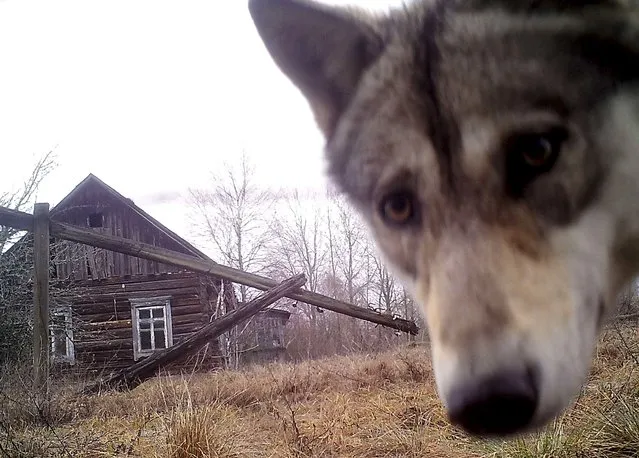
A wolf looks into the camera at the 30 km (19 miles) exclusion zone around the Chernobyl nuclear reactor in the abandoned village of Orevichi, Belarus, March 2, 2016. What happens to the environment when humans disappear? Thirty years after the Chernobyl nuclear disaster, booming populations of wolf, elk and other wildlife in the vast contaminated zone in Belarus and Ukraine provide a clue. (Photo by Vasily Fedosenko/Reuters)