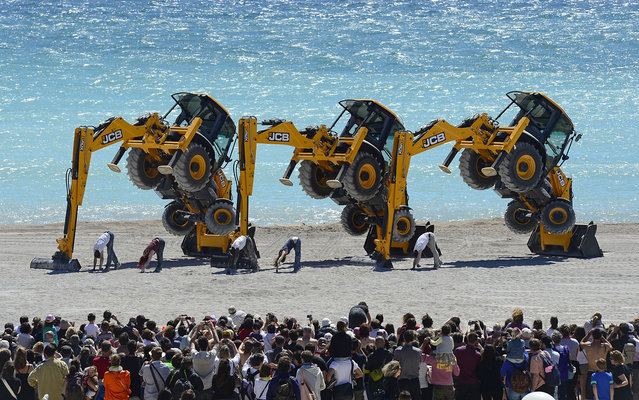
Dancers from the British theater company Motionhouse perform a show with excavators entitled “Traction” on the Prado beach in Marseille, France, on May 10, 2013. (Photo by Boris Horvat/AFP Photo)
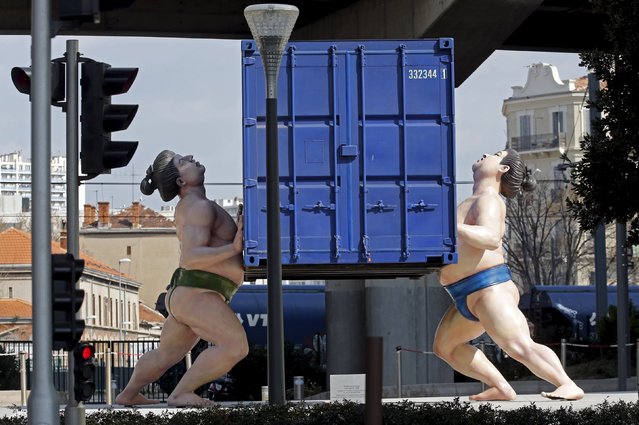
The sculpture “It Takes Two to Tango” by Scottish sculptor David Mach is seen in front of the headquarters of the CMA-CGM shipping company office tower in the port of Marseille, France, March 15, 2016. (Photo by Jean-Paul Pelissier/Reuters)
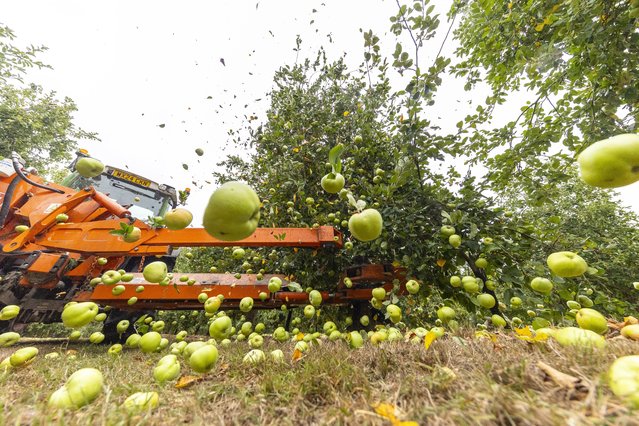
Apples are collected from an orchard in Somerset. UK for the cider company on August 20, 2025. Thatchers, marking its earliest harvest in more than 120 years thanks to a hot summer. (Photo by Brad Wakefield)
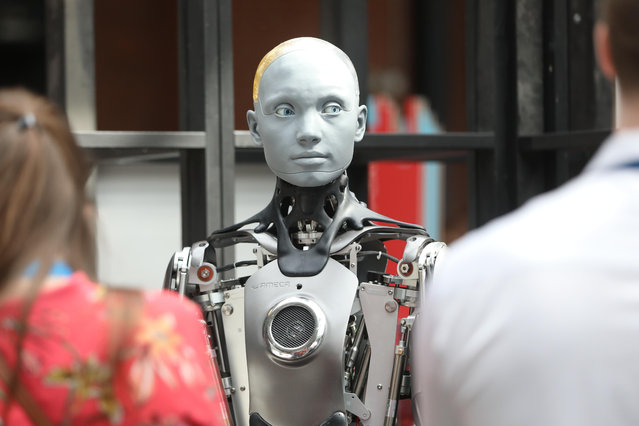
Ameca, a humanoid robot developed by the British company Engineered Arts Digital, at the Re:publica trade fair in Berlin, Germany on May 28, 2024. (Photo by dts News Agency Germany/Rex Features/Shutterstock)
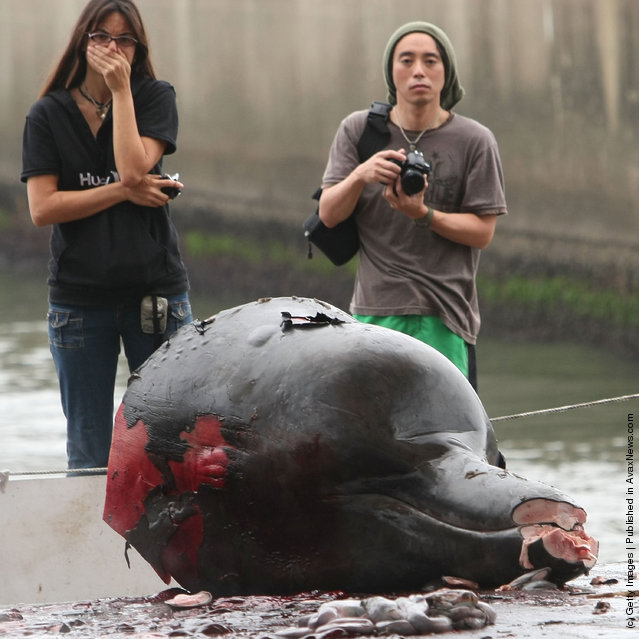
Fishermen slaughter a 9.61m Baird's Beaked whale at Wada Port on June 28, 2008 in Minami Boso, Chiba, Japan. Only five ports are allowed whaling under the coastal whaling program which tries to keep whaling tradition that dates back to the seventeenth century. Japan is only allowed to hunt a limited number of whales every year. (Photo by Koichi Kamoshida/Getty Images)
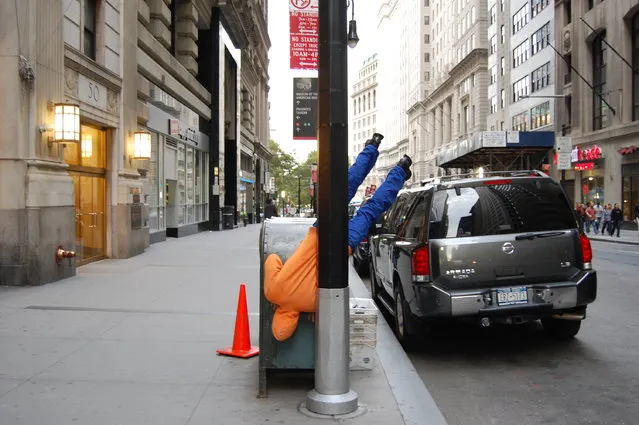
“Bodies in urban spaces” is a temporarily intervention in diversified urban architectonical environment. The intention of “bodies in urban spaces” is to point out the urban functional structure and to uncover the restricted movement possibilities and behavior as well as rules and limitations. Photo: “Bodies in Urban Spaces”, September 26, 2010. (Photos by Andrew Russeth)
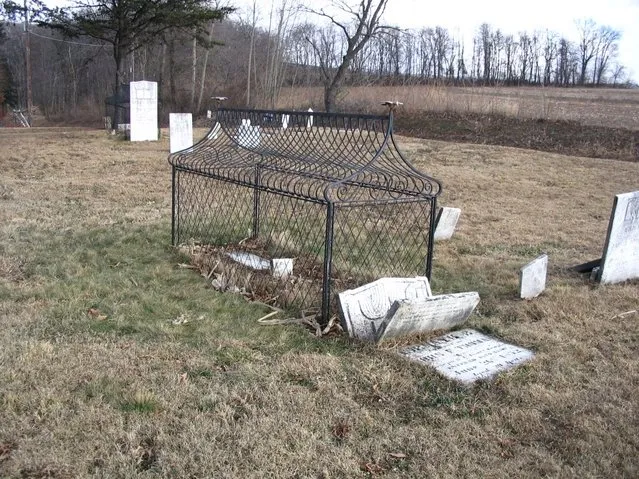
Mortsafes were contraptions designed to protect graves from disturbance. Resurrectionists had supplied the schools of anatomy in Scotland since the early 18th century. This was due to the necessity for medical students to learn anatomy by attending dissections of human subjects, which was frustrated by the very limited allowance of dead bodies – for example the corpses of executed criminals – granted by the government, which controlled the supply.
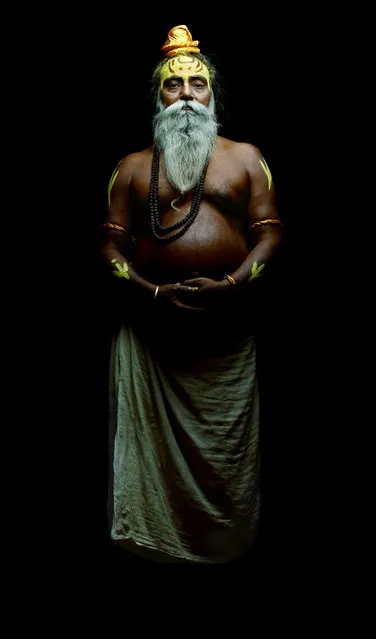
“They’ve been obsessing me for years. I searched and found them in Benares, on the banks of the river Gange (India). They arrive here to get rid of everything and to wait for death. This existence can last for years, sometimes decades, almost a life. Opposite to mine, well organised and filled as a human life can be, to try in vain to push the limits of its end”. – Denis Rouvre. (Photo by Denis Rouvre)