Loading...
Done
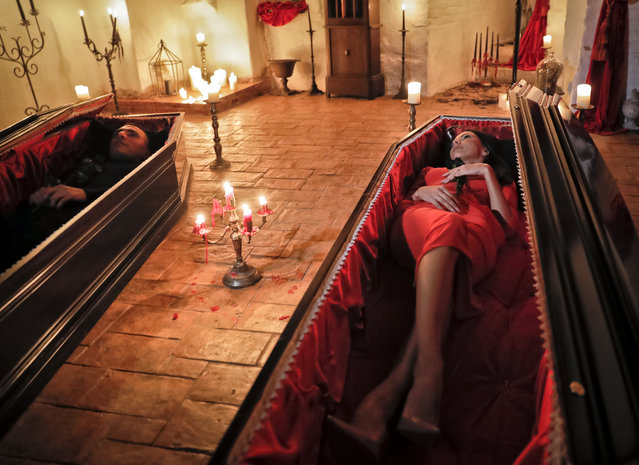
Tami Varma, right, and her brother Robin, the grandchildren of Devendra Varma, a scholar of English gothic tales and an expert in vampire lore, pose in coffins at the Bran Castle, in Bran, Romania, Monday, October 31, 2016. A Canadian brother and sister are passing Halloween night curled up in red velvet coffins in the Transylvanian castle that inspired the Dracula legend, the first time in 70 years anyone has spent the night in the gothic fortress, after they bested 88,000 people who entered a competition hosted by Airbnb to get the chance to dine and sleep at the castle in Romania. A portrait of medieval prince Vlad the Impaler is placed on the wall. (Photo by Vadim Ghirda/AP Photo)

Tami Varma, right, and her brother Robin, the grandchildren of Devendra Varma, a scholar of English gothic tales and an expert in vampire lore, pose in coffins at the Bran Castle, in Bran, Romania, Monday, October 31, 2016. A Canadian brother and sister are passing Halloween night curled up in red velvet coffins in the Transylvanian castle that inspired the Dracula legend, the first time in 70 years anyone has spent the night in the gothic fortress, after they bested 88,000 people who entered a competition hosted by Airbnb to get the chance to dine and sleep at the castle in Romania. A portrait of medieval prince Vlad the Impaler is placed on the wall. (Photo by Vadim Ghirda/AP Photo)
Details
01 Nov 2016 12:32:00
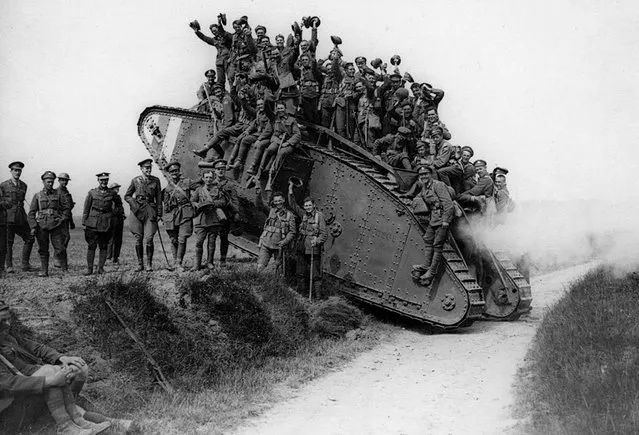
These black-and-white photos are taken from the new book “Armoured Warfare in the First World War 1916 – 1918” by Anthony Tucker-Jones and published by Pen & Sword Military. “Interestingly the British, French and Germans took completely different approaches with varying results”. The British military produced “Little Willie” in Autumn 1915 weighing 18 tonnes, which had a crew of two plus four gunners. “Inspired by a tracked artillery tractor “Little Willie” was referred to as a water tank – hence the name tank – to ensure secrecy”, said Anthony. “This led to the strange looking Mark I with its peculiar rhomboid shape, designed to cross trenches with guns in sponsons on either side. The Germans saw the tank as unchivalrous and were slow to grasp its utility. They favoured the Stormtrooper (specialist soldiers used to infiltrate enemy trenches) and artillery, not the tank”, said Anthony. “However, they didn’t hesitate to make use of captured British tanks. Although the tank helped secure victory and German soldiers dubbed it “Germany’s Downfall” the country was ultimately brought to its knees by the Allies blockade”. Here: British troops hitch a ride on a Mark IV after the massed tank fleet spearheading attack at Cambrai on November 20, 1917. (Photo by Anthony Tucker-Jones/Mediadrumworld.com)

These black-and-white photos are taken from the new book “Armoured Warfare in the First World War 1916 – 1918” by Anthony Tucker-Jones and published by Pen & Sword Military. Here: British troops hitch a ride on a Mark IV after the massed tank fleet spearheading attack at Cambrai on November 20, 1917. (Photo by Anthony Tucker-Jones/Mediadrumworld.com)
Details
23 Feb 2017 00:02:00
A “Maya” girl sits in an altar during the traditional celebration of “Las Mayas” on the streets in Madrid, Spain Sunday, May 10, 2015. The festivity of the Maya comes from pagan rites and dates from the medieval age, appearing in ancient documents. It takes place every year in the beginning of May and celebrates the beginning of the spring. (Photo by Daniel Ochoa de Olza/AP Photo)

A “Maya” girl sits in an altar during the traditional celebration of “Las Mayas” on the streets in Madrid, Spain Sunday, May 10, 2015. The festivity of the Maya comes from pagan rites and dates from the medieval age, appearing in ancient documents. It takes place every year in the beginning of May and celebrates the beginning of the spring. Girls between 7 and 11 years old are chosen as “Maya” and should sit still, serious and quiet for a couple of hours in altars on the street decorated with flowers and plants and afterwards they walk to the church with their family where they attend a ceremony. (Photo by Daniel Ochoa de Olza/AP Photo)
Details
14 May 2015 11:12:00
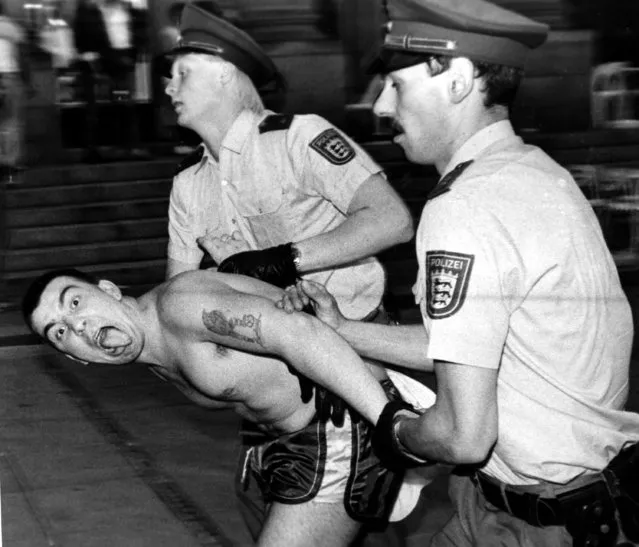
In this Sunday June 13, 1988 file photo West German police officers arrest an English soccer hooligan who sticks out his tongue. Rioting broke out between some 100 hooligans and the police in downtown Stuttgart, West Germany following the European Soccer Championships match between England and Ireland. England was defeated by Ireland 0-1. (Photo by Kraufmann/AP Photo/File)

In this Sunday June 13, 1988 file photo West German police officers arrest an English soccer hooligan who sticks out his tongue. Rioting broke out between some 100 hooligans and the police in downtown Stuttgart, West Germany following the European Soccer Championships match between England and Ireland. England was defeated by Ireland 0-1. (Photo by Kraufmann/AP Photo/File)
Details
05 Sep 2021 05:44:00


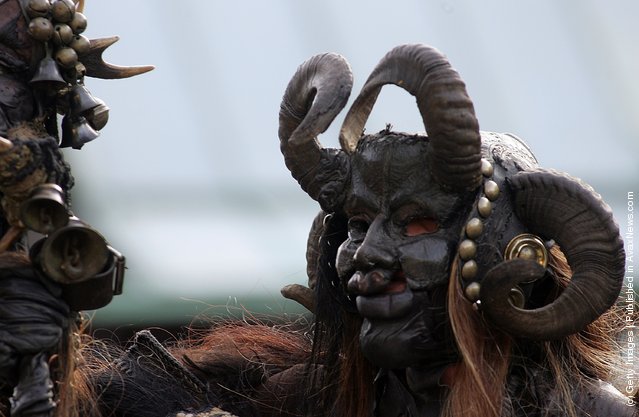
KALTENBERG, GERMANY - JULY 08: Actors dressed as knights perform during the traditional Kaltenberg knight tournament on July 8, 2007 in Kaltenberg, Germany. With around 120,000 visitors each year, the festival including knight tournaments, medieval styled markets and a variety of music performances, the event is one of the biggest of its kind. (Photo by Johannes Simon/Getty Images)
Details
14 Nov 2011 16:55:00
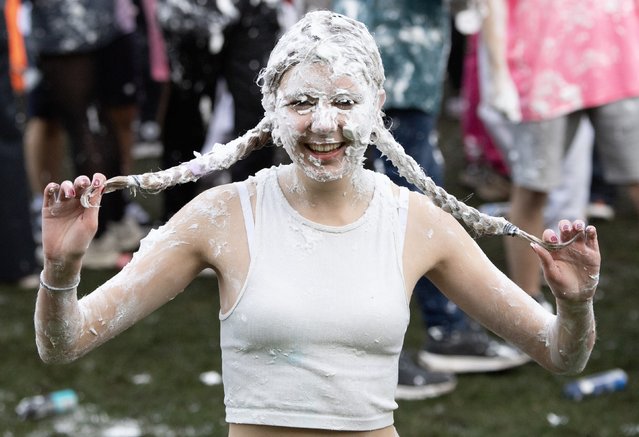
Students from St Andrews University are covered in foam as they take part in the traditional “Raisin Weekend” in the Lower College Lawn, at St Andrews in Scotland, Britain October 17, 2016. The weekend, which begins on Sunday, involves rituals for new students, culminating in a foam fight on Monday morning. (Photo by Russell Cheyne/Reuters)

Students from St Andrews University are covered in foam as they take part in the traditional “Raisin Weekend” in the Lower College Lawn, at St Andrews in Scotland, Britain October 17, 2016. The weekend, which begins on Sunday, involves rituals for new students, culminating in a foam fight on Monday morning. (Photo by Russell Cheyne/Reuters)
Details
18 Oct 2016 12:38:00
Students from the University of St Andrews jump into The North Sea, as a good luck tradition before exams start on the East Sands in St Andrews, Fife, Scotland on May 1, 2018. (Photo by Derek Allan/Alamy Live News)

Students from the University of St Andrews jump into The North Sea, as a good luck tradition before exams start on the East Sands in St Andrews, Fife, Scotland on May 1, 2018. (Photo by Derek Allan/Alamy Live News)
Details
05 May 2018 00:03:00
Students take part in the traditional Raisin Monday foam fight on St Salvator's Lower College Lawn at the University of St Andrews, UK in Fife on Monday, October 16, 2023. (Photo by Lesley Martin/PA Images/Profimedia)

Students take part in the traditional Raisin Monday foam fight on St Salvator's Lower College Lawn at the University of St Andrews, UK in Fife on Monday, October 16, 2023. (Photo by Lesley Martin/PA Images/Profimedia)
Details
10 Jan 2025 03:58:00