Loading...
Done
A driver competes in his tractor during the Tractor Pulling Euro Championships in the western German town of Fuechtorf September 9, 2012. Eighty teams from across Europe participated in the two-day competition where high-powered tractor prototypes must pull a trailer down a 100-metre (328 ft) track as far as possible. (Photo by Ina Fassbender/Reuters)

A driver competes in his tractor during the Tractor Pulling Euro Championships in the western German town of Fuechtorf September 9, 2012. Eighty teams from across Europe participated in the two-day competition where high-powered tractor prototypes must pull a trailer down a 100-metre (328 ft) track as far as possible. (Photo by Ina Fassbender/Reuters)
Details
22 Jul 2013 08:50:00
Cards Poker By Og Abel

The great vector artist OG Abel was a diamond in the rough. Growing up in violent surroundings, OG Abel found shelter in art. With an unsupportive father who always told him artist die broke, his only creative activity was strongly connected to religion. Having a church-going mother, OG Abel says he would spend hour drawing images from the Bible, his favorite pictures being those of animals, especially lions. He would also study the elaborate paintings in churches, the architecture, and/or the sculptures.
Details
15 Sep 2014 11:22:00


“Horst Ludwig Wessel (October 9, 1907 – February 23, 1930) was a German Nazi activist who was made a posthumous hero of the Nazi movement following his violent death in 1930. He was the author of the lyrics to the song “Die Fahne hoch” (“The Flag On High”), usually known as Horst-Wessel-Lied (“The Horst Wessel Song”), which became the Nazi Party anthem and, de facto, Germany's co-national anthem from 1933 to 1945”. – Wikipedia

Photo: German Nazi activist Horst Wessel (left) at the head of a parade of S.A. stormtroopers, or “brownshirts”, in Nuremberg, Germany, 1929. (Photo by Hulton Archive/Getty Images)
Details
08 Jul 2011 09:38:00
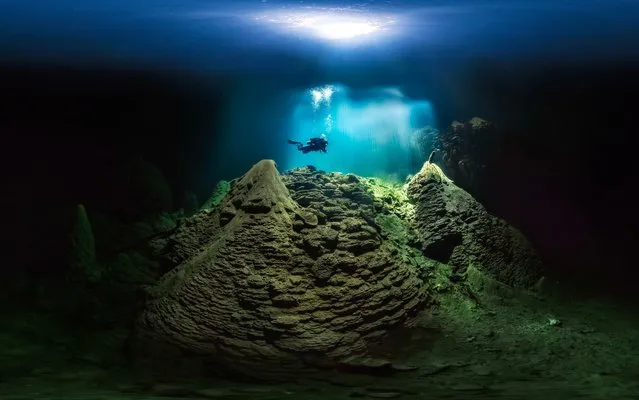
Cave Diver, Anhumas Abyss, Bonito, Brazil: The Anhumas Abyss is an underground cavern with a crystal-clear lake below, more than 260 feet (79 m) deep. A visitor must enter through a narrow opening at the top of the chamber and rappel into the cave. Snorkeling and scuba diving in the lake reveal amazing scenery. Distinctive, conical limestone stalagmites and stalactites occupy the lake and the surrounding area, some reaching 65 feet (20 m) high. “One must rappel about 235 feet (72 m) to get down into this deep lake. The photo was taken at a depth of 50 feet (15 m). It was a challenge to create the image because of the high contrast, plus the diver could not see into the darkness, making communication impossible”. (Photo by Marcio Cabral/Nature’s Best Photography Awards 2017)

Cave Diver, Anhumas Abyss, Bonito, Brazil: The Anhumas Abyss is an underground cavern with a crystal-clear lake below, more than 260 feet (79 m) deep. A visitor must enter through a narrow opening at the top of the chamber and rappel into the cave. Snorkeling and scuba diving in the lake reveal amazing scenery. Distinctive, conical limestone stalagmites and stalactites occupy the lake and the surrounding area, some reaching 65 feet (20 m) high. (Photo by Marcio Cabral/Nature’s Best Photography Awards 2017)
Details
26 Oct 2017 08:10:00
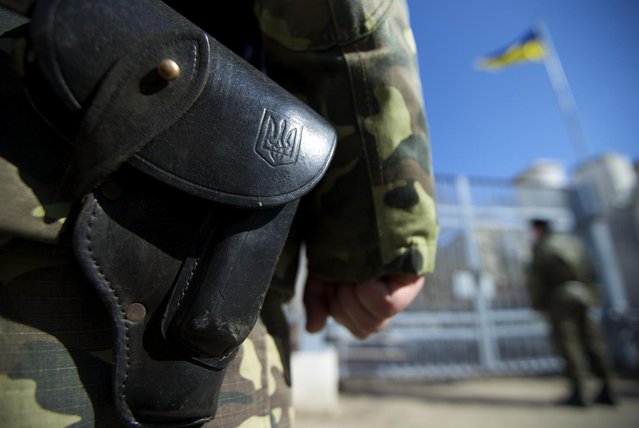
Ukrainian state emblem is seen on a gun's holster as soldiers guard naval base in the village of Novoozernoye, some 91 km west of Crimean capital Simferopol, Ukraine, on Monday, March 3, 2014. Ukraine says Russian forces controlling the strategic region of Crimea are demanding that the crew of two Ukrainian warships in Sevastopol's harbor must surrender. (Photo by Ivan Sekretarev/AP Photo)

Ukrainian state emblem is seen on a gun's holster as soldiers guard naval base in the village of Novoozernoye, some 91 km west of Crimean capital Simferopol, Ukraine, on Monday, March 3, 2014. Ukraine says Russian forces controlling the strategic region of Crimea are demanding that the crew of two Ukrainian warships in Sevastopol's harbor must surrender. (Photo by Ivan Sekretarev/AP Photo)

Details
04 Mar 2014 09:06:00
Alejandro Zelayaran, 43, dressed as Santa Claus, wears a protective face shield as he poses for a photograph on a street in Mexico City, Mexico, December 3, 2020. “Faith and hope must move the heart of the humanity”, said Zelayaran, who will don a face shield when he distributes dolls and other gifts at an orphanage in Mexico City. “I want to see families taking care of each other and knowing that even from afar, love and hope always survive”. (Photo by Edgard Garrido/Reuters)

Alejandro Zelayaran, 43, dressed as Santa Claus, wears a protective face shield as he poses for a photograph on a street in Mexico City, Mexico, December 3, 2020. “Faith and hope must move the heart of the humanity”, said Zelayaran, who will don a face shield when he distributes dolls and other gifts at an orphanage in Mexico City. “I want to see families taking care of each other and knowing that even from afar, love and hope always survive”. (Photo by Edgard Garrido/Reuters)
Details
28 Feb 2021 09:51:00
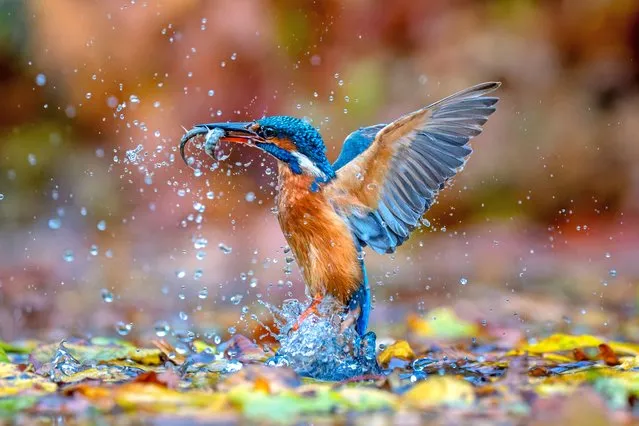
A kingfisher dives into the leafy water of the River Alde near Rendham, Suffolk in the second decade of November 2022 and catches two fish. Kingfishers must be able to see the fish they want to catch before making their dive, so for this bird to be successful when leaves covered the surface of the water shows its true skill for survival. (Photo by Ivor Ottley/Animal News Agency)

A kingfisher dives into the leafy water of the River Alde near Rendham, Suffolk in the second decade of November 2022 and catches two fish. Kingfishers must be able to see the fish they want to catch before making their dive, so for this bird to be successful when leaves covered the surface of the water shows its true skill for survival. (Photo by Ivor Ottley/Animal News Agency)
Details
20 Nov 2022 05:49:00
Zulmira Jesus poses for a portrait at a street in Povoa de Agracoes, near Chaves, Portugal April 19, 2016. (Photo by Rafael Marchante/Reuters)

Zulmira Jesus poses for a portrait at a street in Povoa de Agracoes, near Chaves, Portugal April 19, 2016. In the villages of Agracoes and Povoa de Agracoe, the steady drip-drip of emigration has brought down population numbers from more than 50 residents to fewer than a dozen each. These remaining villagers share the same glum acceptance that, after they have gone, their villages will die out too. It is the same desolate picture in scores of other backwater settlements in Portugal's interior, north to south. (Photo by Rafael Marchante/Reuters)
Details
29 Apr 2016 12:05:00