Loading...
Done
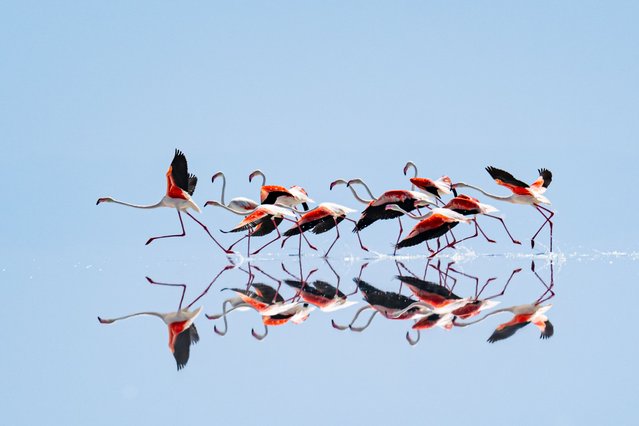
Flamingos preparing to take flight are reflected on Lake Tuz, which hosts thousands of flamingos every year, in Ankara, Turkiye, on June 24, 2025. This year, the lake has seen a decline in flamingo numbers due to drought, prompting the birds to shift their migration route to other wetlands across Turkiye. (Photo by Harun Ozalp/Anadolu via Getty Images)

Flamingos preparing to take flight are reflected on Lake Tuz, which hosts thousands of flamingos every year, in Ankara, Turkiye, on June 24, 2025. This year, the lake has seen a decline in flamingo numbers due to drought, prompting the birds to shift their migration route to other wetlands across Turkiye. (Photo by Harun Ozalp/Anadolu via Getty Images)
Details
31 Jul 2025 02:48:00
A goose has terrorized students at the University of Warwick, Coventry, UK, on May 22, 2013. The bird built its nest near a block of student apartments and attacks anyone who goes near the nest. (Photo by Caters News/The Grosby Group)

A goose has terrorized students at the University of Warwick, Coventry, UK, on May 22, 2013. The bird built its nest near a block of student apartments and attacks anyone who goes near the nest. (Photo by Caters News/The Grosby Group)
Details
26 May 2013 13:01:00
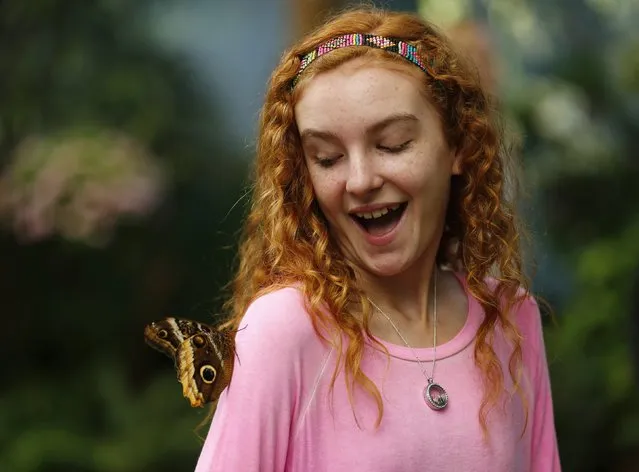
A Common Blue Morpho butterfly lands on the arm of Garbiella as it and hundreds of other butterflies from around the world fill the bird aviary for the next month at the San Diego Zoo Safari Park in San Diego, California March 13, 2015. Called the Butterfly Jungle, the exhibit  has over 30 species of butterflies. (Photo by Mike Blake/Reuters)

A Common Blue Morpho butterfly lands on the arm of Garbiella as it and hundreds of other butterflies from around the world fill the bird aviary for the next month at the San Diego Zoo Safari Park in San Diego, California March 13, 2015. Called the Butterfly Jungle, the exhibit has over 30 species of butterflies. (Photo by Mike Blake/Reuters)
Details
16 Mar 2015 10:02:00
Villagers play traditional games as they take part in a Chyrachka rite during the Shrovetide celebration in the village of Tonezh, some 280 km of Minsk, on March 10, 2019. Chyrachka is a kind of birds that live in this area. (Photo by Sergei Gapon/AFP Photo)

Villagers play traditional games as they take part in a Chyrachka rite during the Shrovetide celebration in the village of Tonezh, some 280 km of Minsk, on March 10, 2019. Chyrachka is a kind of birds that live in this area. (Photo by Sergei Gapon/AFP Photo)
Details
12 Mar 2019 00:03:00
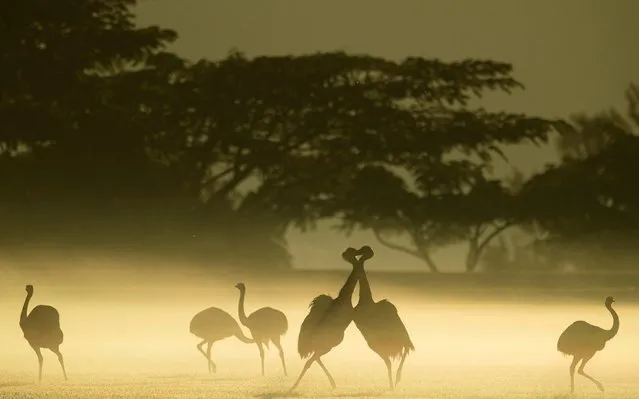
View of a group of ostriches, in the gardens of the Palacio do Alvorada, in Brasilia, Brazil, 02 June 2020. The ostrich is the largest and heaviest bird in the world. When the chicks hatch they are between 25 and 30 cm tall, weighing about 900 grams. (Photo by Joedson Alves/EPA/EFE/Rex Features/Shutterstock)

View of a group of ostriches, in the gardens of the Palacio do Alvorada, in Brasilia, Brazil, 02 June 2020. The ostrich is the largest and heaviest bird in the world. When the chicks hatch they are between 25 and 30 cm tall, weighing about 900 grams. (Photo by Joedson Alves/EPA/EFE/Rex Features/Shutterstock)
Details
08 Jun 2020 00:03:00
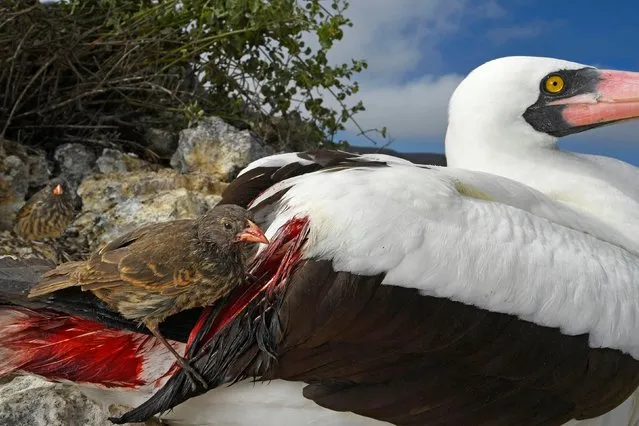
Bloodthirsty by Thomas P Peschak, Germany/South Africa — winner, Behaviour: birds. When rations run short on Wolf Island, in the remote northern Galápagos, the sharp-beaked ground finches become vampires. Their sitting targets are Nazca boobies and other large birds. The finches rely on a scant diet of seeds and insects, which regularly dries up, so they drink blood to survive. ‘I’ve seen more than half a dozen finches drinking from a single Nazca booby,’ says Tom. Rather than leave their nests the boobies tolerate the vampires, and the blood loss doesn’t seem to cause permanent harm. (Photo by Thomas P Peschak/2018 Wildlife Photographer of the Year)

Bloodthirsty by Thomas P. Peschak, Germany/South Africa — winner, Behaviour: birds. When rations run short on Wolf Island, in the remote northern Galápagos, the sharp-beaked ground finches become vampires. Their sitting targets are Nazca boobies and other large birds. The finches rely on a scant diet of seeds and insects, which regularly dries up, so they drink blood to survive. ‘I’ve seen more than half a dozen finches drinking from a single Nazca booby,’ says Tom. Rather than leave their nests the boobies tolerate the vampires, and the blood loss doesn’t seem to cause permanent harm. (Photo by Thomas P. Peschak/2018 Wildlife Photographer of the Year)
Details
19 Oct 2018 00:05:00
Invasion (laser girls) 2017. “I’m always thinking about my art practice, so any experience I have may spike a visual when I have an idea in mind. An example is that, when I was thinking about the Invasion series, I was inspired by Alfred Hitchcock’s movie The Birds (1963). I love Hitchcock’s other movies and have been contemplating a series based on Rear Window (1954). I also find inspiration outside the cinema in music clips and magazines”. (Photo by Michael Cook/Perimeter Books)

Invasion (laser girls) 2017. “I’m always thinking about my art practice, so any experience I have may spike a visual when I have an idea in mind. An example is that, when I was thinking about the Invasion series, I was inspired by Alfred Hitchcock’s movie The Birds (1963). I love Hitchcock’s other movies and have been contemplating a series based on Rear Window (1954). I also find inspiration outside the cinema in music clips and magazines”. (Photo by Michael Cook/Perimeter Books)
Details
09 Nov 2025 05:06:00
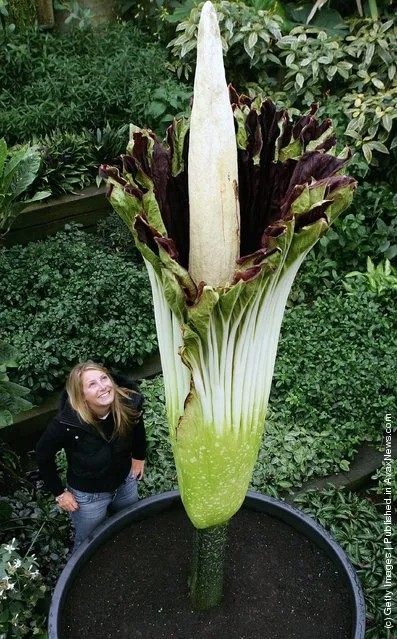
Kew Gardens employee Lauren Bird Royal examines the flowering of the Titan Arum lily at the Botanical Gardens

“The titan arum or Amorphophallus titanum (from Ancient Greek amorphos, “without form, misshapen” + phallos, “phallus”, and titan, “giant”) is a flowering plant with the largest unbranched inflorescence in the world. The titan arum's inflorescence is not as large as that of the Talipot palm, Corypha umbraculifera, but the inflorescence of the Talipot palm is branched rather than unbranched”. – Wikipedia

Photo: Kew Gardens employee Lauren Bird Royal examines the flowering of the Titan Arum lily at the Botanical Gardens at Kew on September 30, 2005 in London, England. For the first time in horticultural history, the Titan Arum lily can be seen at all three active stages in its lifecycle – in flower, fruit and leaf.The flowering corm is nearly three metres tall and weighs 91kg and is very rarely seen outside of the rainforests of Sumatra, Indonesia. (Photo by Scott Barbour/Getty Images)

Details
20 Sep 2011 11:13:00